MOST COMMENTED
"Tight of Form"
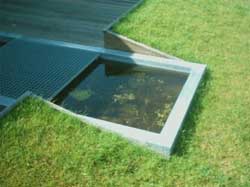 We don't speak Dutch and when we found out about landscape designer Harry de Visser's site, we immediately turned to Babelfish for the 411 in our native tongue. According to Babelfish, the garden designs of Harry de Visser are "tight of form" and we'd have to agree. He employs the technique of "beplanting" (I haven't quite figured out what the English translation of beplanting is - anyone?) and the reuse of materials such as coloured glass, zinc, galvanised gratings, wood, ordinary glass, stone and concrete.
The gardens of Harry de Visser finds their origin in the context as an expressive artist and illustrator. The designs are exclusive, monumentally and frequently minimalistisch of form, but spherical. Main point for a design is the architectonic half-measure sheathing. Architecture and garden must a relation with each other have. Entirely must radiate rest and space. By devising particular elements, every garden gets its own character. take water design, architectural elements, visibility lines, contrast, functional beplanting, reduction and environment prominent. (Babelfish)
Update: We just got word from Harry. Beplanting "means all kinds of plants that you use in a garden." Simple enough, thanks Harry!
Link: Harry de Visser
Award winning architecture in San Diego, California
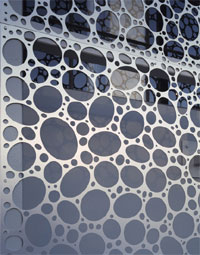 An article in today's San Diego Union-Tribune covers the 2005 San Diego AIA Awards program and quotes LA architect Lawrence Scarpa saying:
"I've served on a lot of (design awards) juries. I was shocked and pleasantly surprised to find this many quality projects.
"There's something going on in San Diego that's right."
In addition to Lawrence Scarpa, the jurors were Michael Folonis of Michael W. Folonis, AIA and Associates and Ralph Johnson, FAIA, firm-wide design principal at Perkins+Will.
Article: SD Union-Tribune - There's something going on
Link: AIA San Diego Design Awards
Emphasizing light, line, and color
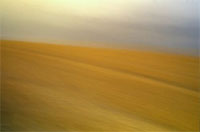 Most photographers that specialize in landscape photography tend to focus on sharp images showing crisp detail and perfect exposure. On the other hand Frank Grisdale prefers just the opposite. He prefers the handheld exposure to the tripod, allowing colors to merge and overlap each other, "drawing with light" as he calls it.
"Most photographs are the result of shooting long hand held exposures. As the camera moves in my hands, real life's fine details begin to merge, overlap, and cancel out on the film, resulting in work which might have been drawn or painted by an early Impressionist."
Intriguing work, Frank!
Link: Frank Grisdale Photography
Limited-edition street banners
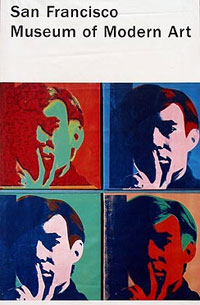 Apparently I'm not alone in the notion of seeing a museum banner hanging from a streetpole and thinking how great that would look hanging in my living room. BetterWall took that idea and turned it into a business. On their website, you can purchase banners advertising an Ansel Adams gallery at the Art Institute of Chicago or Warhol's exhibition at the San Francisco Museum of Modern Art. But these aren't just reproductions of those banners, they are the real deal.
" All of BetterWall’s beautiful banners are the real McCoy! They have been displayed on streetlamp posts and museum facades in cities across the country. Made of vinyl or heavy-weight canvas, the banners are well-equipped to withstand outdoor display.
All banners are in excellent condition with no rips, tears, fading or large blemishes. Minor surface blemishes or other slight signs of wear do not detract from the beauty of the images and add to the banners’ value and authentic charm. Some banners have wind-slits, small half-moon shaped cuts that allow the banners to withstand high wind without ripping."
To date, BetterWall has helped their museum partners keep 10 tons of vinyl out of landfills. Also, by purchasing a banner from BetterWall, you are also supporting the arts, as a percentage of proceeds is returned to the museum featured on the banner. Great idea, guys!
Link: BetterWall [Thanks, Nora!]
Frank Lloyd Wright's Marin County Civic Center - Part II
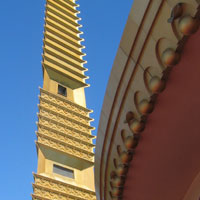 I mentioned previously that I became engrossed in research while putting this together. The most fascinating find on the web was Frank Lloyd Wright Resources (linked below) page hosted by the Marin County Library. This page includes a nice historical brief, photo gallery including images of the design and construction process, a project chronology and a listing of FLLW resources in the library's collection.
But what enthralled me the most was the voices of the Civic Center page which features clips in mp3 format of speeches by Frank Lloyd Wright from 1957 and 1958 and interviews with other architects, politicians and journalists who were involved with the project.
Before Wright's death on April 9, 1959, he had finished the supervision of drawings for the main building and the master plan for the site. In this section we will finish our exploration of Wright's design, and take a look at some of the changes and developments after his passing.
A stunning photo by William Allin Storrer depicts and early view of the Hall of Justice. The photo captures a landscape in keeping with what Wright had experienced before additional landscaping and trees were added to the site.
Link: Marin County Library FLLW Resources
Photos: Lee Sandstead
Photos: Picture the Scene
Photos: Digital Imaging Project
Photos: Digital Imaging Project (Post Office)
Part I - Three hills bridged with graceful arches
Energy efficient lighting solutions
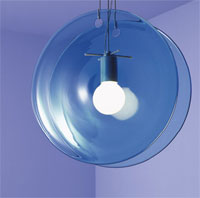 We love getting tips. Especially when they are for such inventive and witty pieces like these light fixtures from Italian manufacturer Tecnodelta. Most of Tecnodelta's fixtures come in wall, floor, hanging, and table variations and Tecnodelta uses the most advanced technology in the production of its lighting devices – fibre optics, LEDs, electroluminescent sheets – in addition to the traditional technologies.
The Bahiana (2004, featured at right) is formed by two pieces of Murano glass held together with a pair of hooks and separated by the bulb socket.
Link: TECNODELTA [Thanks, Marcus!]
Material Reuse
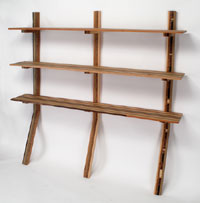 We received an email from Carlos over at Scrapile alerting us to several new pieces in their 2005 collection. Images we received include a wall-mounted shelving system, a circular table with tripod legs, and accessory boxes in several sizes. Scrapile produces their products out of discarded wood from local wood shops. Thanks, Carlos!
Email: ScrapileNYC
Related: Scrapile L+L
West 8 selected as the design team for Jubilee Gardens in London
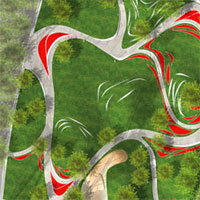 West 8’s design concept focuses heavily on developing an organic, lush and green park, with softly undulating hills. Trees and flowers will bloom throughout the year to provide a ‘botanical ambience’ for one of London’s most important green spaces. The sophisticated topography creates paths which are fluid and inviting, prime lookout points which frame dramatic, panoramic views of the Thames, the London skyline and the South Bank, and intimate spaces where people can find their own space to relax and enjoy the micro-climate. At night, a theatrical spectacle of light will subtly animate and play with the new weaving landscape.
Link: West 8 - Jubliee Gardens
Link: Jubilee Gardens
Article: LondonSE1 - Jubilee Gardens: West 8 selected by public for 'world class' park
Reference: West 8 (L+L)
A traditional terrace house transformed
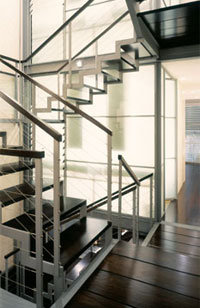 Sydney based firm Dale Jones-Evans Pty Ltd Architecture is committed to design that is of its place and time, a modern architecture that is truly Australian.
For this re-envisioned terrace house in Sydney, Dale Jones-Evans completely gutted the structure and inserted a new steel framed building into the shell. The center of the house features a vertical floating stairwell and illuminated glazed bathroom core. The floor plane extends out at the rear terminating at a sunken black 'grotto' pool, which is wrapped in a fluid woven metal sculptural veil.
Link: The Water House
Firm: Dale Jones-Evans Pty Ltd Architecture
Claude Cormier Architectes Paysagiestes
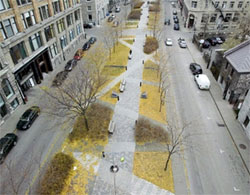 We've always found the website for Claude Cormier Architectes Paysagiestes (that's "Landscape Architects" for you non-franophones) to be rather amusing with it's theme of a landscape architect's Disneyland, excuse-moi, Courmierland in this case, with Frontierlandscape, Fantasylandscapes, Tomorrowlandscapes and Adventurelandscapes. To our dismay, the website is currently a bit low on content, but their work is interesting to browse even in abbreviated form.
What made us decide to feature Monsieur Cormier today was the discussion of our recent Shortcut post, which made us think of Cormier's design of Place d'Youville also in Montréal (shown right and below with more text).
Link: Place Youville
Firm: Claude Cormier Architectes Paysagiestes
This is the quick summary
 Link:
Link:
Making a case for native and climate-appropriate plants
 We occasionally show our southern California bias... but I am not sure why the New York Times shows theirs so often.
The New York Times published an article yesterday profiling proponents of "native" plants in California, focusing on Rene Russo's crusade to promote native species... an interest we share and which we subtly display with our side bar Dudlea image. In my experience, newspapers are infamously inept in their coverage of nature and landscape, and while this article is interesting and worth reading, I find the poor reporting to be annoying. For example:
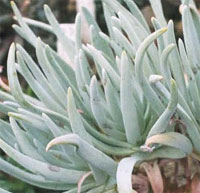
Native plants like senecio and aloe, which fill the yard in front of Andree Matton's house in Monrovia, Calif., thrive on less water than grass.
Senecio and aloe are not native even to this continent, let alone to Monrovia, California.
Article: NY Times - Flora With a Star in Its Corner
Reference: Garden/garden (L+L)
DWR contest to identify the architect of a 1952 modern home
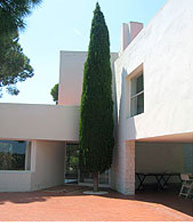 The recent DWR newsletter features a contest to identify the designer or location of a 1952 house by an "influential but relatively obscure" architect. The first 20 responses to either name the architect or the location of the residence will receive a book devoted to the architect in question.
The images are worth a peek even if the contest doesn't appeal to you.
Link: DWR Newsletter
Submissions: summersurvey@dwr.com
UPDATE: Click here for the answer
Urban Stone
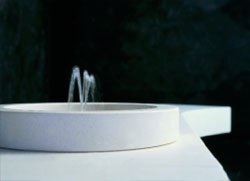 The STO bench system from Macaedis is comprised of 12 different bench modules. Made of natural stone, the models can be linked together to create an organic flow or used as stand alone pieces to accent your urban environment.
Designs are varied, including basic benches, benches with recessed seating, with back and arm rests, fountains, and tree wells.
"Stone is the finest of all natural construction materials. Its physical characteristics and its historical significance cause feelings of comfort that can hardly even be approached by other materials. Its long, beautiful ageing process has all the dignity of a natural cycle. Architecture in buildings and in urban spaces must relate to its surroundings. Stone brings us into touch with our history and our culture, conveying the perceptible message that is a natural part of the human environment.
It transmits wealth, depth, elegance and quality as no other material."
Link: Macaedis
Mid-century Catalan architect
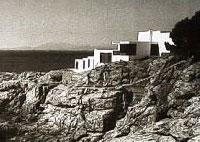 Some of you may recall the contest that DWR was holding to identify the architect of a modern home last month.
The veil has been lifted, and the author has been revealed as Barcelona-born architect José Antonio Coderch (1913–1984), one of the most prominent post-war architects working in Spain.
Link: MEAM Net - José Antonio Coderch
Photos: El Poder de la Palabra
Photos: Casas - Escuela Técnica Superior de Arquitectura de Granada - Casa Ugalde
Photos: Casas - Escuela Técnica Superior de Arquitectura de Granada - Casa Rozes
Book: William Stout Books - Jose Antonio Coderch Houses
Reference: Name that modernist! (Land+Living)
Residence by Kanner Architects as seen at CA Boom II Day One
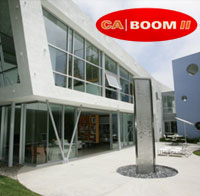 We had the opportunity to tour the 511 House, the private residence of architect Stephen Kanner and his family. This is the second year that Mr. Kanner has graciously opened his home for CA Boom, but we were unable to participate in the first day of the home tours last year.
Located in Pacific Palisades, California, the 511 House is a riot of form, color, texture and materials in an almost post-modern mix of California Modern and Googie road-side architecture.
Link: Kanner Architects
Related: Canyon View by Kanner Architects (L+L)
Reference: CA Boom II Day One (L+L)
Reference: CA Boom II Day Two (L+L)
Reference: CA Boom II Day Threee (L+L)
"For the Closest Approach of the Original Sound"
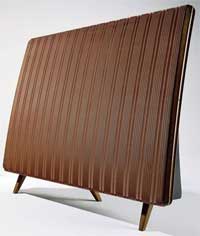 I'll be honest, I don't know jack about speakers or what qualities to look for when purchasing a new set - other than if they sound good - so I won't try to wow you with all sorts of techno-gibberish about ohms and impedance except to say that these are some of the most attractive looking speakers I've ever seen. The QUAD ESL 57 (featured at right), with its ribbed fabric grill, has a 50's retro feel and looks more like a finely crafted piece of furniture than an audiophile's dream. Considering that they were first produced in 1955, I guess that sort of makes sense.
Link: QUAD Musik [Thanks, Goodo!]
Modular furnishings
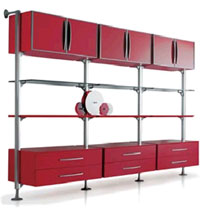 Casamania has a system of modular furnishings designed to fit into modern residential or office settings. The Web system, featured at right, is geared toward the office space and features a wide range of accessories including a reception area,coat racks, wastepaper baskets, and the like. In contrast, the Matrix system (below) features various elements with squared sections and colored translucent panels.
"The radical architecture of the 1960s developed avant-garde solutions that have only recently become part and parcel of European or American cities thanks to Frank O. Ghery and the Futur System group. Casamania has been part of this process for the last twenty years, offering solutions for the home and workplace. Our designs are essentially light, flexible and able to adapt to the different needs of a varied but aware user group, which views the home without preconceptions when it comes to using objects."
Link: Casamania by Frezza (Warning: mildly annoying flash site)
Winning entry in the "Cradle to Cradle" International Design Competition
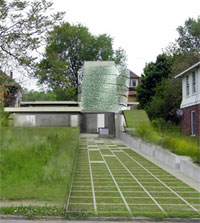 We've talked about Cradle-to-Cradle quite a bit here at L+L, but have never featured the winning professional entry in the C2C Home Competition. Designed by Matthew Coates and Tim Meldrum with Brendan Connolly, Rich Franko, Kristine Kenney, Julie Petersen and Ron van der Veen, the concpet embraces environmental responsibility, social responsibility and community interdependence as a complete manifestation of the guiding principles and design issues laid out in the competition brief.
The design is thoroughly modern in appearance and function while embracing the neighborhood and natural context of Roanoke, Virginia. The large "front lawn" of native vegetation wraps up to become a vegetated roof system which collects and filters storm water for use in the house. The horizontal plan is pierced by the vertical "core" which acts as a stack ventilation tower as well as the energy collection armature. The core is clad with a spinach-protein based photosynthetic plasma cell skin that is able to generate enough power to share with the neighborhood.
Link: Cradle To Cradle Home
Via: Future Feeder
More: Archidose
Reference: C2C Home Competition Winners (L+L)
Reference:
Designing the Future (L+L)
Publish your work in Pamphlet Architecture 28!
 Founded in 1977 as an alternative to mainstream architectural publishing, Pamphlet Architecture encourages architects and writers to put forth their ideas, theories, and designs in modest, affordable booklets. Its success is legendary: Pamphlet Architecture has helped launch the careers of architects from Steven Holl and Lebbeus Woods to Zaha Hadid, and has had influence far exceeding the ad-hoc nature of these humble books.
Could your work spark the next generation of architectural discourse?
Pamplet Architecture is seeking practicing or aspiring architects, urbanists, and landscape architects with visually provocative and intellectually compelling ideas for the future of the designed and built world.
Link: Pamphlet Architecture
Deadline: October 10, 2005
Young French Designer, Gilles Roudot
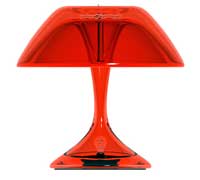 We received a note from French Designer Gilles Roudot alerting us to his creations. Unfortunately, I do not speak French and running the text through Babelfish seemed sketchy at best so I'll just leave you with some eye candy from Gilles. The objects on his site appear to be mostly renderings so I'm not sure if any of his designs have come to fruition but there are several pieces that stand out. Of particular note is the Diner (below), which takes a futuristic approach to a 50's style diner counter, complete with barstools and swingout trays.
Link: Kidino [Thanks, Gilles]
Change its form according to your mood
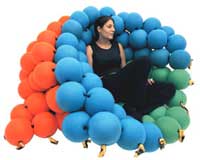 When it comes to comfort, it appears that the Feel Seating System has all the bases pretty much covered. Sleepy? Lay it out flat and take a nap. A little chilly? Fold half of it over and cover yourself with it. Want to relax with a book? Roll it up into a ball and you've got yourself a cozy little nest.
The Feel, from Animi Causa, is created from 120 soft balls that are covered with an elastic fabric and held together with a flexible internal frame. The design is inspired by a molecular structure and can assume various shapes allowing numerous positions.
Link: Animi Causa [Thanks, Amit!]
Also: Pop Gadget
Coffee roasted for friends
 As a biodiesel user and advocate, I try to keep up with the latest advancements in the rapidly growing movement. Something unheard of just jumped on my radar and I'm completely intrigued: a coffee roaster that runs on biodiesel! The Vermont Coffee Company in Bristol, VT, has just invested $100,000 in the development and manufacturing of a smokeless coffee roaster that runs entirely on biodiesel and utilizes its exhaust emissions as additional fuel. Both efficiency and environmental-friendliness have exponentially increased for the company, which already sells exclusively organic, fair-trade beans.
Link: The Addison Independent
Prével brings the chalet to downtown Montreal
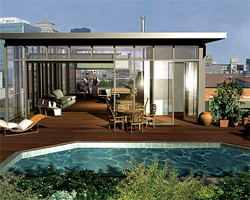 As Montreal enjoys a burst of activity in the housing market developers are looking for properties that can combine all of the elements that make Montreal unique like history, style, and cityscape. Prével's Le Loft does just that by taking a contemporary approach to the reinterpretation of the Lowney candy factory, home of the Cherry Blossom. The Lowney factory sits on the edge of Old Montreal, a stylish and trendy neighbourhood adjacent to the waterfront and downtown Montreal. While the layout and spa-like finishes are typical of most new condos today, what makes Le Loft stand out from the rest is the 4 season urban chalet situated on the roof. The chalet is a glass and steel structure that provides shelter from Montreal's harsh winter, and stunning views of the waterfront and city.
Link: Le Loft
Parc du Sausset and the art of patience
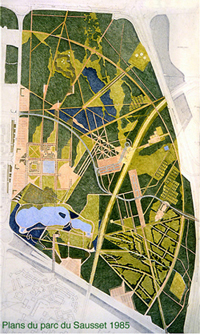 At the time of parc du Sausset's planning in 1979 the trend in France was still to create highly designed parks using exotics and built features. The competition brief for parc du Sausset was different in that it broke with tradition and specified conservation. Michel and Claire Corajoud took up the challenge, and proposed a naturalistic planting scheme that would be as much of a buffer to the growing industry and expanding communities, as it would echo the shapes of its industrial iconography and reflect an agrarian past.
Together with Jacques Coulon and a team consisting of Marc Rumelhart, Tristan Pauly, Claude Guinaudeau, Edith Gerard, Pierre Pascal Mourgue and Gerard Dufrense they took to creating a park that would challenge the instant garden mentality of the time. They planted whips instead of more mature trees, and proposed a marsh that would act as a refuge for wildlife, and treat the water infiltrating from the north through pytoremediation.
Link: parc du Sausset
Firm: Michel Corajoud
Exhibition on the work of Barragan shows his vision for blending architecture with nature
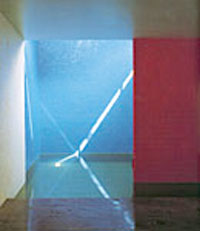 An Exhibition on the work of the Pritzker Prize winning architect Luis Barragan is now showing through November 6, 2005 in Athens, Greece at the Benaki Museum in the Pireaus Street Annexe.
The exhibition presents approximately 70 large-scale photographs by Japanese architect Yutaka Saito, wooden models (approximately 1.0-1.5 sq.m. apiece), as well as a series of the corresponding designs (floor plans - designs) of works by Barragan. In tandem with the exhibition, there is a video installation, with a 15-minute film on the forms of the Barragan oeuvre.
Link: Benkai Museum
Article: Kathimerini
An early American Modernist landscape
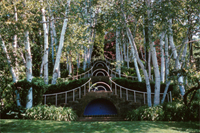 John Fletcher Steele was a one of the first American Modernists of landscape architecture. In 1907 Steele attended Harvard's Graduate School of Landscape Architecture where he was taught by none other than Frederick Law Olmstead Jr. in the Beaux Arts tradition, but later became greatly influenced by the French Modernist of his time; the Vera brothers and Gabriel Guevrekian in particular.
While his style in his professional practice remained relatively rooted in Beaux Arts principles, his writings and exhibition work showcased his Modern gleanings. During his career, Steele made a friend out of heiress Mabel Choate, daughter of Joseph Choate the prominent New York attorney, who's love of travel fed Steele's creativity and together they conspired to create his signature gardens at Naumkeag in Stockbridge, Massachusetts.
Link: Naumkeag Trustees
Link: Naumkeag Projects
Via: Garden Visit
Reference: Modern Landscape Architecture - A Critical Review (L+L)
Tadao Ando's mixed-use complex in Hyogo, Japan
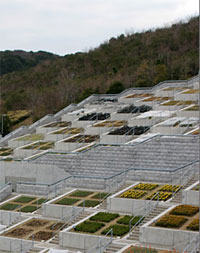 This massive mixed-use complex was constructed on the remains of a hillside whose earth had been used for a huge landfill project for the Osaka Bay area. The design reconstructs the landscape that had been destroyed but also, through the idea of rebirth and reconstruction, serves as a memorial to the thousands who had lost their lives and the destruction of land in the massive earthquake that shook the Kobe region in 1995. The complex is vast in scale, yet the design manages capture the small quiet moments for which Ando is known.
Link: Awaji Yumebutai International Conference Center
Photos: 0lll
More Tadao Ando: Design Boom - 2001 Interview
Location: L+L Maps - Awaji Yumebutai Conference Centre
Wallpaper and paint for the eco-stylish
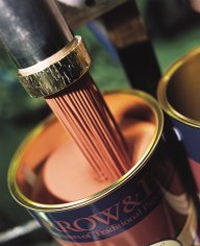 Farrow and Ball wallpapers and paints are beautiful, tactile and unparalleled in quality and finish. Think of them as hand-crafted products that use time-tested palettes for their line of paints, and employ a 19th century method of dragging and stripping for their papers. Sound old-fashioned? Maybe, but Farrow and Ball wallpapers, Emulsions, Exterior Masonry and Eggshell paints are environmentally preferable with low VOC emissions; the same goes for their papers.
As a user (ok, F&B addict) I can testify to the fact that there is little to no smell after an application, and the matt finishes allow light to blend with the colour rather than reflect off of it. There are over 100 Farrow and Ball colours to choose from, most of them with unconventional names and descriptions like Dead Salmon and Pigeon, but they do not custom blend, which can be a downside for some. On the plus side, Farrow and Ball paints are to be stirred not shaken and they don't separate when left to stand. Furthermore, most distributors offer free (with purchase) in-home consultation. Sample pots are available, and recommended, before committing to a colour.
Link: Farrow and Ball
Creative conversions of underused buildings
 LoftyHeights is a new project started by Oliver Bollmann that looks at adaptive reuse and green building practices in the San Francisco Bay area that aspires to become a clearinghouse where architects, city officials, investors, home owners and real estate agents come together to post and learn about local, and potentially sustainable, building opportunities. The focus of the project is the existing urban environment, often underused or abandoned, the message is the idea that urban density is more sustainable. The site has been in existence since July 2005.
What we're committed to at LoftyHeights is to bring forth the creative conversions of underused buildings, buildings that sit idle after the dot.com crash or others, including warehouses, industrial, R&D and offices, into living homes that create community while remaining kind to our dwindling resources. Creating a quality of space for the owners out of an everyday structure, using green practices, encouraging proximity and density.
Link: LoftyHeights