

Winner of the 2009 Mies van der Rohe Award
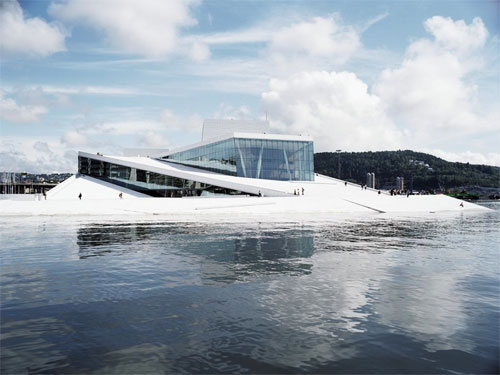
This landmark building in Oslo by Snøhetta (Kjetil Trædal Thorsen, Tarald Lundevall, Craig Dykers) is the largest cultural centre built in Norway in 700 years. The competion brief stated that the operahouse should be monumental in it’s expression. Snøhetta's interpretation of monumentality is a concept of togetherness, joint ownership, easy and open access for all which is manifested in the warping roof plane making the an extended piece of civic public space. Monumentality is achieved through wide horizontal extension and not verticality. Integral to the 1,000-room interior, which is largely lined with crafted woodwork (using the traditions of Norwegian boat builders), are a number of art commissions interwoven into the structural fabric, including a cloakroom, a collaboration with their 2007 Serpentine Pavilion collaborator Olafur Eliasson.
The European Commission and the Fundació Mies van der Rohe announced today that the Norwegian National Opera & Ballet, Oslo, Norway by Snøhetta is the winner of the European Union Prize for Contemporary Architecture – Mies van der Rohe Award 2009.
Link: Snøhetta
Location: L+L Maps - Norwegian National Opera & Ballet
Photo above © JENS PASSOTH
View Land+Living Maps in a larger map
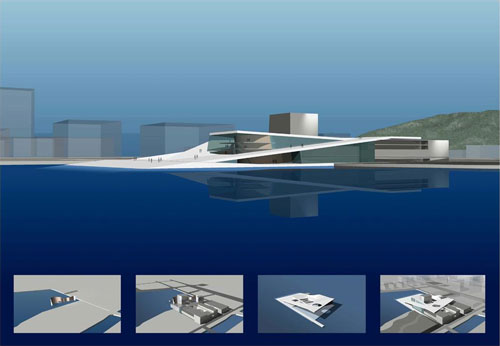
CONCEPT © SNØHETTA
The conceptual basis of the competition entry, and the final building, is a combination of three elements – the wave wall, the factory and the carpet.
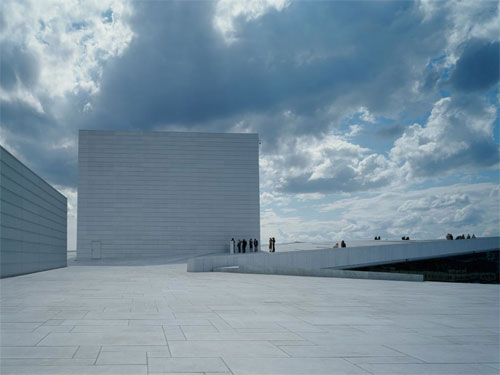
ROOF AND STAGE TOWER Photo © GERALD ZUGMANN
The wave wall : Opera and ballet are young artforms in Norway. These artforms evolve in an international setting . The Bjørvika peninsula is part of a harbour city, which is historically the meeting point with the rest of the world. The dividing line between the ground ’here’ and the water ‘there’ is both a real and a symbolic threshold. This threshold is realised as a large ‘wave wall’ on the line of the meeting between land and sea, Norway and the world, art and everyday life. This is the threshold where the public meet the art.
The Factory : Snøhetta proposed that the production facitities of the operahouse should be realised as a self contained, rationally planned ‘factory’. This factory should be both functional and flexible during the planning phase as well as in later use. This flexibility has proved to be very important during the planning phase: a number of rooms and room groups have been adjusted in collaboration with the end user. These changes have improved the buildings functionality without affecting the architecture.
The Carpet : The competion brief stated that the operahouse should be of high architectural quality and should be monumental in it’s expression. One idea stood out as a legitimation of this monumentality: The concept of togetherness, joint ownership, easy and open access for all. To achieve this, we wished to make the opera accessible in the widest possible sense, by laying out a ‘carpet’ of horizontal and sloping surfaces on top of the building. This carpet has been given an articulated form, related to the cityscape.
Materials : In the operahouse, three main materials were specified as early as the competition entry: White stone for the ‘carpet’, timber for the ‘wave wall’, and metal for the ‘factory’. During the continued work on the project, a fourth material, glass, which allows for the exposure of the underside of the ‘carpet’, has been given specific attention. The materials, with their specific weight, colour, texture and temperature, have been vital to the design of the building. Snøhetta’s architecture is narrative. It is the materials which form the defining elements of the spaces. It is the meeting of the materials which articulates the architecture through varied detail and precision.
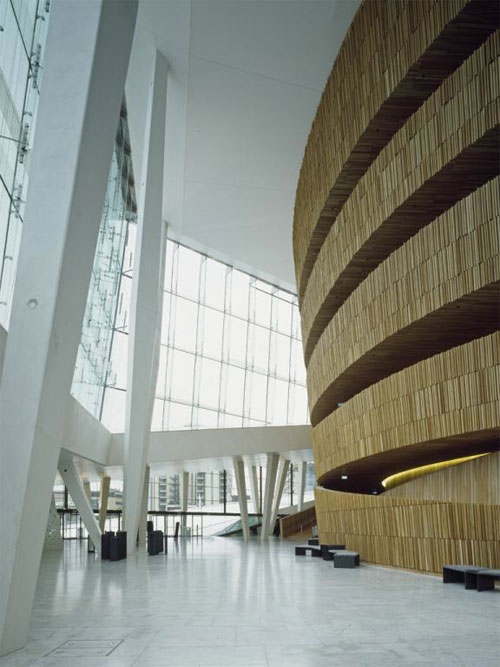
FOYER Photo © GERALD ZUGMANN
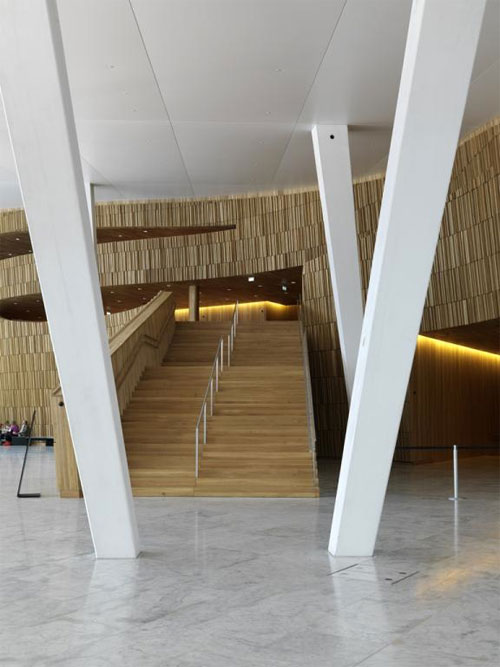
FOYER Photo ©JIRI HAVRAN
The Oslo Opera is one of three projects in the EU-project “ECO-Culture”, which focuses on energy efficiency in cultural buildings.
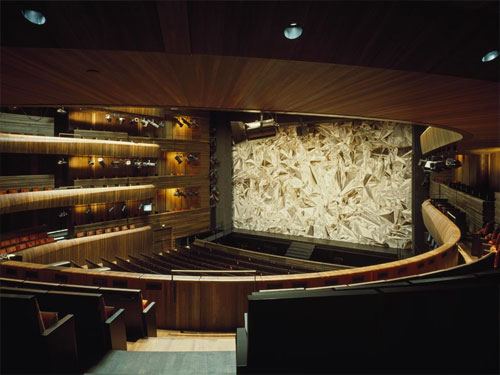
MAIN AUDITORIUM Photo ©GERALD ZUGMANN
More Waterfront Cuture
Nefertiti Egypt fine antique reproduction furniture, French, hotel furniture, hotel renovation supply