

2009 Pritzker Architecture Prize Laureate
Peter Zumthor of Switzerland has been chosen as the 2009 Laureate of the Pritzker Architecture Prize. The Zumthor choice marks the second time in three decades of the Pritzker Architecture Prize that Switzerland has provided the laureate. In 2001, Jacques Herzog and Pierre de Meuron were the honorees.
In Zumthor’s own words as expressed in his book, Thinking Architecture:
I believe that architecture today needs to reflect on the tasks and possibilities which are inherently its own. Architecture is not a vehicle or a symbol for things that do not belong to its essence. In a society that celebrates the inessential, architecture can put up a resistance, counteract the waste of forms and meanings, and speak its own language. I believe that the language of architecture is not a question of a specific style. Every building is built for a specific use in a specific place and for a specific society. My buildings try to answer the questions that emerge from these simple facts as precisely and critically as they can.The formal ceremony for what has come to be known throughout the world as architecture’s highest honor will be held on May 29 in Buenos Aires, Argentina.
After the jump is a sampling of Zumthor's work.
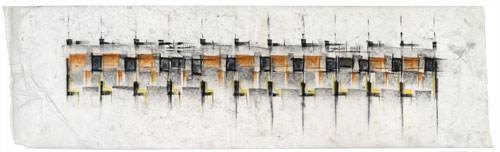
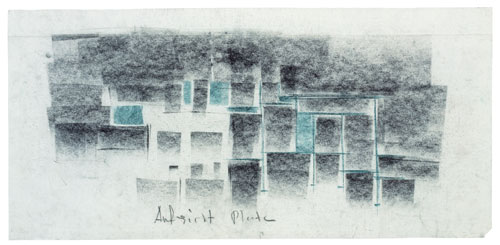
Image above: Sketch by Peter Zumthor of Homes for Senior Citizens, Chur, Masans, Graubünden, Switzerland, 1993.
Although most of his work is in Switzerland, he has designed projects in Germany, Austria, The Netherlands, England, Spain, Norway, Finland and the United States. His most famous work is in Vals, Switzerland — the Thermal Baths. Most recently critics have praised his Field Chapel to Saint Nikolaus von der Flüe near Cologne, Germany. The jury singled out not only those buildings, but also the Kolumba Museum in Cologne, calling the latter "a startling contemporary work, but also one that is completely at ease with its many layers of history."
Brother Klaus Field Chapel
Wachendorf, Eifel, Germany, 2007
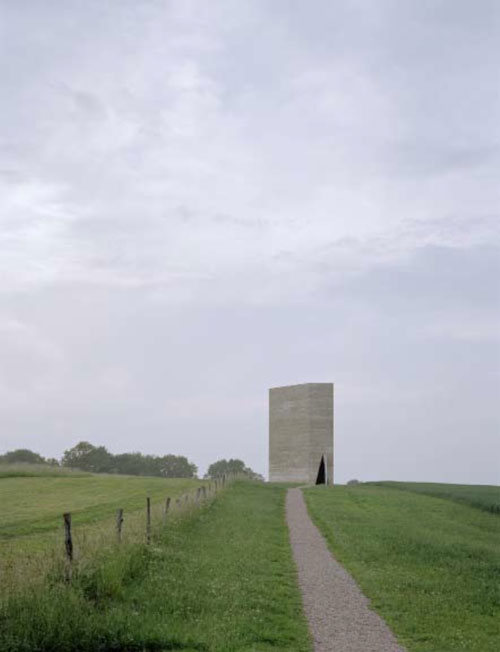
(Photo by Walter Mair)
Swiss Sound Box, Swiss Pavilion, Expo 2000
Hanover, Germany, 2000
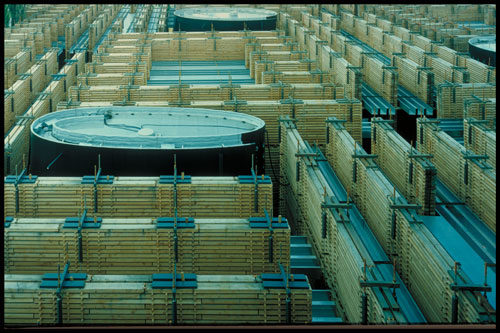
AKA the "Klangkörper Schweiz," the pavillion was designed a welcoming place to rest, eat, drink, and listen. The pavilion is constructed out of 144 km of lumber with a cross-section of 20 x 10 cm, totalling 2,800 cubic metres of larch and douglas pine from Swiss forests, assembled without glue, bolts or nails, only braced with steel cables, and with each beam being pressed down on the one below. After the closure of the expo, the building was dismantled and the beams sold as seasoned timber.
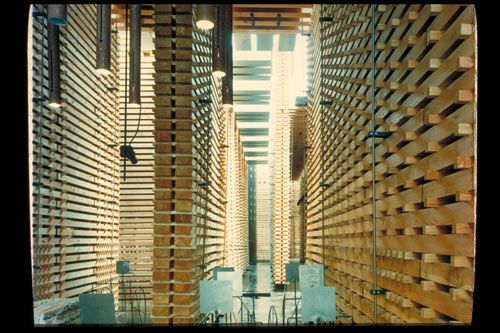
(Photos by Thomas Flechtner)
Thermal Bath Vals (www.therme-vals.ch)
Graubünden, Switzerland, 1996
The load-bearing composite structure of the baths consists of solid walls of concrete and thin slabs of Vals gneiss broken and cut to size in the quarry just behind the vthe mountain just behind the baths has a temperature of 30°C.
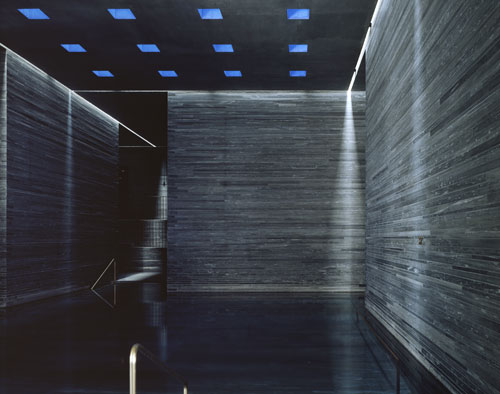
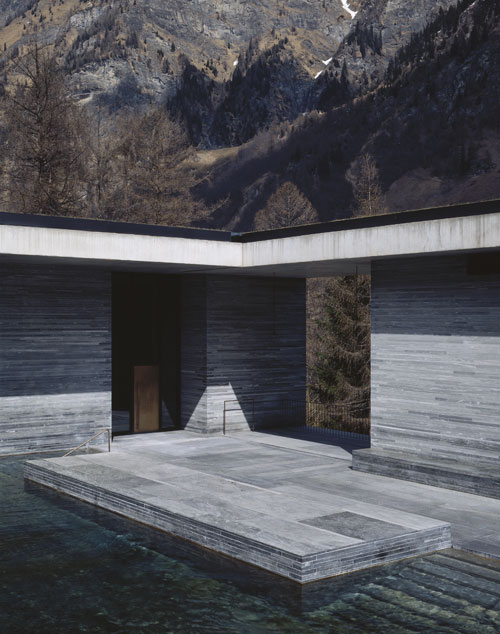
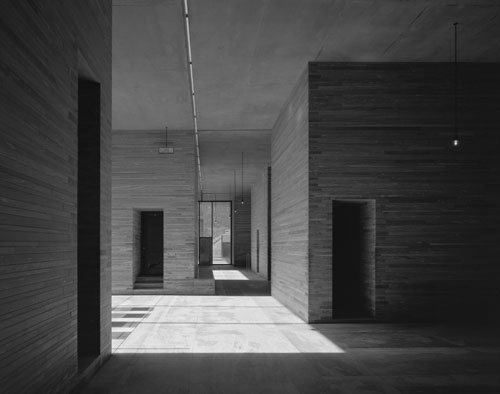
(Photos by Helene Binet)
Kolumba, Art Museum of the Cologne Archdiocese
Cologne, Germany, 2007
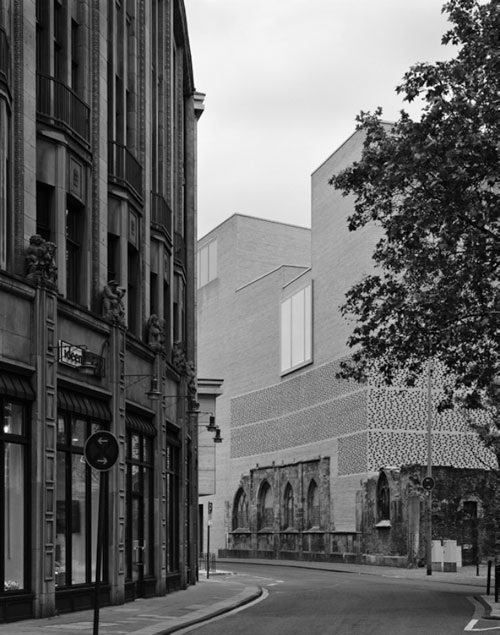
The new building in the city centre rises from the ruins of the late gothic Saint kolumba church, destroyed in World War ii. its ground floor contains a large archaeological excavation site with the remains of previous church buildings which date back 7th century, and the chapel “Madonna in den Trümmern” (Madonna among the ruins) built by Gottfried Böhm in 1949/50.
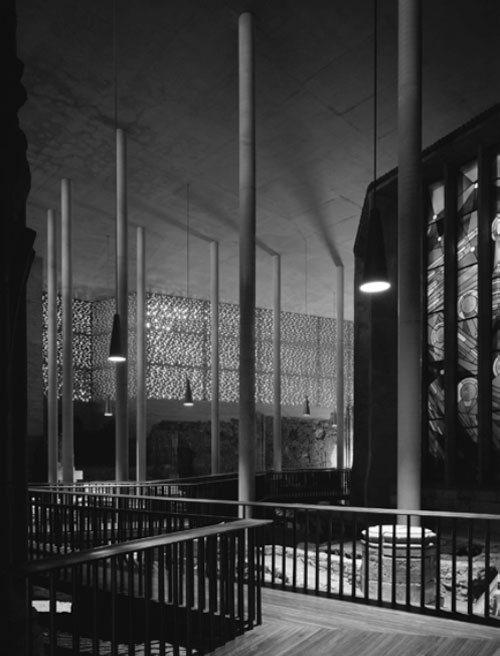
(Photos by Helene Binet)
Saint Benedict Chapel
Sumvitg, Graubünden, Switzerland, 1988
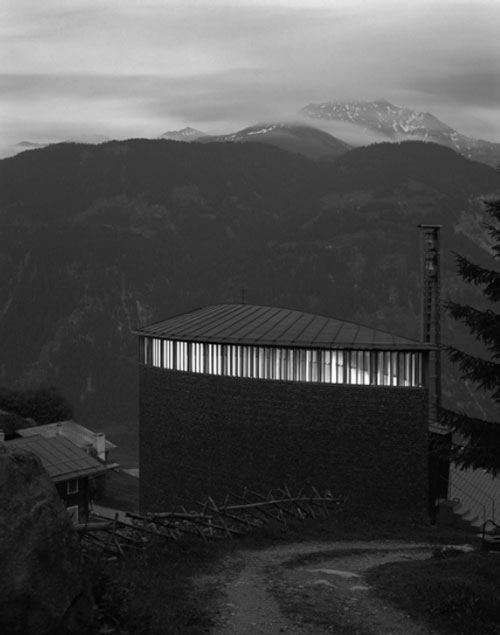
(Photo by Helene Binet)
A new wooden structure (faced with larch wood shingles) replaced the avalanche-destroyed baroque chapel in the village of Sogn Benedetg (St. Benedict). The new site on the original path to the Alp above the small village is protected from avalanches by a forest. The village authorities issued the building permit with the comment “senza perschuasiun” (without conviction). yet the abbot and monks of the disentis Monastery and the then village priest Bearth wanted to build something new and contemporary for future generations.
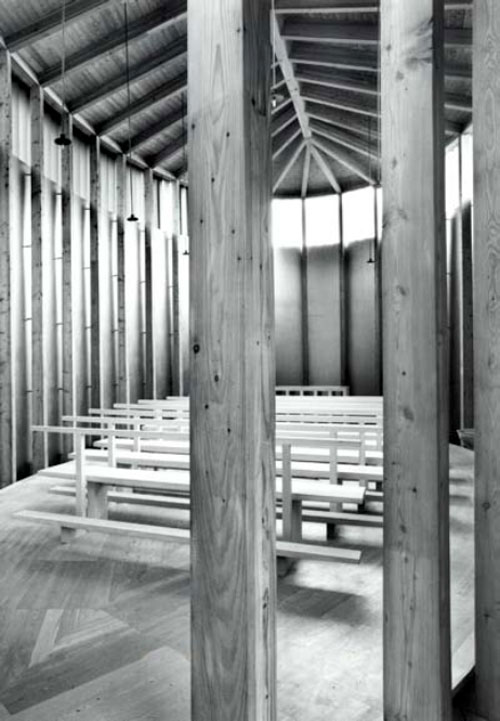
(Diascan by Peter Zumthor)
criticism