

Screw the rules of the road
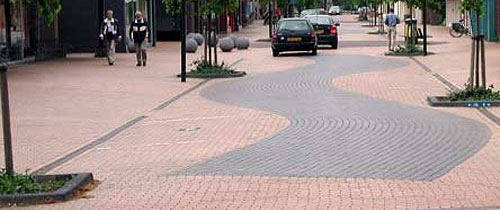
More than two years ago, I read an article by LA based journalist Sam Kaplan talking about what he called "woonerfern," a Dutch concept of street design which blurs the boundaries of traffic separation and use. However a quick web search for "Woonerfern" will turn up nothing other than references to this article by Mr. Kaplan, and using a Dutch-to-English dictionary was no help either. A bit more research, and AH-HA! I discovered the term "Woonerf" (or the plural "Woonerven"), a concept developed in the late 1960's and early 70's which is credited to the late Dutch civil engineer Hans Monderman, who's philosophy of road design throws out the conventional wisdom that driving and walking are incompatible and that traffic must be directed and controlled by signals and signage.
The concept has evolved into numerous variations of philosophy: Home Zones, Shared Space, Living Streets, New Mobility, etc. But never mind what it is called, the concept of a street serving multiple functions is an interesting one. It expands the possibilities of walkable, sustainable cities which accommodates the automobile, but emphasizes and encourages alternate modes of movement and inhabitation of the street-scape--linear public space. Plus, it is just a good era to revisit 'infrastructure' rather than, say, sexy modern mountain vacation homes. So, let's take a look at shared spaces, shall we?
Link: Salon - Why don't we do it in the road?
Link: NY Times - A Path to Road Safety With No Signposts
Link: Wired - Roads Gone Wild

Amsterdam - Photo by Flickr user Joel Mann
What all of these ideas have in common is that the design and layout of the street is radically different from automobile oriented thoroughfares, signaling visually to drivers and pedestrians that this zone, district, block, square etc. is a place where the rules of the road are different, and passage through the zone takes on a different speed. The idea is superior to pedestrian-only zones where the automobile has been banished, allowing the road network to remain unified, though distinguishing paths of movement. Australian shared-space proponent David Engwicht says, "Standardized signage and use of standardized road markings should be reduced to a minimum," Engwicht writes. "As they create predictability and contain no intrigue. They also reinforce that a street belongs exclusively to the motorists."

Rue Prince Arthur, Montreal - Photo by Flickr user Mike "Machine" rodnroll
The paradox of the concept is that by blurring the boundaries between pedestrian and auto traffic, the streets actually become safer places. The problems in implementing such a concept is cultural, for instance in the United States where car drivers assume that the road is the domain of automobiles and the movement of traffic takes precedence. Many American cities require pedestrians to push a button a stop lights in order to obtain a crossing signal, penalizing the pedestrian with by slowing progress which makes walking an unattractive option. And as Linda Baker points out in her article in Salon, children in the United States are taught to "stay out of the street." Drivers feel that they have priority... the mode of thought is that pedestrians need to get the hell out of the way to facilitate the fast movement of traffic.
But the paradox continues when traditional intersections are replaced with the woonerf concept; fewer accidents, and shorter trip times even though traffic speed is reduced. And who has the right of way? Hans Monderman's answer to that question was, "I don't care. People here have to find their own way, negotiate for themselves, use their own brains." That's quite a concept, actually. Imagine the need to think while you drive, rather than the attitude that seems so common among drivers that their trajectory and progress is the only thing that matters.
In some towns, especially historic towns in Europe, the movement is driven by a desire to reduce the road side clutter of signage. The small town of Enumclaw in Washington state which re-designated its main street as a civic space.
Clematis Street in West Palm Beach is an example of the developing American model. While it does not throw out the curb and sidewalk form of the typical American street, it pairs down the street to its basic elements and to human scale

Clematis Street - Photo by Flickr user mycitylibrary
But the best examples go beyond traffic calming by implementing a strong design strategy.
One can imagine a city fabric of grand boulevards which accommodate both pedestrians and larger volumes of traffic and transport linked by a web of smaller, slower streets forming the connective tissue of the city, defining neighborhoods and districts.

Sign at entrance to shared street in central Köln, Germany - Photo by Flickr user Payton Chung

Rue Prince Arthur - Photo by Flickr user lightspeedchick
And what of the notion that the automobile represents the ultimate in personal freedom? The Wired article quotes Hans Monderman saying, "There's still this notion that we should build big roads everywhere because the car represents personal freedom. Well, that's bullshit. The truth is that most people are prisoners of their cars."
blurring the boundaries
Another thing about American traffic