

An Tur Solais - The Spire of Dublin
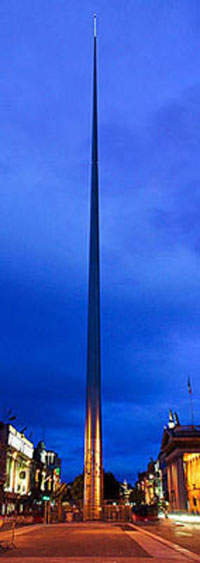 A day on which one can't help but think of monuments and symbols seems like an appropriate time to take a look at a successful modern monument... at least Witold Rybczynski thought so, and it got me to thinking about it as well.
The Spire of Dublin, also known as An Tur Solais (the Monument of Light) and The Spike... it also has some unsavory nicknames in the Dubliner tradition: The Stiletto in the Ghetto, The Nail in the Pale, The Binge Syringe, and (perhaps my favorite) The Erection in the Intersection.
The monument was conceived in the early 1990's to provide a replacement for Nelson's Pillar which was blown up by former IRA members in 1966. An architectural competition was held with the intention of building the monument in time for the millennium. Alas construction was delayed by a pair of lawsuits filed by failed competitors - one designed a resurrection of Nelsons Pillar but topped by a bronze sun, the other a column topped by a revolving restaurant...
Of course monuments are contentious by their very nature - e.g. Ground Zero, Alex Eiffel, World War II Memorial in Washington, D.C., etc. And the sore losers of the competition weren't the only detractors of the winning entry - public opinion and politicians decried the monument citing its inappropriateness to the context, the exorbitant cost and everything in between. Not to mention the planning process and environmental regulations (EIS). It is a wonder it was ever built at all... and so it is perhaps a fitting symbol of the new Ireland where such things are possible. And yet that uncovers an ironic twist: this monument of the new Ireland, built to replace a symbol of British imperialism, was an entry by a British architect, Ian Ritchie.
Link: The Spire of Dublin
Slideshow: Slate - The Spire of Dublin
Designer: Ian Ritchie Architects
Related: Seeing Éire [I] - Ailtireacht na Baile Átha Cliath (L+L)
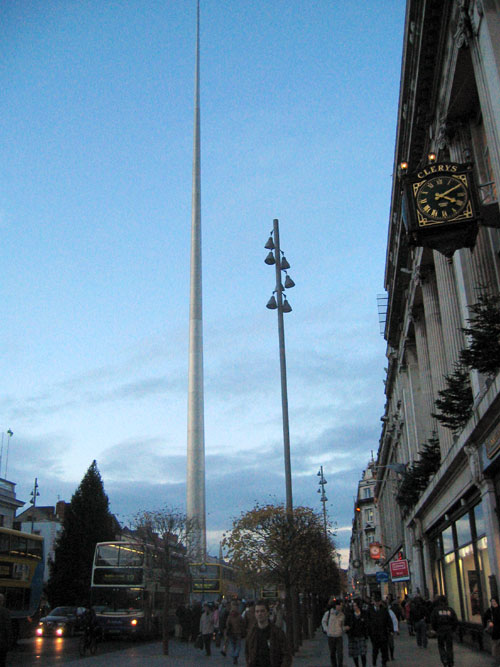
But what does the Dublin Spire mean? Witold Rybczynski points out that there is no writing, no iconography, no overt symbolism. It means whatever you want. And that is what gives the Spire its strength.
It has with time become an important urban landmark, but it doesn't take much to see the Spire as an allegory for Ireland - past, present and future.
It serves as an historical marker, bringing prominence to Irish independence as it sits adjacent to the General Post Office which served as the headquarters for the leaders of the Easter Rising of 1916, and remains an important symbol of Irish nationalism today. It is a engineering feat evoking Ireland's important place as a technological center for modern Europe. Ian Ritchie says that it celebrates Ireland’s confident future in the third millennium. And Ritchie's design alludes to Irish heritage, albeit subtly, with the mottled etched patterns relating to the land and the spiral base drawn from Celtic iconography.
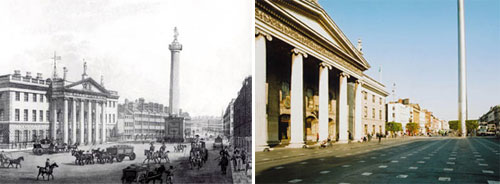
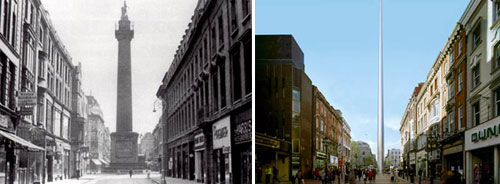
Yet nothing about this monument jumps out screams to be noticed. The effect almost subtle yet inspiring. Two attributes that seem to be missing in the mad rush to memorialize which we are experiencing in the US. Looking at the Ground Zero memorial, I have to wonder what it says about our culture that we are building a monument to absence. As much as "Reflecting Absence" made sense to me a few years ago, now with time it seems strange to emphasize two holes in the ground as a monument for the future.
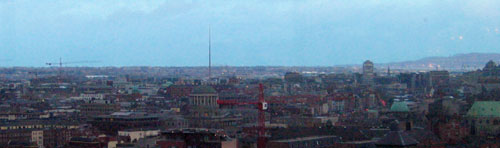
Some Spire specs:
- Completed: January 2003
- Height - 120 metres (400 feet)
- Diameter - 3 metres (10 feet) base, 15 centemeters (6 inches) top
- Material - body is austenitic stainless steel, passes through, street flushed bronze base
- Etc. - Internal 2 ton internal damping system allows the tip to sway no more that 1.5 meters
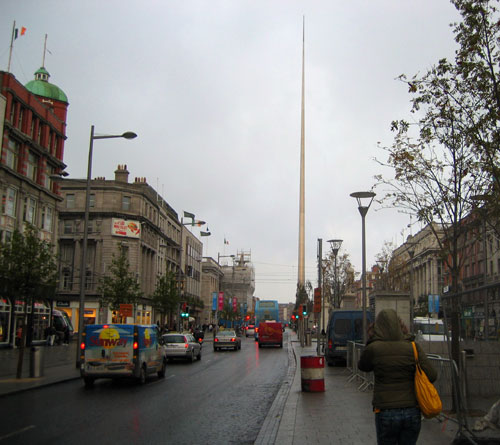
The Spire is visible from a distance, a slender ethereal exclamation point in the horizontal sky line. On O'Connell Street the Spire has a distinct and strong presence without overpowering the scale of the city.
The presence at the street level with its cloud-like etched patterns. At night, the spire seemingly disappears into the darkness, only to reappear at its apex which is a glowing beacon.
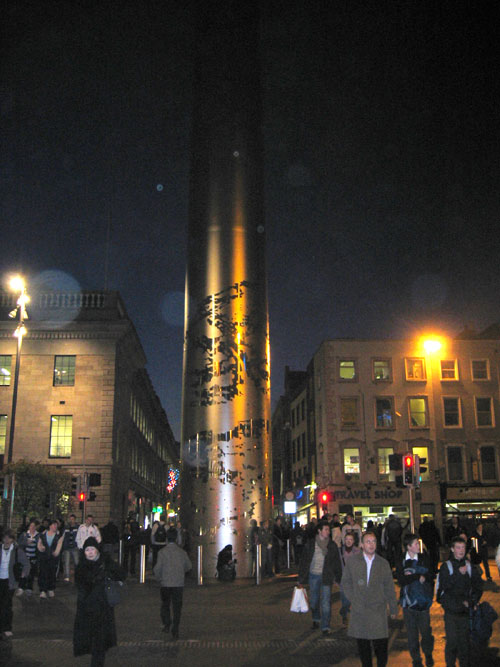
When I visited Dublin in the fall of 2001, the Spire was nothing more than a hole in the ground. The finished monument I saw when I returned in 2005 felt curiously at home in its surroundings, as if O'Connell Street felt complete.
View Land+Living Maps in a larger map
Other References:
McDonald, Frank; The Construction of Dublin, Gandon Editions, 2000.
The Reflecting City
Archiseek Ireland