

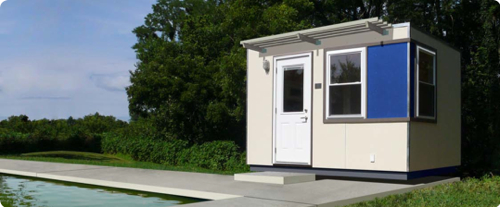
 D.C. architect Carib Daniel Martin came up with the idea of HELP (Housing Every Last Person) soon after Hurricane Katrina devasted the Gulf-Coast region. His idea was to create an emergency housing system that was easily transportable and could be quickly assembled.
With a working demo in place, he secured the means to manufacture his creation and has spent the last two years fine-tuning his work. Expanding on his original design, he has evolved the structure to also meet the needs of the commercial, non-emergency market by producing 4 models: the microCABANA, microHOME, microSTUDIO, and microSHED.
D.C. architect Carib Daniel Martin came up with the idea of HELP (Housing Every Last Person) soon after Hurricane Katrina devasted the Gulf-Coast region. His idea was to create an emergency housing system that was easily transportable and could be quickly assembled.
With a working demo in place, he secured the means to manufacture his creation and has spent the last two years fine-tuning his work. Expanding on his original design, he has evolved the structure to also meet the needs of the commercial, non-emergency market by producing 4 models: the microCABANA, microHOME, microSTUDIO, and microSHED.
A full-service website is due to be launched this coming Labor Day weekend. Link: m-finity.com
Link: Path to Prefab
microSHED
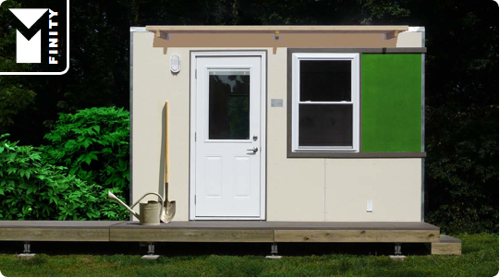
microSTUDIO
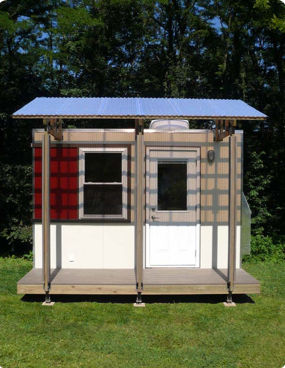
microCABANA
microHOME
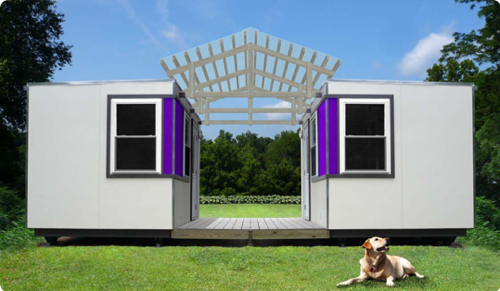
Jonesboro, IL - August 13, 2007 - It may take hammers and nails to build a house, but to build a prefab it takes patience and perseverance.
Nearly two years ago, shortly after Hurricane Katrina made landfall along the Gulf Coast, D.C. area architect Carib Daniel Martin derived the idea for HELP (Housing Every Last Person), an immediate-response emergency housing system that could be assembled quickly and transported easily to wherever the need arose. Assisted by more than 40 volunteers, Martin spent the Labor Day weekend of 2005 building a full-scale prototype of the HELP Home. Since then he has spent most of his time working to turn this idea into a reality.
The HELP Home received immediate attention by the media. It was printed in magazines and newspapers around the world as well as featured in television and radio shows. Soon thereafter Martin was inundated with emails of positive response from those affected by the storm and many who were not. He was also contacted by groups working on the New Orleans rebuilding effort, FEMA, and Florida's Division of Emergency Management.
What was required, he soon discovered, was a means of manufacturing. To this end Martin contacted builders across the nation, including premanufactured and modular housing companies, portable shed fabricators, and independent contracting firms. After several false starts, Martin was ultimately left without a means to bring his house to the general public. "Manufacturers didn't want to take a chance on something so radically different from what they were currently producing without a stack of orders in hand, and without a manufacturer and a reliable time or cost estimate it was impossible to secure any orders."
Faced with this seemingly insurmountable catch-22, Martin determined he would either have to produce them himself or abandon the idea all together. So, in 2006, he founded Mfinity, LLC, a product manufacturing company. In early 2007, he relocated to southern Illinois and, with his life savings and a line of credit, set up a 3,500 square foot production facility on the property of his childhood home.
Realizing the logistics nightmare of providing emergency housing as a startup company, Martin evolved the design of the HELP Home to fit the commercial, non-emergency market. After redesigning the house from the ground up, he renamed it the microHOME. Creating derivative designs as well, including a shed and studio version, he also rethought the way in which the home would be delivered and set up on site.
The average American home is roughly 2,200 square feet yet the microHOME is less than a 100 square feet. A mix between a small house, a ship's cabin, and a travel trailer, it comes standard with a kitchenette, including a sink, stove, refrigerator and storage, as well as a private bathroom with a pass-thru shower and composting toilet. There are also a multitude of interior options and porch styles to choose from allowing the homeowner to personalize their own dwelling. With just a single 8 foot by 12 foot unit the microHOME can provide all the daily needs of three occupants.
With the first production unit built and installed on site for tours, Martin hopes to expand the list of items offered by Mfinity to include a wide range of architectural and furniture systems. "There is a need for well-designed, modern products that can adapt to our changing lifestyles. I want to help fill this need."
Asked what he had planned this upcoming Labor Day weekend, Martin laughed and replied, "I'm throwing a big party. It's been a long two years and it's time to celebrate."
Carib Daniel Martin, principal of Architecture Design And Production Tectonics (ADAPT), is a licensed architect and certified by the National Council of Architectural Registration Boards (NCARB). Described by the Washington Post as "eloquent protests against the global status quo," Carib's work has been published internationally as well as displayed at the National Building Museum in Washington, DC and the National Centre of Craft and Design in Lincolnshire, UK.
More than one use