

A centerless center rooted in the landscape
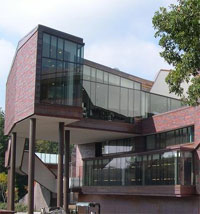 A free-thinking women's college, Wellesley features a campus that is the antithesis of traditional academic hierarchical form. Buildings are clustered and scattered across the wildly varied Massachusetts landscape, exemplifying the ethos of the school.
It has been argued that "no single building on the Wellesley campus can claim as much historical significance and general admiration as does the landscape itself, and the buildings best loved within the Wellesley community have aesthetic properties which blend with those of the landscape."Link: Wellesley College Wang Center
Firm: Mack Scogin Merrill Elam Architects
Firm: Michael Van Valkenburgh Associates
Article: Boston Globe - Center of attention on a centerless campus (BugMeNot)
Via: The Dirt
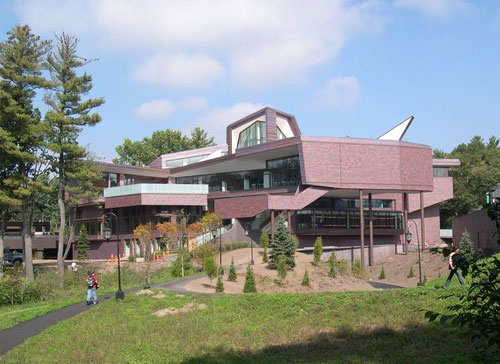
The new campus center, designed by Atlanta firm Mack Scogin Merrill Elam Architects, its into the larger campus master plan as envisioned by Michael Van Valkenburgh Associates and is part of a larger plan which includes physical plant facilities and a parking structure as well as a large landscape rehabilitation project. The design for the building and landscape seek to be derived from the values which are already embedded in the land as well as to make physical Wellesley's guiding principles.
Programmatic distribution should be as much about experimental, spatial and processional variety as functional adjacency. The building is made of "un-owned" spaces.The design strategy was to conform to the historic precedents of the campus while creating spaces of discovery and experimentation. The form of the building is derived from the college's multiplicity of values: emphasizing and celebrating the natural topography of the site, creating connections to the campus' multiple hubs, and serving as a beacon.
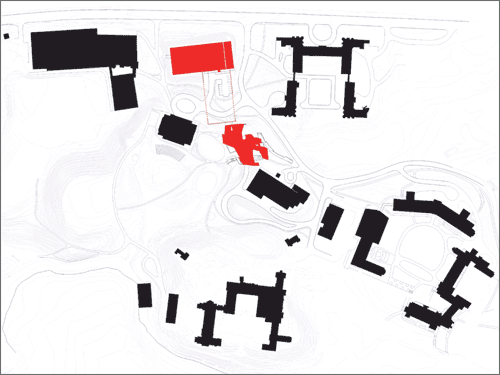
LOCALIZED CAMPUS PLAN; WANG CENTER MIDDLE, PARKING STRUCTURE TOP
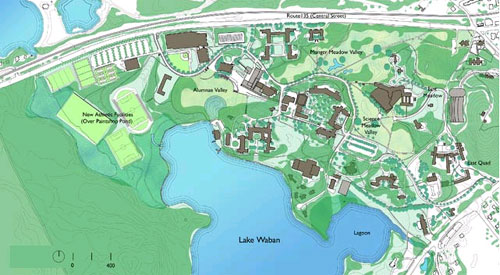
CAMPUS MASTER PLAN BY VAN VALKENBURGH ASSOCIATES. WANG CENTER SITE AT "ALUMNI VALLEY" (MIDDLE LEFT)
INTERIOR RENDERING, MULTIPURPOSE SPACE
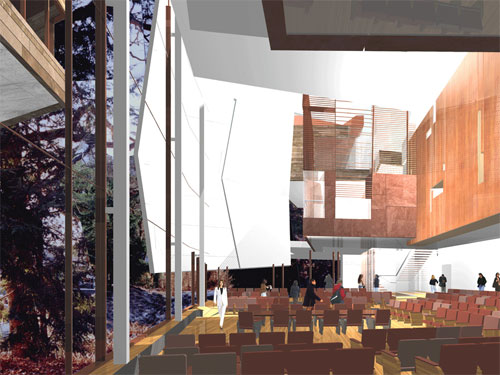
INTERIOR RENDERING, CIRCULATION SPINE/STUDENT ORGANIZATION STORAGE CABINETS
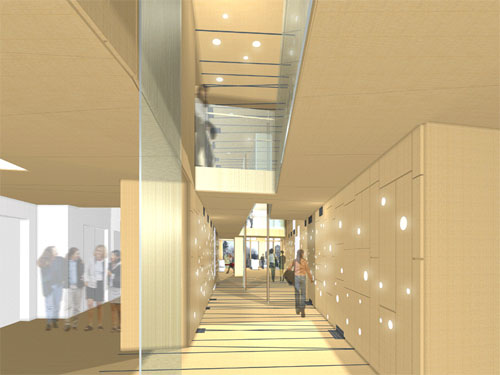
The Wang Center connects to the landscape at multiple levels. The program for the building includes a bookstore, a pub, a cafe, mailboxes, multipurpose function rooms, meeting rooms, space for student organizations, a dining hall, convenience store, exterior terraces and numerous study/social nooks.
One this is for certain, this building is all about context. In any other location, it is a catastrophe, but here it fits perfectly.
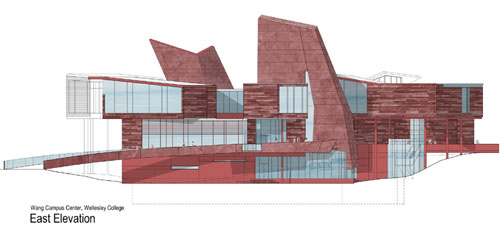
EAST ELEVATION
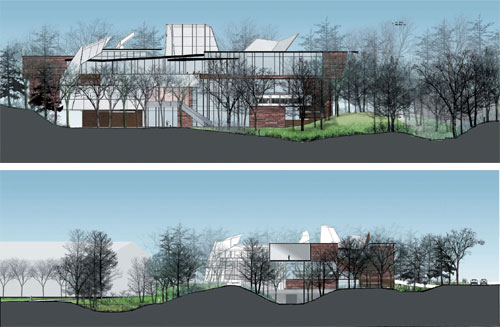
TWO SITE SECTIONS BY VAN VALKENBURGH ASSOCIATES
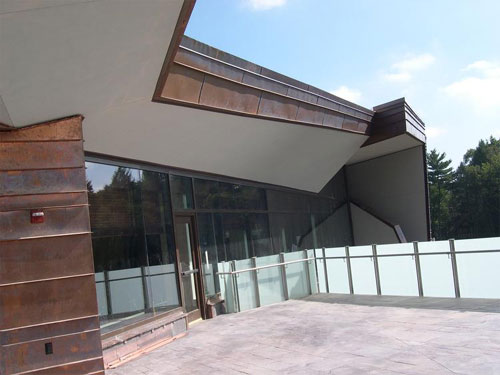
TERRACE
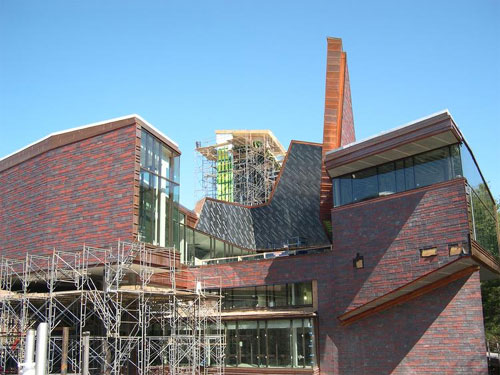
UNDER CONSTRUCTION
View Land+Living Maps in a larger map
similar to Clark U's Goddard Library