

A modern, organic parterre garden
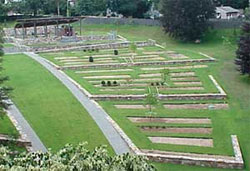 An expansion of Harvard University's Arnold Arboretum designed by Frederick Law Olmstead, the Leventritt Garden was designed by Reed | Hilderbrand Landscape Architects with Maryann Thompson Architects to display a diverse array of sun-loving ornamental shrubs and vines.
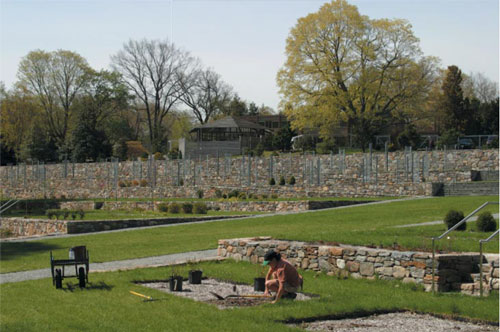
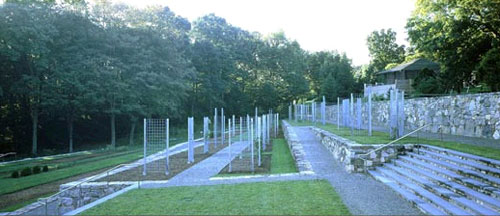
The garden site is approximately 4 acres and features an elevation change of nearly 30 feet. A system of non-reinforced three foot thick stone walls were implemented to create a series of garden terraces which provide level ground and an organizational system for horticultural display. The design is evocative of tradition of agricultural landscapes as well as French parterre gardens.
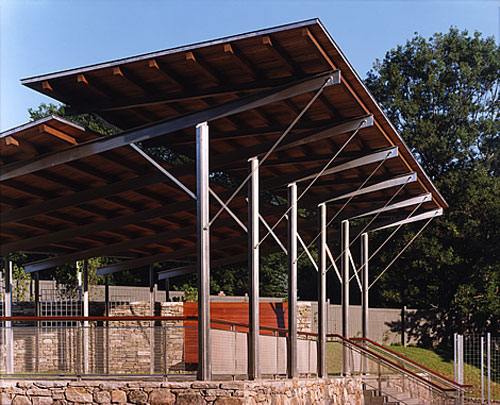
An open-air pavilion built of brushed stainless steel, tongue and groove cedar, and lead-coated copper sits atop the banks of terraces as a focal point and garden overlook. The pavilion and surrounding steel panels provide climbing surfaces for flowering vines.
Link: Leventritt Garden
Firm: Reed Hilderbrand
Firm: Maryann Thompson Architects
Link: Ordering and Terracing in the Leventritt Garden (pdf)
Link: Shrubs and Vines for the Leventritt Garden(pdf)
Here we found a convergence of horticultural science and landscape design that evolved into a unique expression of program and site.
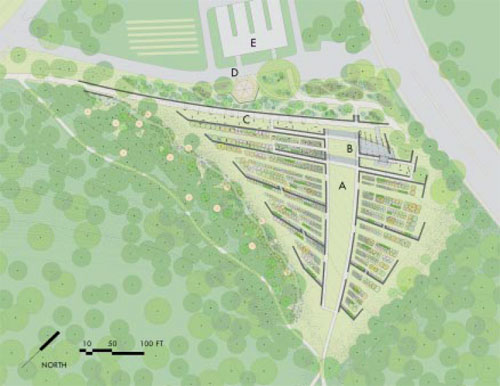
Seen from the vantage point above the garden’s main terrace, the scheme is expansive and directional, with the site’s roughly triangular shape emphasizing an arcing lawn and path that gesture back toward the Arboretum’s open lawns and pervasive canopy trees.
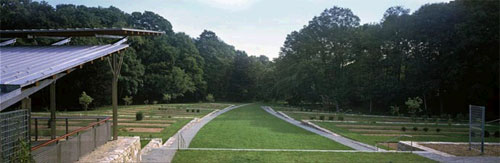
Yet when viewed from below, as the true breadth of terraces and masonry walls becomes more apparent, the scheme’s dual nature is realized: it is both a traditional terraced display and an active, modern sculptural form whose essential expression is derived from the site’s specific conditions.
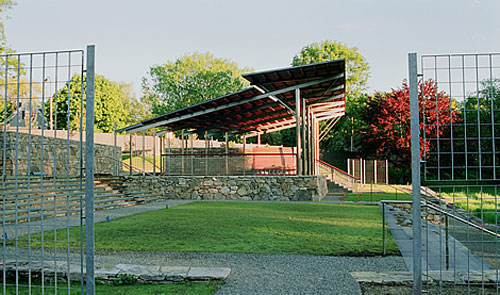
The juxtaposition of the wood elements with the stainless steel allows for a reading that is both modern and vernacular, both clean and textured. The pavilion's columns and beams rise from the earth with a natural economy of means, while its system of struts and cables suggest an architectural interpretation of the tendrils of climbing vines. The geometry of the column lines shift in plan and section, at once veiling the entrance to the pavilion, then opening the space dramatically out toward the gardens.
View Land+Living Maps in a larger map