

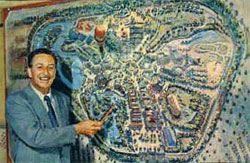
 Disneyland is not regarded fondly by the architecture and design community at large with it's faux castles, jungles and streets and oversized rubber-headed rodents gallivanting about. But there is no denying the genius of the planning concepts and methods pioneered and honed by Walt Disney and his "Imagineers" and the impacts that their work has had not only on American and international cultures, but also on the design professions.
At Disneyland, designers created the first physical space conceptualized as an interactive experience using cinemagraphic story telling devices to choreograph the free movements of visitors through a three dimensional fantasy movie. Sequences of spaces and transitions were carefully planned to combine disparate elements into a cohesive whole.
An article in the LA Times talks a bit about the influence of the park on everyday places such as malls and revived downtowns, "lifestyle centers" and other places where the distinction between fantasy and reality has been blurred beyond the gated and bermed Magic Kingdom.
Article: LA Times - A Park With a Powerful Spell
Link: Wikipedia - Disneyland
Link: Disney corporate history - Disneyland
Link: Disneyland Beginnings
The late architect Charles Moore was the first avant garde deisnger to look seriously at Disneyland as a design model with his 1965 essay "You Have to Pay for the Public Life" in the Yale journal Perspecta 9/10:
By almost any conceivable method of evaluation, Disneyland must be regarded as the most important single piece of construction in the West in the past several decades. The assumption inevitably made by people who have not yet been there -- that it is some sort of physical extension of Mickey Mouse -- is wildly inaccurate. Instead, single-handed, it is engaged in replacing many of those elements of the public realm which have vanished in the featureless private floating world of Southern California, whose only edge is the ocean and whose center is otherwise undiscoverable. Curiously, for a public place, Disneyland is not free. You buy tickets at the gate. But then, Versailles cost somebody a lot of money, too. Now, as then, you have to pay for the public life.
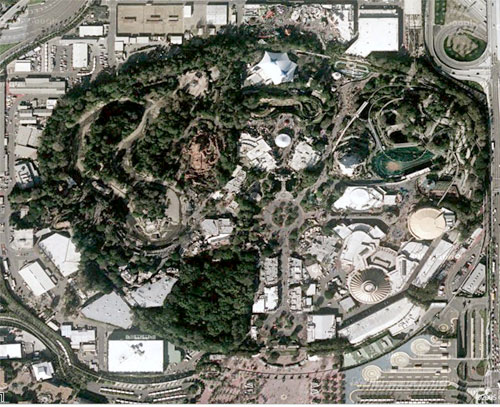
Satellite image from Google Maps