

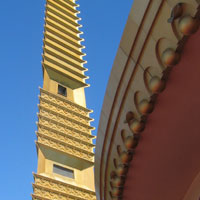
 I mentioned previously that I became engrossed in research while putting this together. The most fascinating find on the web was Frank Lloyd Wright Resources (linked below) page hosted by the Marin County Library. This page includes a nice historical brief, photo gallery including images of the design and construction process, a project chronology and a listing of FLLW resources in the library's collection.
But what enthralled me the most was the voices of the Civic Center page which features clips in mp3 format of speeches by Frank Lloyd Wright from 1957 and 1958 and interviews with other architects, politicians and journalists who were involved with the project.
Before Wright's death on April 9, 1959, he had finished the supervision of drawings for the main building and the master plan for the site. In this section we will finish our exploration of Wright's design, and take a look at some of the changes and developments after his passing.
A stunning photo by William Allin Storrer depicts and early view of the Hall of Justice. The photo captures a landscape in keeping with what Wright had experienced before additional landscaping and trees were added to the site.
Link: Marin County Library FLLW Resources
Photos: Lee Sandstead
Photos: Picture the Scene
Photos: Digital Imaging Project
Photos: Digital Imaging Project (Post Office)
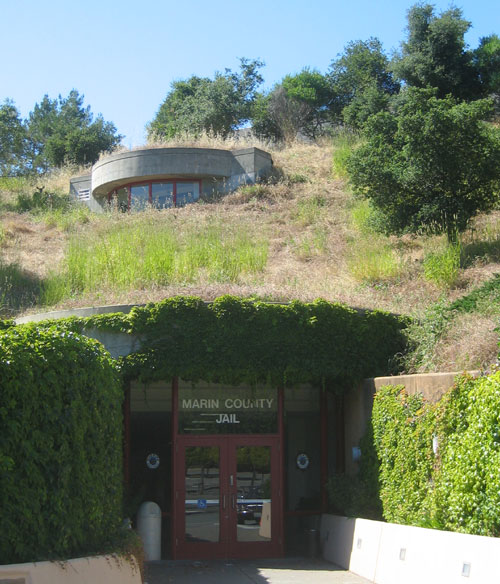
Notice (below) how the hillside in the photo above has been lushly planted with trees, in part to obscure an added jail facility.
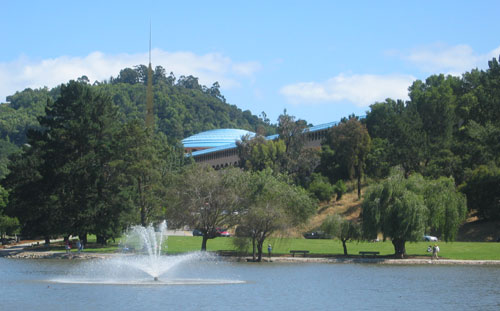
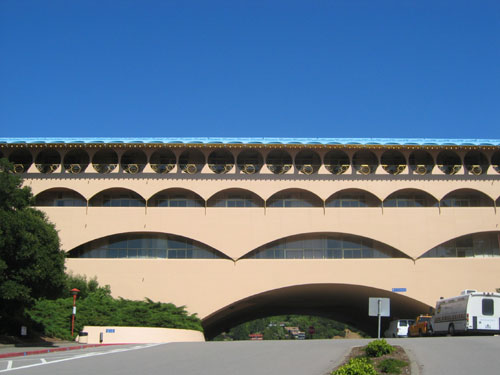
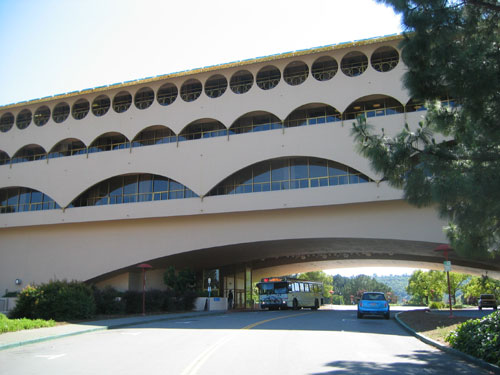
Apposite to Wright's fascination with the automobile and his vision for democracy, the building is designed in many ways to be experienced by car; viewing from the highway, moving through the site and actually passing beneath the building. This movement of Marin's citizens in and around the building emphasizes its accessibility. The entrances to the building are located beneath the three ground level arches.
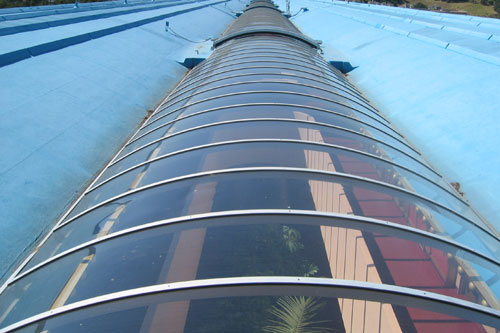
In addition to the change of roof color previously mentioned, another change to come after Wright's death was to add a skylight structure over the interior atrium.
In recent years, the building has also been retrofitted for seismic safety. Despite Wright's claims that the building was "earthquake proof," its resistance to lateral loading was insufficient.
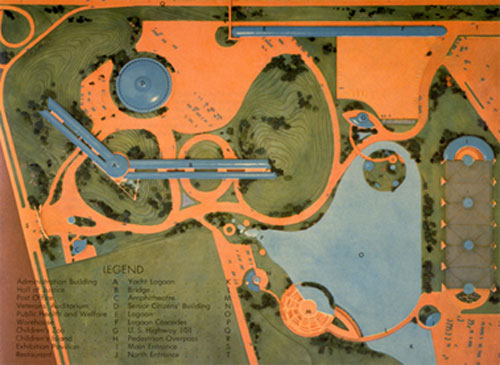
The only buildings which Wright proposed which were fully developed and actually built are the Halls of Administration and Justice, and the Marin County Post Office.
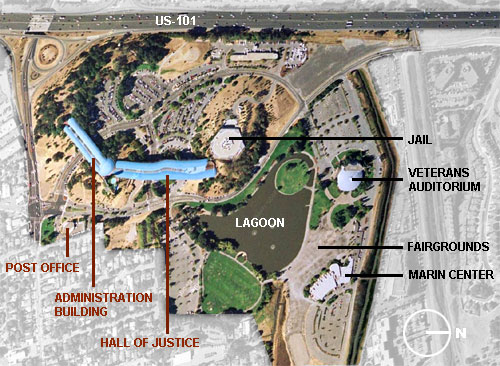
The Veterans Memorial Auditorium designed by Wes Peters of Taliesin Architects and Aaron Green (who was an associate of Wright's and had been involved with the Civic Center since its inception) is smaller than the auditorium proposed by Wright. The location for the larger auditorium is now occupied by a circular parking lot (seemingly holding its place), while the smaller Veterans Auditorium was located at one end of the fairgrounds where Wright had indicated a semi-circular structure at one end of the proposed county fair pavilion. Renderings for this pavilion indicate a large tented structure supported by pyramidal pylons.
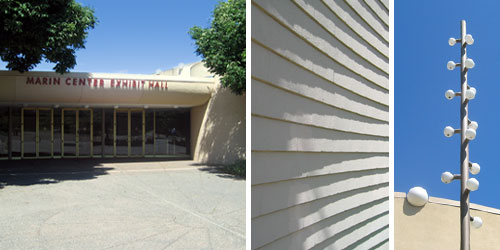
While based loosely on elements developed during the design process, Taliesin Architects devised a different solution for the Marin Center Exhibit Hall and fairgrounds. While the placement of the Auditorium is consistent the original plan, the remaining structures and site developments deviated markedly from Wright's master plan, and the execution of the buildings is of noticeably lesser quality.
Recently, Marin County has proposed to redevelop the Marin Center and Fairgrounds area. The planning process is documented on a website for the Marin Center Renaissance project. The design team consists of Mark Cavagnero Associates and Royston Hanamoto Alley & Abey.
The Marin County Jail was designed by DMJM with planning input from Aaron Green and William Schwarz. The building, completed in 1994, is adjacent to the Hall of Justice but is mostly buried within the northernmost hill so as not to detract from the Wright designed building.
Pfeiffer, Bruce Brooks. Frank Lloyd Wright in the Realm of Ideas. Carbondale: Southern Illinois University Press, 1988.
Gebhard, David. Romanza: The California Architecture of Frank Lloyd Wright. San Francisco: Chronicle Books, 1988.
Additional sources:
Dunham, Judith. Details of Frank Lloyd Wright: The California Work, 1909-1974. San Francisco: Chronicle Books, 1994.
View Land+Living Maps in a larger map
Wright Wedding