

 I participated on a jury for a USC landscape architecture studio as I mentioned a couple of weeks ago and had intended to do a write up last week. But (in addition to just being busy) I soon realized the challenge that lay before me as I began to sift through the notes and images that I have compiled.
The problem: how to do justice with limited time and space to all of the hard work of this group of students? Since I have already had my chance to "review" them, I will refrain from offering too many comments and will instead provide a gallery of their work.
The studio was entitled BrownLAb: Wunderkammer @ the Yellow Car Maintenance Yards. The project location is a brown field site in south Los Angeles, a former maintenance yard for the defunct Yellow Car rail transit network. The industrial functions of the facility over the years have left the site contaminated.
Currently, the site is underused but does serve several functions. The MTA uses some of the remaining maintenance buildings on the south edge and a school for "at-risk" students occupies the north west portion of the site. The most active function of the site is a swap meet on the north eastern edge which functions as a community gathering place for the surrounding neighborhood.
Seeing student work is refreshing. Unlike the majority of my work in the "real world," it is all about the process of design, analysis and presentation. The limitations on creativity are basically nonexistent. David Fletcher and Tom Leader created an outstanding studio project and environment; the resulting student work was well developed and intriguing, the product of collaborative investigation and individual design development.
The students analyzed the site; the history of the Yellow Car system, use, contamination, urban and regional context, socio-economic data, etc. The combined research and data was compiled in a template format of 11x17 pages which were laminated and traded around the studio during the course of the project. These pages were plastered on an entire wall at the review providing the jurors with a wealth of background information.
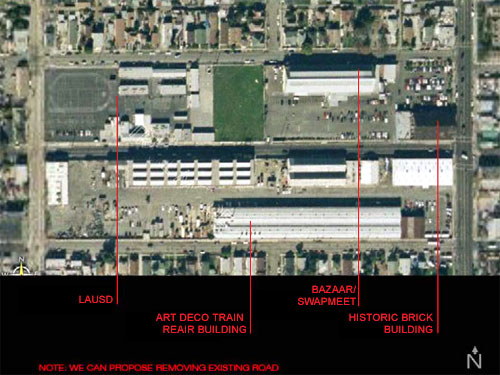
EXISTING SITE CONDITION
Studio Brief
The contingencies of remediation timelines, changing technologies, uncertain economics, and fluid politics demand an alternative to common Masterplanning processes which typically suggest a final project or vision which remains inflexible to variation. Also, the public is typically not involved in the remediation process. Such and approach tends to amplify negative perceptions of a place, reinforcing a communities geo-psychological disconnect from a site and it's potentially instructive histories.Our goal is to suggest alternative approaches to site healing and to approach remediation and redevelopment from social, cultural, historical, ecological, artistic and environmental perspectives. The focus of the brownlab is to create a forum to investigate remediation technologies and to apply them to a redevelopment. Here, the redevelopment strategy is used as a vehicle for engaging communities, ecologies, and stakeholders, for changing perceptions, for initiating processes of transformation that unfold over a period of years, beginning with remediation. Strategies should balance aesthetic, environmental, cultural and economic needs. They would lay the groundwork for extensive private reinvestment, allowing for business expansion and redevelopment while suggesting innovative, yet not untested ecological technologies that can solve infrastructural needs while improving environmental health, social/recreational opportunities, and site image.
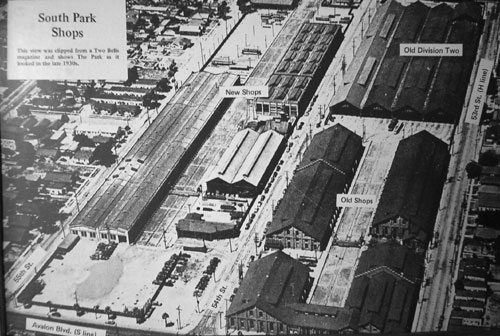
HISTORIC VIEW OF SITE
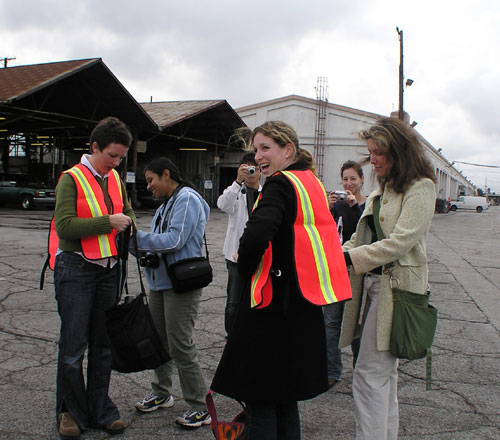
SITE VISIT
The studio participants were: Claire Cottrell, Veenu Jayavam, Erin Lau, Catie Lee, Catherine McLaughlin, Jillian Morgan, Amy Morie, Ray Nagahata, Harmil Raikhy, Kay Sales and Naomi Sanders.
So, finally, the student work I have been promising, in alphhabetical order (2 here, more to come).
Claire Cottrell
Garden Cinema
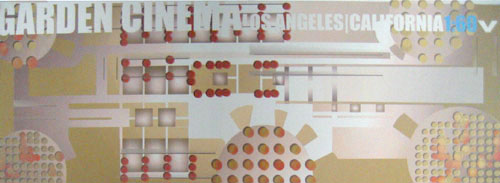
SITE PLAN
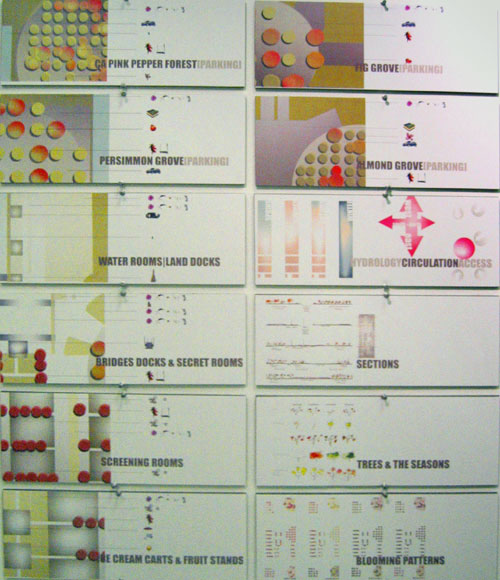
Claire’s proposal for the site was as a community park by day and an activated gathering place for film by night. The roofs of the structures would be removed to facilitate remediation, and the walls would be left as a framework for the landscape and as projection surfaces.
Groves anchor the corners of the park and create points of entry. Rows of corral trees within the concrete walls help define the "screening rooms." A large rectangular retention pond at the center of the site seasonally collects runoff. An ephemeral zone of commerce, providing an armature for the vending carts and wandering merchants who occasionally occupy the existing swap meet, is also defined.
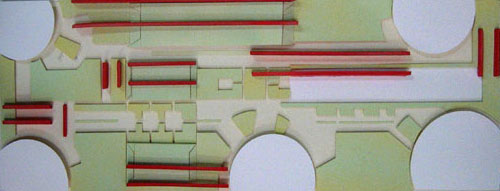
SITE MODEL
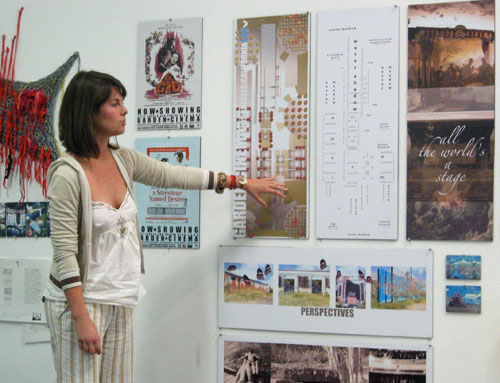
PRESENTATION
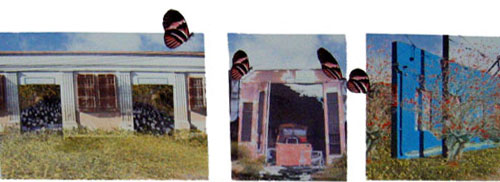
PERSPECTIVES
DESIGN ELEMENTS
Veenu Jayavam
SITE MODEL
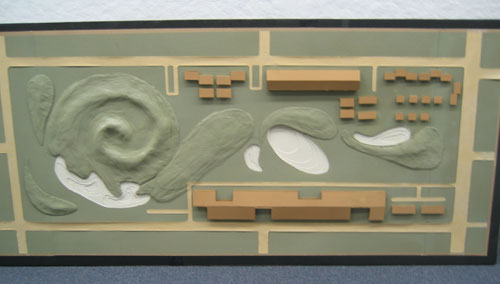
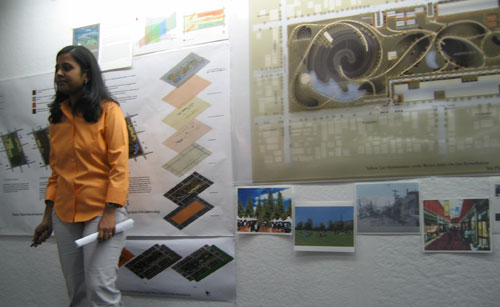
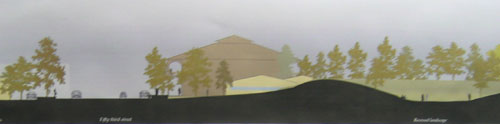
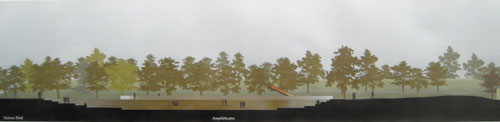
Veenu envisioned the site as primarily an open space, an ecological habitat in the city. The secondary functions of use would incorporate the exisiting swap meet with an expanded commerce zone for store spaces as well as transient functions such as a farmers market. The existing maintenance facility would be used as a technical institute. A series of "kiosks of historical refernce" would be spread across the site to provide educational information.
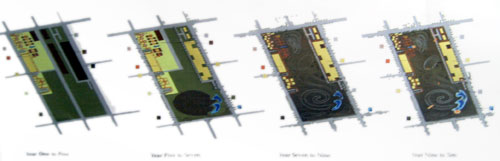
The landscape would be sculpted as part of the remediation process, creating landforms layered organically (like lava flows) onto the site. An amphitheater would be carved out between the structures at the center of the site, and a water retention pond would be created on the western edge.
PHASING DIAGRAMS
 SITE SECTION (fragment)
SITE SECTION (fragment)
positive impact