

 Sometimes it doesn't matter what opinion I may hold when I read gibberish spewed by someone feigning authority. Mind you, I am not a journalist (most traditional journalists would be quick to point out that journalistic shortcoming of blogs), but I am an educated professional with experience, opinions and knowledge that give me some background from which to judge the worthiness of an argument within my field. I have read the opinions of many educated opponents of New Urbanism that I can respect, but an article published Sunday in The Orange County Register written by Steven Greenhut is not among them.
Now, I do not consider myself an expert in New Urban theory, but I do think that Mr. Greenhut is grossly misinformed. Or perhaps he just enjoys lighting a fire and fanning the flames. At any rate, he misses the concept that New Urbanism promotes a mix of housing types and income levels and that the principles can be applied to lower density situations. Mr. Greenhut has bitten off more than he can chew... and indeed more than can even be responded to in this format. Never the less, let's take an abbreviated look, shall we?
Article: Orange County Register - City planning by Those Who Know Best (reg required)
Link: BugMeNot.com (get a username/pwd here)
Link: Congress for New Urbanism
Link: NewUrbanism.org
Let's start with some common ground. Mr. Greenhut is not a fan of "faux-downtowns," and neither are we (see: 1, 2, 3, 4, 5), but it is ridiculous to pin this trend squarely on New Urbanism. This is a much larger topic than can be addressed and understood here, and it is really a superficial swipe used to bolster his opinion. So, I'll swipe back just as quickly and move on.
Mr. Greenhut implies that New Urbanism somehow threatens single family residential neighborhoods. I challenge him to point out an instance where New Urbanists are proposing to replace a single family residential neighborhood. This would be news to me, and I would be very interested in any information he could provide. Mr. Greenhut also indicates that New Urbanism prices young families out of neighborhoods. Yet Orange County with it's current brand of sprawl has the highest median home prices in Southern California. So really it is the shortage of housing opportunities within an healthy region that drives up housing prices. Wouldn't it be desirable to provide other housing options and to increase the supply of housing as New Urbanists would promote?
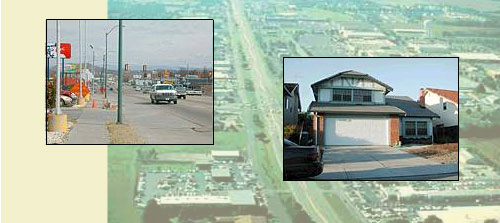
The American Dream?
True, New Urbanism promotes density, but Mr. Greehut and other detractors speak as if a neighborhood of detached homes and a suburban way of life are going to be replaced with dense urban blocks and city living, His entire article seems to be a knee jerk reatcion to the word Urbanism. They somehow missed the other stereotype of New Urbanism: the white-picket-fence neighborhood stereotype. Have they never heard of Seaside, Florida? Despite the spin, New Urbanism is about a range of housing options and densities.
Interestingly, Mr. Greenhut points out Fullerton as an example of what is right in Orange County, resembling "an old Midwestern city." So what he is saying is that Fullerton displays characteristics that New Urbanism supports. New Urbanism is based on the historic precedents of Midwestern American towns as much as it is based on more dense European city models. New Urbanism provides forms and solutions that are appropriate to different situations, though Mr. Greenhut ignores this fact. A quick browse through the Congress For New Urbanism’s project list lays waste to his contention that "core of the New Urbanist thinking... emphasizes high-density urban living and eschews the supposed wastefulness of the car culture." He seems to think somehow that New Urbanism is only about dense cities and about abolishing cars.
This is a common argument among opponents of New Urbanism, but it just doesn’t hold up. True that New Urbanism has experienced much success in urban environments, but that is not all that there is to it. New Urbanism is more about providing options of living and lifestyle. And yet Greenhut says that "New Urbanists never mention the word freedom." Wouldn't choice of living style, a choice of housing types and a choice of mobility be freedom?
He also says that New Urbanists "are consumed by the form of a city, without thinking about the people who inhabit the communities they seek to reorient." Funny that New Urbanist form is exactly about providing human scale and inhabitable spaces.
Mr. Greenhut points out the charming and unique places in Orange County like Laguna Beach and San Clemente, at Old Towne Orange or downtown Santa Ana. Once again, these places most closely resemble New Urbanism which for some reason he wants to fight. In reality, New Urbanism is quite different than what Mr. Greenhut supposes, and his offhanded comparison of New Urbanism to urban liberalism is weak.
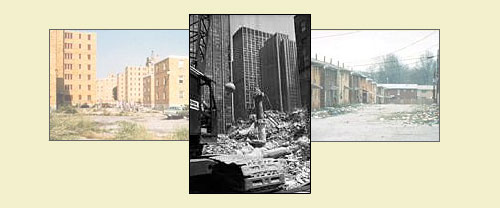
1960's "Urban Renewal"
New Urbanism very different than the modernist planning and social engineering practices of the 1960's, in many ways New Urbanism is the polar opposite. Not to mention that the failure of modernist planning was influenced by many other factors including policies of the US Government dating back to the early 1900's. This is far too deep a topic to breeze past and provides no useful backing for Mr. Greenhut's argument.
Whether Mr. Greenhut realizes it or not, there must be some kind of plan for dealing with the issues of growth and demand in a vital region. Some kind of planning will be "imposed" but he provides no alternatives other than opposition.
low income housing
Undesirable housing?
N.U. & SoCal