
Land+Living
Land+Living
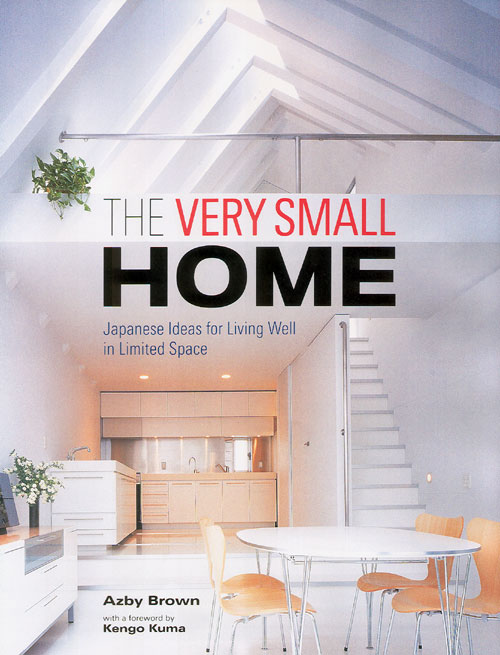
The Very Small Home
Japanese Ideas for Living Well in Limited Space
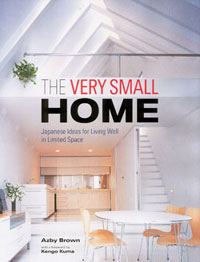
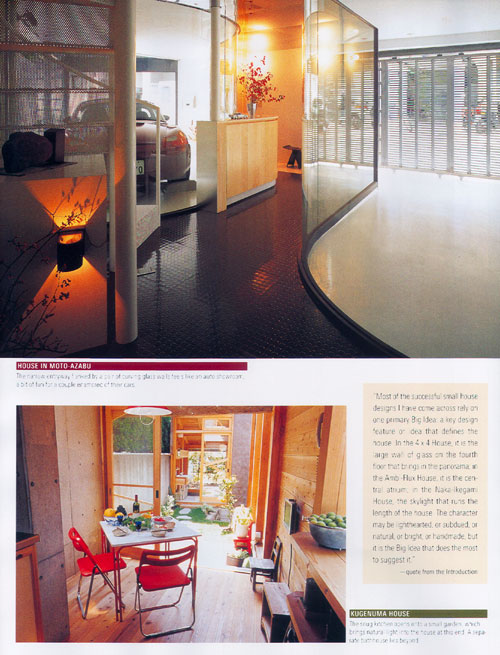
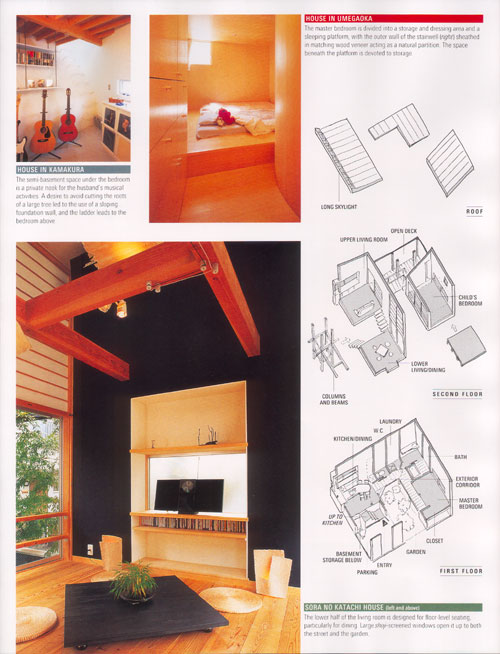
Ever since I picked up a copy of the Slesin book Japanese Style back in the early 90s, I have been a huge fan of Japanese design. Japanese homes are the epitome of compact and efficient design and in Azby Brown's forthcoming book, The Very Small Home, he explores the attitude in Japan towards efficient and functional design. Needless to say, you won't find any McMansions here. Projects in the book range from traditional and handmade to futuristic.

Urban living space in the west is becoming increasingnly crowded; conditions that the Japanese have coped with, and their architects have gained much experience dealing with, for quite some time. Japanese design patterns are bound to be adopted by Western architects and this book makes a point to showcase some of the finest small home design that Japan has to offer.

Release Date: May 2005

Link: Amazon
Author: Azby Brown
Publisher: Kodansha International


 Comments (42)
Yankee Abroad  — February 12, 2005
half-truths
Ask any American expatriate living in Japan, China, or South Korea about the apartments/houses/buildings there and they will tell you some sad stories. Most Northeast Asians live in cement block monstrosities. Stalinist grey, drab, utilitarian and mind-numbing uniform. Probably the uglist cities in the world are located there. The majority of Japanese have no style. Walk into the average apartment and you'll find cheap consumer goods, Western knock-offs and cramped conditions. Same for Korea except worse. "Japanese design patterns are bound to be adopted by Western architects" Yeah, right! 1,001 Uses for Cement. More cement! More cement! Read "Dogs and Demons" by Alex Kerr.
back to top ↑
Anthony  — February 13, 2005
If you say so.
I've never traveled to Japan so I can only comment on what I've seen in books and magazines. Maybe I'm just a fan of concrete but regardless, in my opinion, I've seen some pretty damn creative uses of the this "drab" material. To each his own, eh?
back to top ↑
Blair Crawford  — March 3, 2005
The Small Outdoors
Travelling in Asia I've seen children sitting at windows in high rise apartments, rocking from side to side to express energy. I am intrigued by the impact on Chinese, Japanese families of having no outdoor living spaces. I came across this blog while researching a business idea for outdoor furniture for high-rise balconies - seats and trellises, garden frames for growing herbs and some vegetables. Has anyone (who might read this comment) come across instances of Asian people attempting to use balconies for anything other than drying the laundry? I would be interested to know.
back to top ↑
Kati  — March 11, 2005
Concrete block living spaces in Europe
I've never been in Asia, so i can only imagine that those concrete monstrosities are the same ones that the Soviet years blessed the Eastern European bloc countries with as well. Almost every town and city in my country, Hungary, including the beautiful Budapest is circled by huge areas of high-rise (only 10-12 storeys, but in E-Europe, that is considered a high rise) concrete bloc monsters, entire suburbs even. From many points on the hilly side of Budapest, there is a beautiful view, you can see the whole city under your feet, but these buildings provide such a contrast to the original and even the modern architecture of the city and the nature around it, it's horrible. And to make matters worse these buildings were built with toxic and cheap materials, so the government now has to spend zillions of Euros to make them livable for a few more decades, when noone knows what is going to happen to these buildings and the people living in them. But to be on-topic: the pictures in this Japanese design book are beautiful and esthetic. I guess they don't have anything to do with the living conditions of 99.55% of Asian residents. This is about 'haute' design and not mass living conditions, and i don't think we should denounce the book for glorifying concrete montrosities, because it doesn't talk about those homes at all. This book -judging by the small taste i got here- is about higher-end design of living spaces, and for that, it looks good and interesting. From the amazon product page: "Particular emphasis is given to what the author call the Big Idea (...). Among the Big Ideas introduced here are ingenious sources of natural light, well-thought-out atriums, snug but functional kitchens, unobtrusive partitions, and free-flowing circulation paths." You won't find these big ideas in monstrous concrete high rise developments...
back to top ↑
sumchee  — March 14, 2005
different expectations
we don't wear our shoes in the house. >> The majority of Japanese have no style. Walk into the average apartment and you'll find cheap consumer goods, Western knock-offs and cramped conditions. Same for Korea except worse.<< do i hear a big shot showing of his big spacious house with expensive goods and pretentious lifstyle. how do you people not dirty the house wearing your shoes all over the place. bathroom. bedroom. weird.
back to top ↑
karena  — March 29, 2005
Another Ugly American
>>The majority of Japanese have no style. Walk into the average apartment and you'll find cheap consumer goods, ...<< I am a designer and I lived the expat life overseas (Asia and England) for 15 years. I feel compelled to say that most people--whatever their nationality, wherever they live--need help in the design/style department. Including Americans. Why do you think "design" shows on TV are so popular here? What's with the false superiority trip?
back to top ↑
expat  — April 2, 2005
The majority of Japanese . . .
As an American expat now living in Europe, I would say that the vast majority of Americans have no style. Now that my palate has been cleansed, so to say, by living here for a while, I can see American taste for what it is -- hokey and junky!
back to top ↑
bjb  — April 4, 2005
sponge painting and faux patinas
title says it all. agreed, american taste is scary,and as much as I loved Europe (engineering, style, quality, food), they have tacky people/design too. the phrase euro-trash didn't come from nuthin'. I'm new to this site, so haven't read all the posts, so perhaps I'm repeating a post, but has anyone read Not So Big house by Sarah Susanka? kind of a backlash against starter-mansions and advocates excess in homes to be traded for quality. hmmmm.
back to top ↑
dee hoffman  — April 14, 2005
Much too smaLL house
Loved and got great ideas from all three Two Big books. I wish builders agreed with Sarah's premise. I am trying to build a wonderful little house that contractors label too small ....which I take to mean not profitable enough for the builder. Now it seems even the pre-fab houses are getting bigger. With all the baby boomers and singles retiring one would think smaller homes would be a logical choice. Did you see the size of the the upcoming Dwell House? Peace!
back to top ↑
RAF  — May 15, 2005
Scale
Living on an island in New Zealand, one meets many boatbuilders from around the world, who built their boat then spent years sailing here from somewhere up north. For them a "very small house" is a huge luxury. Scale is relative... try a conventional sloop for a few years. The value of Japanese design is not how its masses live (which is western derived like the business suit), but the traditional design principles, which can be adapted by anyone. Light-weight furniture and daily accessories which are stored in the closet-room-walls allow one to live elegantly in one or two rooms. The principles of nature brought in keep one sane even when in dense urban living. In our experiments, we found 10 m2 (100 sq ft) to make a wonderful home, provided it was built in a "T" shape with a high ceiling and a sleeping loft (built on a slope) over the entrance/1-person cafe table.
back to top ↑
sad.  — May 16, 2005
sad.
"The majority of Japanese have no style...Same for Korea except worse." Being in style depends on the person. Those views change depending on where someone comes from and the environment that person was raised in. What does it mean to be stylish anyways? Making everything from expensive materials? That is so American. Living in luxury, always 1st class with their shoes on in the bathroom (oops, dog poo?). Japanese people use wood a lot, not cement. I would like to see how you make a tiny space, "stylish".
back to top ↑
Larry Tremblay  — June 9, 2005
Concrete can be beautiful
The Communists/Socialists/Leninists (take your pick) gave concrete a bad name for all the reasons cited here. But please check out what has been done by Frank Lloyd Wright and other visionaries who actually have taste and talent. Concrete can be quite beautiful. Also see what is being done today with concrete interiors - countertops, decorative castings, etc...
back to top ↑
bricks r4 pricks  — June 26, 2005
cement rocks!
I have seen a bathroom made entirely of rendered-polished cement with intentional faults and cracks added in for a little bit more dramatism. I am sure the idea of having a non-tiled bathroom conveys on most a sense of deprivation, poverty, unwanted spartanism. Not so. It is to date one of the most striking batrhooms I have ever seen. Cheap and extremely effective. It turns the bland, fluffy bathroom interiors into a total design piece, and it costs next to nothing to do. The bathtub was also rendered, polish cement, by the way. I think the material rocks and it is the modern equivalent to mud. As per my own experiences in Japan, for a Unitedstatesian to call a Jap classless it is quite a statement. Because we do take offense of calling yourselves 'Americans' when they are Americans sharing the continent that are fare mor styilish than U guys are. Hop on your SUV and drive off you guys.
back to top ↑
reality  — June 26, 2005
is this a joke?
To lump North Asia as a whole is really very very silly. Having just worked in the various countries mentioned (Japan, Korea, China etc) and the Asia region for a decade, even a nobody like me can see that Japan is "light years" ahead of Korea, China and the West (though not Scandanavia) in its style quotient. As a non design person, for the first time in my life I thought design was important. That was because of a recent trip to Tokyo. Also, cramped conditions are usually a matter of economics and not style. To suggest otherwise is to be disingenuous, and silly. Me thinks this was written by someone working in Korea or China, definitely not someone who has walked around Tokyo. Discriminate when you read such opinions.
back to top ↑
Niko  — November 15, 2005
Emulate Asians NO WAY
Japs and other asians marvel at the beauty of Australian and European cities. Asian cities by comparison are shit. There is comfortable and there is very small, which would you have? True some Australian homes are over the top big but 90% are just right (200-300sqm). No use attempting to copy the jammed conditions of Japs and other asians.
back to top ↑
marketekt  — November 15, 2005
Wu Tang Says:
Konnichiwa, bitches!
back to top ↑
John Watts  — February 2, 2006
Solve Homelessness
Why not take advantage of the innovative use of very small spaces to solve the problem of homelessness? Rather than a large homeless shelter, how about a space about the size of a small closet containing just enough room for a small bunk? The person inserts a small plastic card provided by local government or a charitable organization. The space opens. The person enters and spends the night. In the morning a timer causes the space to open and the individual moves on. The amenities inside could be very complete with regard to heating, air conditioning ventilation, depending on resources available. Why not? We need innovative thinking with regard to resolving homelessness and the design of very small spaces may be part of the answer.
back to top ↑
diana  — February 3, 2006
re the Solve Homelessness: here in crowded NYC, the problem with homelessness is not lack of homes but mental illness, substance abuse, and other social problems. NYTimes just had a story about bohemians in Brooklyn renting out a mattress in their loft space for $35 a month. Were they considering a homeless person? of course not -- potential takers were bohemians like themselves, who were considering the mattress offer so they'd have more time available away from their day job for their music, etc. I like your idea of innovative bunk spaces, but we'd just be providing white middle-class kids with more time for their art. It wouldn't solve the problem of the schizophrenic who doesn't care that he's sleeping on the street in filthy clothes because he thinks his real problem is aliens firing brain-rays at him. In the 80's we had a squatter movement here in the East Village, many of whom claimed that squats would solve the homeless problem. The squatters were overwhelmingly white and quite often graduate school dropouts -- the real homeless were living in tent cities in Tompkins square park and wouldn't live in the squats because that was illegal, even though the squatters tried to recruit them. The city ended up selling msot of the squats to the white squatters for a $1 a building and the police chased the black homeless out of Tompkins square park as part of Giuliani's gentrification program. So it goes.
back to top ↑
John O'Grady ivanogradiev@eart  — February 12, 2006
Homelessness Solutions
Yes, having been homeless myself for over 9 months, and having lived in the Tenderloin of San Francisco for many years, I can assure you that many of the people who are homeless have many BIG problems. My solution is to have semi-trailers, outfitted with mattresses, AC/heat, and outside of the trailer, portable toilets/showers. These trailers could be placed wherever the political winds blow, and would allow the most vulnerable and hopeless among us a place to sleep at night. Inside the trailer itself, there would be boxes, 4x4x8 ft., one on top of the other and side-by side, running the length of the trailer. They would be on a slight incline toward the entrance to the box, so they could be washed out during the day. They would have small, waterproof mattresses inside them. The truck would arrive at the appointed hour, the 'guests' would enter, and in the morning, they would be awoken, and sent on their way. Then, the truck would depart also, possibly to a depot where other trucks like it would be cleaned and prepared for the next evening. Various charitable organizations could be alerted to this routine, and could be on hand in the evening and the morning to provide food, medical care etc. I have more ideas, but this is one of the basic ones.
back to top ↑
Suzanne  — March 14, 2006
Use of outdoor balconies
In response to a post/question by Blair Crawford (The Small Outdoors). Take a look at this experiment, in Montreal, last summer. http://english.rooftopgardens.ca/?q=image/tid/24
back to top ↑
tarun  — April 25, 2006
just 25 sqr.foot
how do we make it very beautifull
back to top ↑
ken  — June 8, 2006
not ture?
I lived in Japan and China for several years, and I have to say that though there was some og the gray depressing buildings that you talk about, by no means was that the norm. I had no problem finding modern, bright, clean, though compact places to live. Singapore was one of the finest places to live that I have ever been, certainly the cleanest city. Taipei also has many very nice places to live. There is no shortage of style in the far east.
back to top ↑
Paul B  — June 14, 2006
In dwelling, live close to the ground
My first blog and I am thouroughly entertained! I came upon this site trying to decorate my really small home in Irvine, CA USA. Live and Let Live. Our world is getting too populated and we need to find a kind of peace in our dwelling. Small or large, our dwelling must allow us to connect with what is important to us. For the japanese, this is a pure art, when the warrrior steps forward. For the lazy, its chaos.
back to top ↑
Tom Sandonato  — June 29, 2006
kithaus
Just wanted to share our small house. Made in America.Some assembly required. http://www.kithaus.com/
back to top ↑
charles in seattle  — July 3, 2006
perspective
form indeed follows function and small can certainly be as functional as large. ...interesting to see all the defensive reactions to only one crank entry. Let's just hope he stays abroad.
back to top ↑
barbara in brisbane  — July 21, 2006
beauty is - concrete is
yoshinobu ashihara talks about an architecture of the floor,and the taking off of ones shoes on entering the house.....it's like a mental 'leaving behind' of outside concerns. This suggests a psychological screen between public and private space, rather than the western tradition of a solid wall marking inside and outside. Frank Lloyd Wright used concrete to dissolve the physical wall betweeen inside and outside.....by looking to the east for insight.
back to top ↑
Err  — August 8, 2006
Having lived in Japan for a few years..I really have to say the majority of the houses are joke. Most fall down in 10 years, they have poor insulation and recently there have been frauds relating to the data calculating the strength of foundations of buildings. Someone who says that the buildings in East Asia are to be an example for the ones in the best, be it in America or in Europe, should seriously be dragged outside and shot
back to top ↑
mimi  — September 1, 2006
Response to [different expectations]
[how do you people not dirty the house wearing your shoes all over the place. bathroom. bedroom. weird.] please keep in mind that not all americans are mindless indoor-shoe wearing people. I have lived in america all my life and my household as always been very careful to take off shoes before entering, and I myself have seen other americans do the same thing. So please, don't judge people by the country they're from.
back to top ↑
russtinail  — September 17, 2006
response to all
there are lots to learn from everyone, everywhere, and every little corners of this earth that we will never have time to explore within our brief life time. please travel indiscriminately as much as you still can. there's always more than meet the eye. those that are designers/architects and never been to japan - GO. it's one place on earth you have to visit in your life time. no one can carry out details so obsessively like the japanese. (& whoever said singapore is one of the finest places to live obviously have not yet 'lived'). yes, we 'asian peoples' grew up rocking helplessly in our tiny balconies between lines of wet clothes. we can't seem to think of any other uses of balconies 'cus we grew up without opportunities of frolicking in liberating open spaces. (our ancestors apparently didn't go rip off some far-away continent to propagate and occupy so we can possess, preserve, then take for granted this apparent idea of 'open space'. but ok. perhaps - it's really like this:- if you'd bother to do real research when you 'travelled through asia' and visited those 'balconies' instead of just playing 'tourist' - you'd find some of items below:- 1-lots of asian highrise balconies are also part of their kitchen. 2-and laundry would hang out partly 'cus that's also where the bathroom and laundry rooms are. & not 'cus they don't have dryers but drying clothes in very polluted air is often preferred than machine dryed clothes. just is. 3-asian balconies - are mostly not associated with lifestyle. it's not about 'hanging out'. not about the view. balconies are very utilitarian spaces. that's where you can pour water out after you mop the floors of your entire apt. and hopefully it goes into a drain instead of just out the building. no guarantee. 4-because most asian cities have such high densities and air quality is always an issue, there's a big distinction bet. indoor and outdoor. basically: indoor=clean. outdoor=not clean. therefore, balconies=not-so-clean. hope those insights help in creating furniture ideas. possiblities for 'furniture' in such spaces endless - really. the balcony is really part of the back-of-house in a home. perhaps you can create the possiblity of kids really playing there. normally you'd be play on the balcony if you're a boy or a tomboy. unfortunately, it's usually sort of a gross space.
back to top ↑
ART MCCLUD  — November 10, 2006
japanman7772000@yahoo.com i love japan fukuoka best city in japan. perhaps best in asia
back to top ↑
Jason Kaldis, Architect  — February 11, 2007
Efficient Use of Space, Designed Well
The challenge of architectural design everywhere is to use resources efficiently: for the wealthy this can mean how much can one get for one's budget or how fast can a project be delivered, for the socially responsible this can mean building green or providing housing for homeless people, for the average consumer this can mean how can one fit everything one thinks one needs into smaller spaces and yet not feel closeted. Brown's books are one atempt to illustrate well conceived, well designed choices that minimize the use of space or make the most of small spaces one already has; the same is the case for many parts of Susanka's many books. They are useful resources to glean ideas that others have tried out. Some of them are quite expensive to pursue that involve architects, engineers, and builders while others are things you can do today with the help of storage and organizer systems or just re-organizing how you see and use existing small spaces. Contrary to the tenor of some of the postings, the idea is to advance the best of these ideas, to learn from other cultural settings and see how they might be applied to your setting and your needs. Several of the posts clearly get this idea and submit their own ideas for the design and efficient use of small spaces. One unfortunate error in two posts is the conversion of metric to English with regard to floor area: 10 m = 32.8 ft. thus 10 m2 = 1175.84 ft2 and not 100 ft2 as posted. Similarly, the 200 -300 m2 cited as an average Australian home would imply 23,500 to 35,275 sq. ft. homes. The post should have read 20-30 m2! Even then sizes beyond 20 m2 are above average - but may reflect the norm for what is published in other journals that feature residential design. A 10 m2 or 1000 ft2 dwelling generally allows 2 - 3 small bedrooms, 1 bathroom, a kitchen, living room, dining room, some closets and circulation space. Square feet for homes listed in realty advertising excludes garage square footage. A two car garage is generally 20' x 20' or 400 ft2. The current new production home in the U.S. averages 2100 ft2 and comprises 3-4 bedrooms, all the spaces listed above, and adds a family room and additional baths (usually a master bathroom and a powder room). As a means of comparison, 100 years ago the average U.S. home was half that size and less. Much of the reason books like this are becoming more prevalent - and needed - is the underlying understanding that as our populations grow, as transportation becomes more expensive and commuting less desirable, as land costs rise, as services and utilities become harder to deliver to outlying areas, we are living in denser settings and our remaining resources are becoming more precious. There are a host of books that better address these issues under the rubric of Building Green, New Urbanism, and Socially Responsible Design. Quality design is something that can and should cut across all economic spectra, all cultures, and all design philosophies. Brown's books are attempts to show how we can learn from small, well-designed spaces in Japan.
back to top ↑
pierre  — February 19, 2007
you create your reality 100%
you can ONLY experience that which you are the vibration off...
back to top ↑
tracy  — April 18, 2007
Living in Japan
I lived in Japan for a number of years and found a lot of stylish elements throughout the country. And Japanese people are very stylish. Unfortunately, what is touted as the Japanese aesthetic is largely an idealized, architectural concept. Certainly, one can go there and find beautiful paper lamps, beautiful cabinets, pottery etc, but if you enter the typical Japanese home, it doesn't exist. Japanese living spaces are indeed very small, and they are filled with the same kind of crap that Americans fill their space with.
back to top ↑
strive  — May 12, 2007
International needs for education in decorative concrete
How do countries like Asia, Europe and South America create and maintain the elaborate decorative concrete designs now that American construction crews have wrapped up their contract and gone home? One example is DisneyWorld in Asia. Americans created decorative concrete drainage systems, functional masterpieces and were done. Do contractors in these foreign countries have training? Do they have access to tools and supplies needed for decorative concrete? How popular is decorative concrete in their part of the world - is it becoming more popular? It appears these countries initiated brilliant ideas out of necessity and poverty with their use of concrete drainage systems. With the education and resources available in America, architects and contractors had the opportunity to further develop the premise of these ideas. They've turned out multi-million dollar corporations who now contract with these countries to implement technique and knowledge in constructing massive projects which are beautiful, ornate and purposeful. Why can't these countries operate independently of American concrete institutions?
back to top ↑
Buzz  — June 21, 2007
Bigger not alwasy better
Hi, I'm from South Africa so I thought an African perspective was needed. Here in Johannesburg, we still have huge disparities between the haves and the have-nots, one of which is the issue of housing. Yes, we do have squatter camps and shack housing,but like every aspect of life, you cannot blanket an entire city, nation with a generalised view of how things are. While the middle-class here live in lovely houses with gardens, the majority of people do live in shacks and makeshify housing but this in no way takes away from their dignity and pride in their surroundings. Many houses/shacks are decorated in the most inventive and unusual ways using everyday items like labels of popular tinned foods, or mundane everyday things like feather dusters. The point is that while money may be a constraint, imaginative and style certainly is not. In a nutshell, it is the individual who decides to accept a drab concrete block or turn it into a piece of art. And there are individuals no matter where you live!
back to top ↑
WS~LOUISIANA  — July 9, 2007
South Africa- Beautifully Stated!
To each his own!!!!!
back to top ↑
miriam blaisdale  — August 16, 2007
energy blackholes
using dryers to dry your clothes is incredibly wasteful. although not aesthetically attractive, when one billion Chinese decided to machine dry their clothes, which WILL happen, you will be wondering why energy consumption has increased as rapidly as it has. it is important to be aware of the humanprint one is making on this planet. the notion of monster homes will become very outrageous when one finds their energy bill is $2,000 a month.
back to top ↑
Suziq  — September 7, 2007
simple vs. extravagent
I spent time in Japan as an exchange student in high school. The efficient use of space and energy was impressive. For example, before the clean toilet water went into the tank for the next flush, the water was used in a mini-sink to wash our hands! Also, the water heater was turned on only when needed; it didn't heat water all day. The spaces were small but well-used. Why do we need all this space?? Maybe Asian countries have been forced to live simply and efficiently, but we have learned to live extravagently and excessively. There could be a balance. Our Korean friends also seem to buy only the things they truly NEED. I envy that. Fewer things and less clutter makes life so much simpler. And a small home forces the residents to live efficiently.
back to top ↑
Aceman  — February 17, 2008
Small translate to peace of mind.
I Agree. at the pace pre-fab houses are going, only the rich will be able to afford them, and yet why buy them when for the money spend you can have a custom made house. Personally, as a latter member of the baby boomer generation, I can't wait to build my 1000 sq ft / 1 bedroom home with all the basic needs that a couple of tw2 needs. Hopefully, somewhere in the tropics, with two walls of glass overlooking the valley and costing me no more than 50 G's.
back to top ↑
IRGEORGE LLANES PECORE  — December 4, 2008
the VERY SMALL HOME
In other words, it's a low cost housing for people who aRe just only starting a new family. - meaning it's a starter HOMES.
back to top ↑
Alan  — December 9, 2008
Hey Jason - let's review our math
Hey Jason Kaldis, Architect: Are you confusing square meters with "meters squared"? Saw your math and couldn't even read your post, dude! 3.2808333*3.2808333 = 10.76 square feet per square meter...SO a 200-300 m2 house DOES contain from 2153 to 3229 square feet - which is still pretty big for this discussion!
back to top ↑
Darcy  — February 10, 2010
small living
japan is realy compacted but theres probably smaller.
back to top ↑