

Land+Living
Land+Living
"The Copyrighting of Public Space"
Public art is... apparently... private?
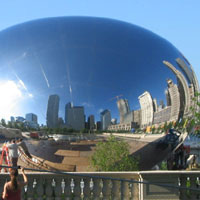
Related to our continuing concern with the privatization of public space, here is an interesting situation featuring Anish Kapoor's Cloud Gate sculpture in Chicago's Millennium Park.

According to a post at New (sub)Urbanism, photographer Warren Wimmer was prevented from photographing this piece of public art.

Fascinating.

Link: New (sub)Urbanism - Copyrighting of Public Space
Reference: Chicago's Millennium Park (Land+Living)
Reference: It's a Crocker etc. (Land+Living)


 Comments (1)
john t unger  — January 29, 2005
Penny wise, pound foolish
Penny wise, pound foolish Ben Joravsky's article on the copyrighting of Millennium Park deeply reinforces my belief that I made the right choice as an artist when I moved out of the city. But the article fails to address some of the key questions raised: Does the city actually forward any of the revenue generated by photo permits to the artists whose work is in question? Do the permits pertain to the copyright of specific artwork, or to the design of the park (in which case, perhaps the city is entitled to keep the money). If the City does keep the permit money, how much of it goes to the creation of new public artwork or the maintenance of existing work? As an artist who has previously created public art in Chicago, I would personally prefer to see my work constantly in print than to receive an occasional small check generated by photography fees. On a purely mercenary level, I believe the cumulative effect of thousands of postcards, tee-shirts etc. is of much greater benefit long-term. Just as file trading in the music industry has been proven to actually increase sales, it seems obvious to me that an artist who seeks public funding for public work can only benefit from increased awareness generated by souvenirs featuring their work. I also believe that the key concept of public art and public space is the word "public." This is what distinguishes parks from parking lots and public art from the private holdings of collectors. I am sorely tempted to install a hidden web-cam in the park to broadcast video of these works 24-7. And yeah, I'll call that a public art piece. I could probably save some time by borrowing a feed from Chicago's developing surveillance network. Extending copyright limitations to the uses of public space is not on a par with regulations addressing safety, security or social behavior. While it may be reasonable to regulate noise, drunkenness or other behaviors, I can't see any way in which the copyright of public space benefits the people for whom the space is created. Chicago's parks and public artwork are among it's greatest assets, generating a huge portion of the tourist economy. The City should be taking a longer range view of the way in which professional photos of the park increase local revenues. After all, as the saying goes, any publicity is good publicity.
back to top ↑