

Experiment in environmentally sensitive erosion control
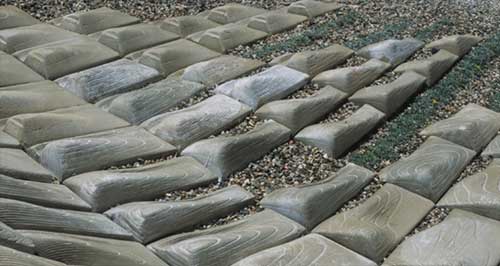
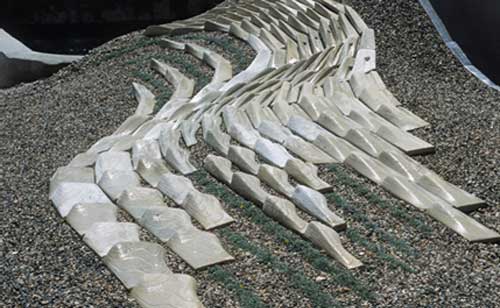
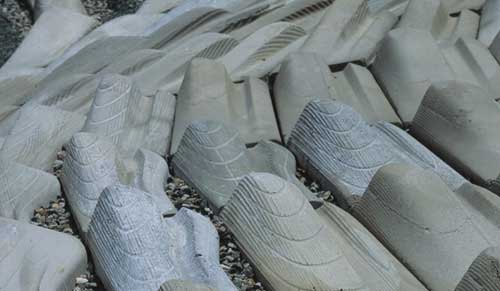
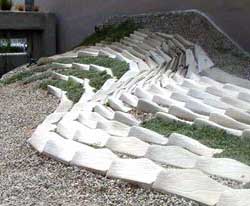 Designed by architect Marcelo Spina of Los Angeles based firm Patterns, Land.Tiles is a system composed of 118 different CNC milled and vacuum formed textured concrete blocks.
Every tile has similar sectional characteristics derived from a process of double pleating a continuous surface. The inherent complexity of the terrain's contours originates a dimensional logic of construction that through a process of subdivision, allow every tile to adjust to its site specific condition while maintaining its prototypic geometry and morphological qualities.
Designer: Patterns
This project was installed in conjunction with a SCI-Arc seminar at Materials & Applications in Silverlake. M&A is a research center dedicated to pushing new and underused ideas for landscape and architecture into view.
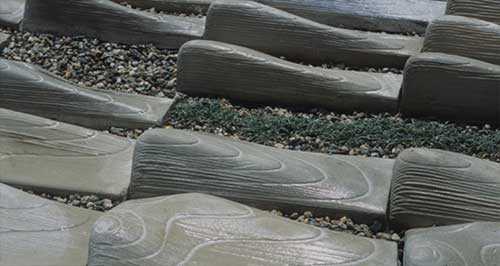
Designed by PATTERNS principal Marcelo Spina in collaboration with the Land.Cro.Sy.Rials seminar class at SCI-ARC, Land.Tiles is the outcome of the research and development of an emergent generation of highly integrated, environmentally-sensitive, contour-responsive erosion control and landscape consolidation systems. Portrayed as an "actively affective landscape micro environment" the installation includes a circuitry of continuous water flow that stimulates severe and shifting conditions. The project duration of six months allows structural, surface, and vegetation conditions to be monitored over an extended period of time.
VERY UGLY!
Nice
The eye of the beholder...
Incredible
bad