
Land+Living
Land+Living
Fairview House
1960's California stucco box house updated on a budget

Updated and refreshed on a budget, this house in San Gabriel, California is an example of significant cosmetic transformation on a budget... specifically my budget.

Building on the simple stucco box form, the design is clean, modern and simple. Throughout the house and property, the key was to get the most bang for the buck by using a minimal palette of materials and to reuse much of the existing material on site.

Design: Studio J2L
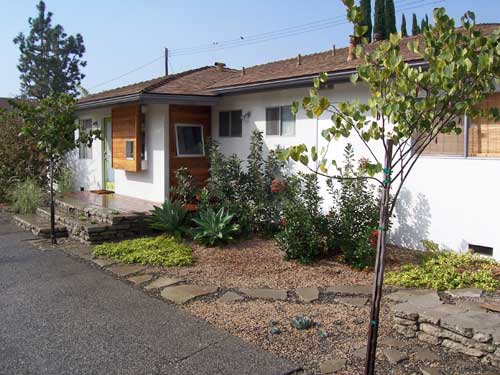
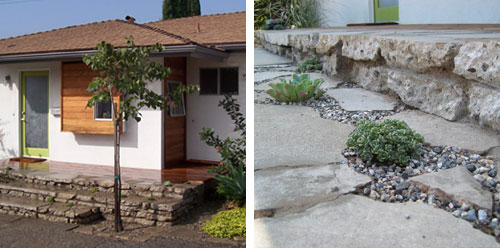
The small front yard was liberated of excessive concrete paving which was broken out by sledge hammer and reused to build paths, walls and steps. To emphasize an undistinguished and hard to see front door, a broad new entry porch was created to replace the small steps. A redwood clad bay adjacent to the front door was popped out of an existing window opening creating extra space in the kitchen as well as a visual cue for the new entry.

The property lacked an irrigation system, and with a small landscape budget the solution was to utilize native and drought tolerant plants that could survive on natural rainfall with minimum supplemental watering. Plants were selected for a range of foliage color and texture.
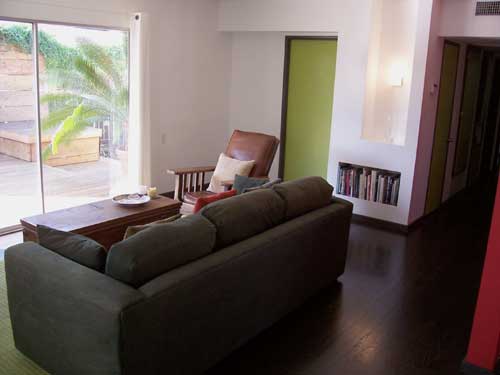
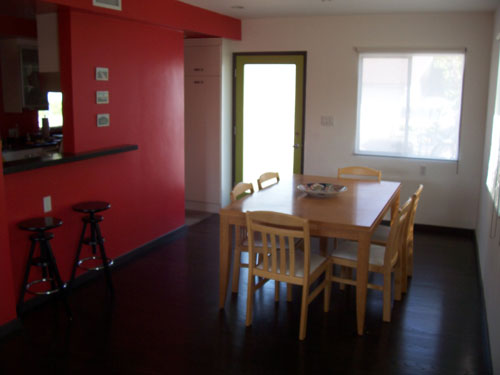
The interior was treated minimally with walls painted white with dark brown trim and the existing hardwood floor stained a rich ebony. Bold red walls define the kitchen as volume within the living area.

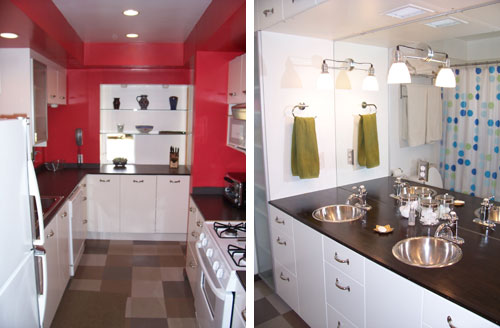
The basic interior layout remained unchanged, and most work was undertaken in the remodel of the kitchen and bathrooms. White Ikea cabinetry was used in the kitchen and bathrooms. Counter space in the kitchen was doubled with the removal of a nonessential exterior door and by borrowing space from the outside with the popped out window bay. To integrate the kitchen with the living space and to carve out more space for cabinets, two interior doors were removed and widened and a small bar opening was created.
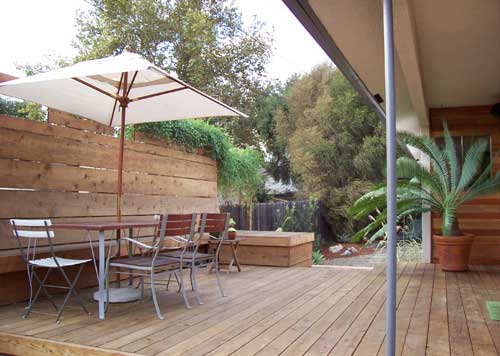
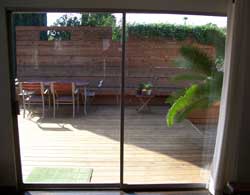
A large deck extends the living space out the back of the house and creates an outdoor room framed by a redwood trellis and bench on one side and the exterior wall of the house reclad with redwood siding.

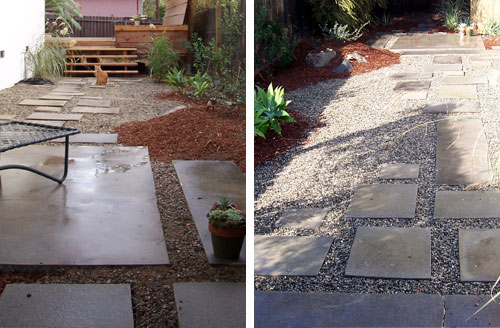
The backyard landscape extends the minimal regional concept of the front. A large concrete slab from the former laundry yard was cut into slabs of various sizes and combined with concrete stepping stone slabs to create a patio and pathway.
Resources:

  • Cabinets - Ikea, Akurum system, Applåd (white laquer) and Avsikt (frosted glass) doors
  • Flooring - Armstrong linoleum tiles, 4 color random pattern (Home Depot special order)
  • Bathroom sinks - Kohler Bolero Round Lavatory
  • Exterior lights - Red Dot vapor proof lights (Home Depot)
  • Plants - Tree of Life Nursery
  • Redwood siding - Home Depot, tongue and groove fence panels
  • Windows - Milgard aluminum awning
  • Paint - Dunn-Edwards
        White [10-1], Dark Earth, Crisp Tint [DE 213], Neptune Rim [DE CO 30]

  •  Comments (9)
    bben  — February 19, 2005
    On a budget, huh?
    I was beginning to wonder if "on a budget" was blasphemy to modernists' ears. MODERN does not have to equal EXPENSIVE, and it's encouraging to see that someone out there agrees. Finally.
    back to top ↑
    Joseph  — May 27, 2005
    Front Door
    Was wondering where you got that door? How did you attatch that redwood siding to the house? I live in Pasadena and wanted to see the house in person? Address?
    back to top ↑
    James  — May 27, 2005
    email
    Joseph, This is a private residence, of course, but I'd be glad to answer a few questions. The front door is a standard Home Depot item which was frosted using etching cream (an acid based product found at craft stores which provides a cloudy/uneven frosted effect). The redwood was used where stucco had been removed from the walls (to fill in where a door/window was removed, etc.). While very labor intensive, it is relatively easy to do. After the stucco was removed, plywood was nailed to the studs over which building paper was applied (with flashing properly installed at the base), and then the tongue and groove redwood was nailed on top (carefully nailed at the top tongue edge). Drop me an email if you like: james(at)landliving.com
    back to top ↑
    Gina  — July 13, 2005
    where do you start
    I love what you've done. My husband and I like modern design. We moved into a circa 1961 home about 8 months ago, and virtually everything is original... granted, it's in great shape, but still original. We want to update and modernize things without losing the charm but we're feeling overwhelmed and not sure where to begin. Any pointers?
    back to top ↑
    James  — July 16, 2005
    Identify the strong points and weak points
    Gina, I would recommend consulting a design professional to help, but what I can tell you is to identify what it is about the house that you like. Emphasize any strong elements that can be made into design features. In the case of this house, I started with a very blank slate, but what I saw in the basic design was a series of planes and volumes which were not previously distinguished. The strong moves were to select a color palette to help give character where there was none, red for the kitchen "volume" and green for all of the doors all balanced with white walls and dark brown trim. Other decisions, such as cabinetry, were made for a unified and simple design.
    back to top ↑
    Anonymous  — July 25, 2005
    this is fantastic, too beautifu.
    back to top ↑
    Dejana  — August 10, 2005
    strange but great house, I think that in there live people with caracter
    back to top ↑
    debbie  — August 24, 2005
    counter surfaces?
    what did you use for the bathroom countertop? The wood looks lovely. i love the landscape design as well.
    back to top ↑
    James  — August 24, 2005
    Counters
    The bathroom counters are simply birch plywood, stained with a combination of ebony and walnut stains, and then finished with several coats of marine grade varnish. This type of surface and finish is definitely more susceptible to wear than other traditional counter surfaces, especially at the edges, but the varnish can be refinished relatively easily. And you can't beat the cost.
    back to top ↑