

Article by Maria Cook, The Ottawa Citizen
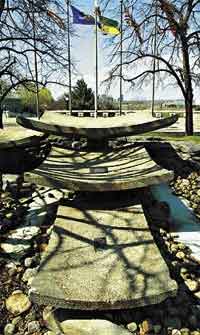 "Created in the 1960s, this often overlooked urban gem is still a work of artistry and breathtaking vistas."
"It's a brilliant public space," says Mr. Zvonar (landscape architect), who works for the federal department of public works in the heritage conservation section. "It has so many moods and characters. It's a work of incredible artistry."
Landscape Architect: Don Graham
Article: The Ottawa Citizen
View Land+Living Maps in a larger map
Excerpts:
Downtown Ottawa is crying out for public space and greenery among the towers and parking lots. So why don't more people know about the Garden of the Provinces?
Located at the western edge of downtown at Wellington and Bay streets, across from Library and Archives Canada, the clean, simple geometry of the four-acre garden creates an effect that is gentle and quiet.
Broad terraced steps lead down to Wellington Street, while large, open platforms offer views up the Ottawa River and across LeBreton Flats. A grove of European Linden trees set in grass is contained by rectangular stone walls which form seats.
The upper terrace contains a horizontal fountain of concave concrete slabs with five basins suggesting the five Great Lakes. The lower terrace features a tree-shaped stainless steel sculptured fountain over five metres high.
Bronze plaques with coloured enamel floral motifs of the provinces and territories are set in the stone balustrades of the upper and lower terraces. Flag poles fly banners representing the provinces and territories.
"Nobody said, 'Let's build a garden of the provinces,'" recalls landscape architect Don Graham. "They said, 'Let's build a people park.'"
Mr. Graham, now 73, designed the $400,000 park in 1960, while working for the Federal District Commission, the precursor to the NCC.
"We wanted to achieve a counterpoint to all the activity going on in Confederation Square," he says. "A walk along Sparks Street ends up at the Garden of the Provinces."
During his career, Mr. Graham worked on the Ottawa River Parkway, the Gatineau Parkway and the Sparks Street Mall. In 1964, he opened the first landscape architecture practice in Ottawa, and was the designer of Andrew Haydon Park in Ottawa's west end.
He created the landscape designs for the Canadian Pavilion, and Parc Notre Dame at Montreal's Expo 67, and credits Expo for sparking interest in landscape architecture as a profession at Canada.
Landscape architecture during the period after the Second World War was full of new ideas, he says.
"The modernist landscape was ultimately rooted in realizing positive social goals --it was looking at how people could be made healthier through the development of the exterior living environment."
Unlike 19th-century landscapes, there was no set formula. Modern landscape designs were like cubist art works; they could be appreciated from a number of different angles.
The design still looks fresh and strong 40 years later.