

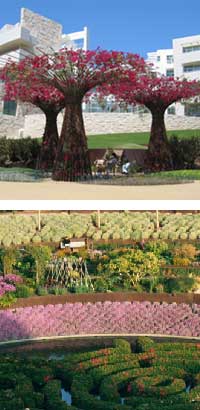
 The gardens and landscape of the Getty Center are easily the largest and most easily accessible example of contemporary landscape design in the Los Angeles area, if not the western United States.
The Getty Center complex spreads like an Italian hill town on the slope of the Santa Monica Mountains and is interwoven with a vast array of garden and landscape environments, all set within a vast sea of native chaparral and oak trees. Within the complex itself are two typologies of landscape: the architectural landscape designed by the Olin Partnership and the legendary Emmet L. Wemple, and the commissioned work of art that is the flowing sculptural Central Garden by artist Robert Irwin with Spurlock Poirier.
Continue to the next page for a brief photo tour and further description of the landscapes.
Landscape Firm: Olin Partnership
Landscape Firm: Emmet Wemple and Associates
Central Garden description: Robert Irwin
Landscape Firm: Spurlock Poirier
Architecture Firm: Richard Meier & Partners
Book: Robert Irwin Getty Garden
Book: Seeing the Getty Center Buildings & Gardens
Garden descriptions: Landscaping at the Getty Center
Emmet Wemple and Associates began the landscape design process and conceived preliminary designs for the grounds in conjunction with Richard Meier's master plan. Wemple and Associates executed the design for the landscape of the hills around the Center with native and drought tolerant plants including a precise grid of 8,000 Quercus agrifolia (native Coast Live Oak trees) which extended one of Meier's organizing grids across the hills. The oak trees also serve a practical purpose as they are uniquely adapted to southern California's climate which is prone to wildfires: they surround the Center with a natural fire break.
Laurie Olin and the Olin Partnership, designed the landscaped spaces adjacent to the buildings in conjunction with plant selection and procurement by Fong and Associates of Orange County and Raymond Hansen. Daniel Urban Kiley also consulted on the project.
The landscape that weaves through the complex of buildings is beautifully executed and compliments the architecture. The central court features an alee of cypress trees set into travertine cobbles along a rectangular reflecting pool. Niche gardens and courtyards among the museum's pavilions offer wonderful places to reflect and soak up the atmosphere. It is said that the gardens feature many trees, shrubs, and herbs that were discovered to have been used at the villas in Pompeii and Herculaneum in Italy. Indeed the landscape is a marvelous blend of the garden traditions of California and the ancient Mediterranean.
Where the intermingled gardens compliment and mirror the strict architecture of the Getty Center, Irwin's Central Garden provides a marvelous and studied contrast. The garden extends from the geometry of the complex where a water rill runs through a grotto-like space carved into the terrace walls, and becomes a stream which serves as a "sculpture of sound" ending in a waterfall which plunges into a large circular reflecting pool. In the center of the pool "floats" a contemplative, Mandela-like maze of azaleas. A path zigzags down the slope, crossing the stream and slicing with plates of corten steel into a manicured lawn which flanks the garden. Irwin plays with the lawn as a pedestal to the Center's buildings and creates a buffer of shaggy bunch grasses which transition from the lawn to the unconventional and varied planting arrangements surrounding the stream and pool.
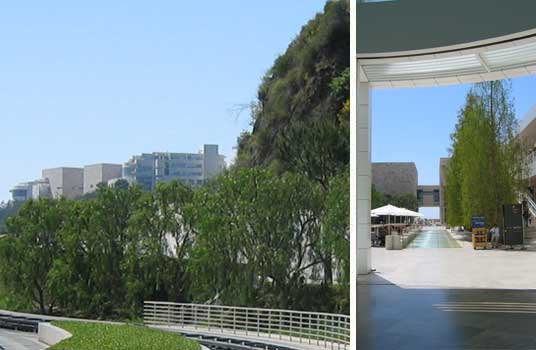
The Getty Center from the bottom of the tram Central court from the lobby
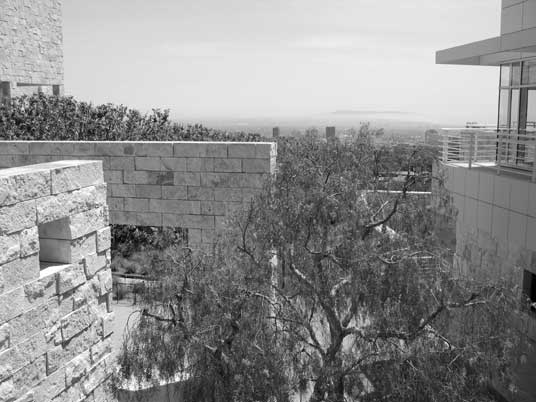
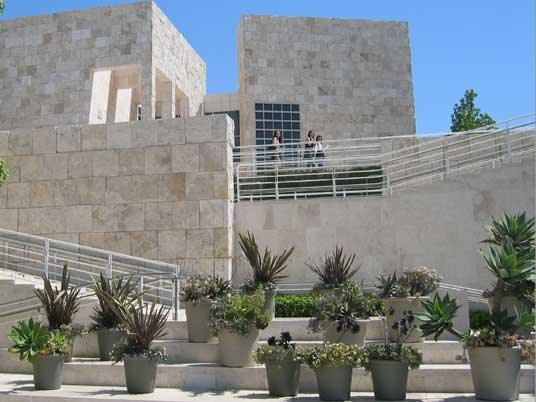 Tableau of potted succulents on the lower terrace
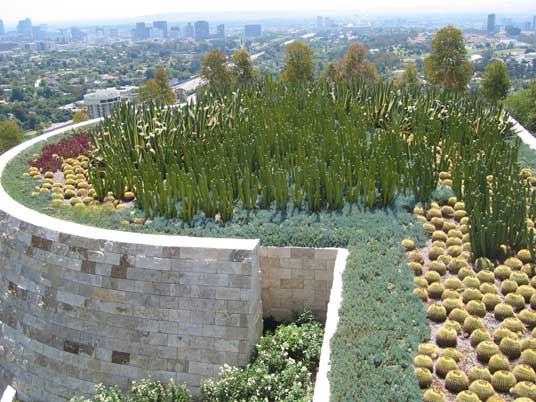
The beautiful south promontory succulent garden is meant to represent the arid native landscape which once occupied the plain below, though the garden actually features plants from around the world.
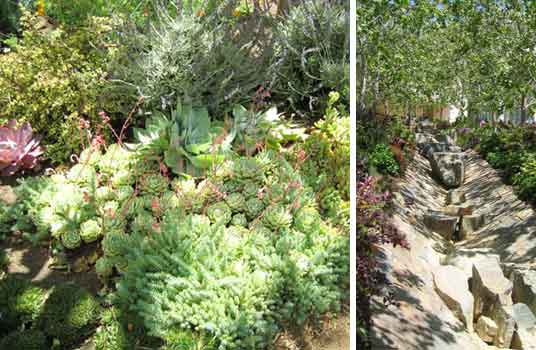
The Central Garden features a lush woodland planted with an array of native and exotic plants juxtaposed in striking arrangements of color and texture. A sculpted water flow and canopy of sycamore trees (though interestingly the European variety rather than the native Platanus racemosa) reflects the natural ravine which originally existed in this location.
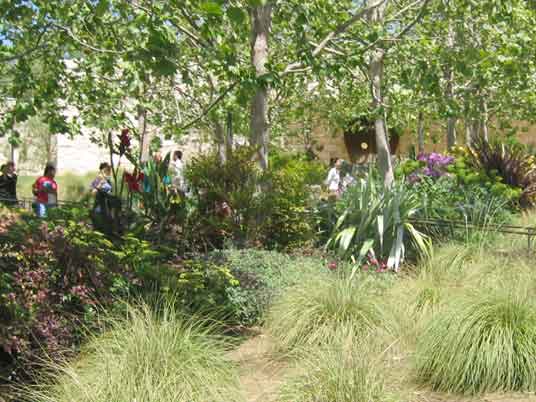
Bunch grasses mediate between the maincured lawn and lush woodland plantings along the stream.
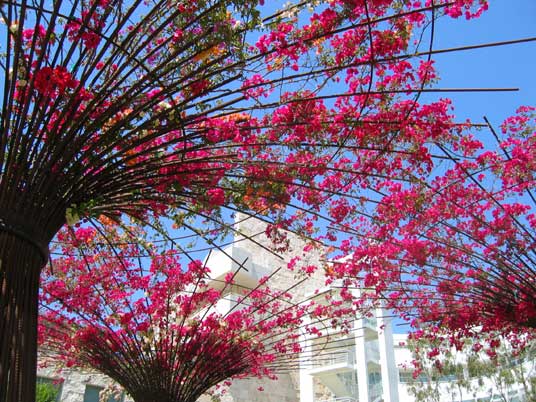
Sculpted trellis fountains forged from rebar overflow with bougainvillea.
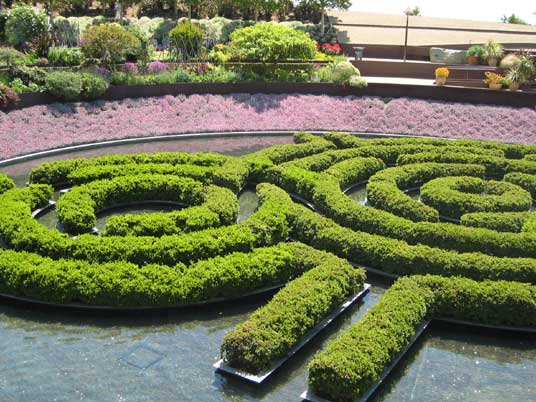
The reflecting pool and maze at the bottom of the Central Garden.
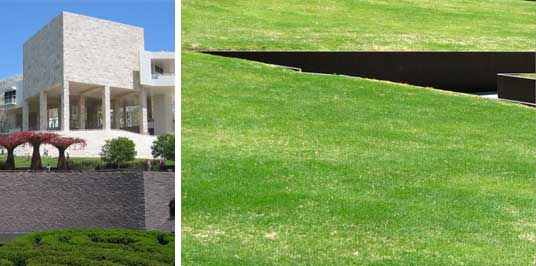
A view across the reflecting pool towards the museum (left). The zigzap path slicing the lawn (right).
View Land+Living Maps in a larger map
rebar
Getty Chairs