Landscape
The elevated railway turned park opened today
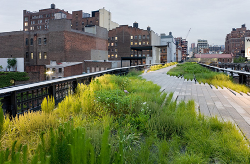 Section 1 of the High Line (from Gansevoort Street to 20th Street) opened today: Tuesday, June 9, 2009.
This fact is nearly a miracle when you consider not only the idea of turning an abandoned New York City elevated railway into a public park and all of the hurdles involved to make it possible, but it is especially amazing that the project was built to such a high quality of design and execution.
The design, inspired by the melancholic, found beauty of this postindustrial ruin which was reclaimed by nature, is led by landscape architect James Corner Field Operations, with Diller Scofidio + Renfro Architects. The landscape is designed by Field Operations with the consultation of the master Dutch planting designer Piet Oudolf. The reinterpretation of this urban relic imagined by James Corner Field Operations and the design team is a brilliant blend of preservation, innovation, conservation, restoration, and orignal modern design.
Lead designer/landscape architects: James Corner Field Operations
Architects: Diller Scofidio + Renfro Architects
Planting specialist: Piet Oudolf
Lighting: L’Observatoire International
Link: The High Line
Article: NY Times - Renovated High Line Now Open for Strolling
[photos, video, interactive]
Book: Designing the High Line: Gansevoort Street to 30th Street
Related: The Standard NYC (L+L 4/9/2009)
Related: "Down-to-Earth Masterpieces of Public Landscape Design" (L+L 5/5/2005)
Location: L+L Maps - The High Line
MoMA Exhibition
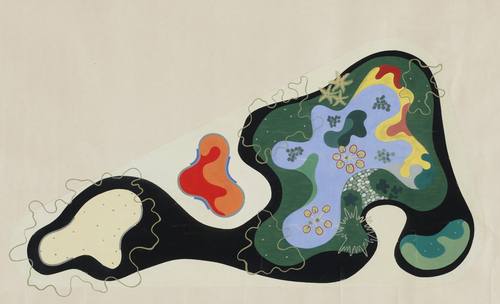
The exhibition, running at MoMA in New York City from April 8, 2009–September 14, 2009, draws from the rich collection of The Museum of Modern Art to examine the diverse attitudes toward landscape over the last hundred years.
I saw a sneak peak of the exhibit before it opened a couple of weeks ago, and what I saw left me wanting to see more. Featured designers include Roberto Burle Marx, Frank Lloyd Wright, Hans Hollein, Diller + Scofidio, Tadao Ando, Mies van der Rohe, Bernard Tschumi, Enric Miralles, and many more.
Link: MoMA
Article: Art Daily
Tadao Ando's mixed-use complex in Hyogo, Japan
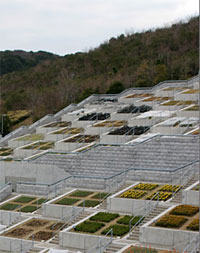 This massive mixed-use complex was constructed on the remains of a hillside whose earth had been used for a huge landfill project for the Osaka Bay area. The design reconstructs the landscape that had been destroyed but also, through the idea of rebirth and reconstruction, serves as a memorial to the thousands who had lost their lives and the destruction of land in the massive earthquake that shook the Kobe region in 1995. The complex is vast in scale, yet the design manages capture the small quiet moments for which Ando is known.
Link: Awaji Yumebutai International Conference Center
Photos: 0lll
More Tadao Ando: Design Boom - 2001 Interview
Location: L+L Maps - Awaji Yumebutai Conference Centre
Wall displayed airplants at the Bardessono Hotel
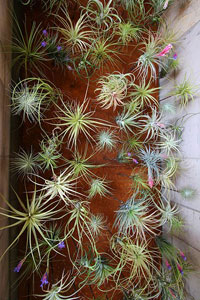 A very nice indoor vertical garden designed for a space without irrigation or drainage at the platinum LEED certified Bardessono hotel in Yountville, California.
The simple solution uses airplants (Tillandsia, members of the Bromeliad family) attached to metal rods which protrude from the wall. The visual effect of hundreds of Tillandsia "floating" within these alcoves is striking. And while some of the plants will need to be changed out occasionally, it is a much more sustainable solution than the typical hotel lobby floral display.
Link: Thigmotropism
Link: Bardessono Hotel
Article: NYT
Location: L+L Maps - Bardessono Hotel
Landscape — August 23, 2007
Posted by Anthony
Spaces of simplicity, elegance and balance
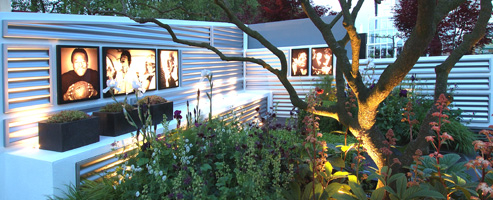
flashfilm.com has an interview with London-based garden designer, Philip Nixon. Philip is a participant of the Chelsea Flower Show and is currently working on an exhibition for the 2008 Gothenburg Festival in Sweden.
Via: flashfilm.com
Link: Philip Nixon Design
Inaugural launch of Orange County's Great Park
 Roll on down to El Toro on Saturday, July 14, 2007, where you can get a glimpse of the future according to Ken Smith.
The City of Irvine and the Orange County Great Park Corporation are hosting the inaugural launch of the Great Park, and you are invited.
The design team for the Great Park is lead by New York City landscape architect Ken Smith. His band of merry-makers include Enrique Norten (Ten Arquitectos), Mia Lehrer, (Mia Lehrer + Associates), Buro Happold Engineers and Ecologist Stevel Handel.
Link: The Great Park Takes Flight
Link: www.greatparkballoon.org
Link: Orange County Great Park
Previously: Ken Smith in the O.C. (L+L)
Previously: Orange County Great Park (L+L)
Do it: L+L Maps - Orange County Great Park Balloon & Visitors Center
American Society of Landscape Architects honors 38 projects
 The American Society of Landscape Architects (ASLA) has announced the recipients of its 2006 Professional Awards. The jury considered over 500 entries and selected 38 projects to receive awards. The awards will be presented on October 8 at the ASLA Annual Meeting in San Francisco.
The top "Awards of Excellence" are awarded in several categories:
Link: ASLA 2007 Professional Awards
(complete awards list and project profiles)
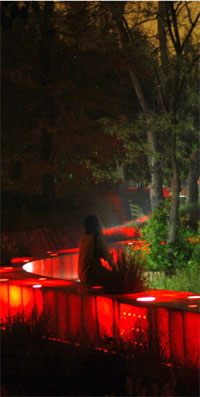
IMAGE: The Red Ribbon - Tanghe River Park, Qinhuangdao City, Hebei Province, China
Turenscape (Beijing Turen Design Institute) and Peking University Graduate School of Landscape Architecture, Beijing, China.
Sean Canavan
Not quite the Kathryn Miller approach to guerilla gardening (Sean is more akin to these fellow Brits), but pretty cool.
Video: Google Video
Contemporary Ephemeral Gardens in celebration of Québec City's 400th anniversary
 The Ephemeral Gardens will be an artistic event where creators from different horizons are invited to bring an artistic viewpoint on the major themes of Québec City's 400th anniversary. This viewpoint will be expressed through creator gardens : outdoor creations using mediums that combine different elements, including plant materials. The gardens will be on view at Espace 400e , a focal point of the festivities to be created alongside Louise basin in downtown Québec City.
The goal is to create 6 contemporary art gardens.
This call for proposals is aimed at seasoned and budding creators. They may be architects, landscape architects, or visual artists and may be from Québec City, Canada, or countries historically linked to Québec City: France, the United Kingdom, and the United States.
Registration deadline is January 31, 2007
Link: Québec 400: Ephemeral Gardens
Landscape — September 13, 2006
Posted by James
American Society of Landscape Architects honors its student members
 The American Society of Landscape Architects (ASLA) has announced the recipients of its 2006 Student Awards. Awards were given in seven categories to 24 projects representing 15 schools.
The ASLA website features full descriptions and slide shows for each project. Just a few excerpted images shown after the jump to whet your appetite.
And props to Brett Milliga from the University of New Mexico who made all of his classmates look bad by scoring two awards...
Link: ASLA 2006 Student Awards
Vertical Garden Competition Winning entry by David Fletcher + Juan Azulay
 The MAK Center and SCI-Arc invited thirteen emerging architecture firms and architects to design a 'vertical garden' at the Schindler House. To contend with the vertical growth of the city, a vertical garden will be designed to occupy the edges of the Schindler House property, adding a new dimension to the landscape of the low-rise Schindler House and creating a green buffer between the house and its neighbors. The Schindler House is as inseparable from its garden as it is from its condominium neighbors; the vertical garden will address this condition and posit new ideas relating to landscape, public art, urban growth, and architecture.
The proposal by David Fletcher + Juan Azulay proposes a light weight structural system enveloping the site to provide support for the growth of an organic sturctural system - strangler fig (f. petiolaris). Over time, the organic structure fuses with the non organic structure and becomes dominant.
Video: mak T6 Vacant by Fletcher + Azulay
Link: SCI-Arc - MAK Center | Vertical Garden Competition Winners Announced
Link: MAK Center
Gardens for the new emergent times
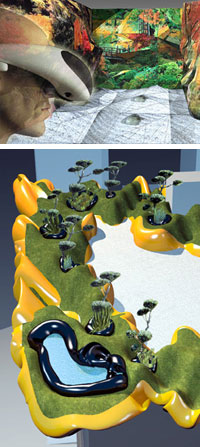 Spanish born garden designer Fernando Gonzalez is the principle and founder of Metagardens, a gardens design firm based in London. Fernando says that “the boundaries between the artificial and the organic are more blurred than ever before” and his innovative design practice seeks to address these challenges of the digital age through both built and experimental projects. Through computational techniques and an exploratory approach to design it proposes to go beyond the ordinary and conventional.
We live in a post-human environment where the relationship between the biological and the machine is more of a symbiosis than of contradiction. Our cybernetic culture sees Nature as something manufactured far away from ‘naturalistic’ theories that dream with a romantic and uncontaminated environment outside of our culture or, even worse, as a return to the past. But while the rest of the artistic disciplines are mutating to adapt to the new challenges garden design practices and theories are still based in outdated ideas incapable of dealing with the complexity of the new situation.
Link: Metagardens
Honoring the role of design in daily life
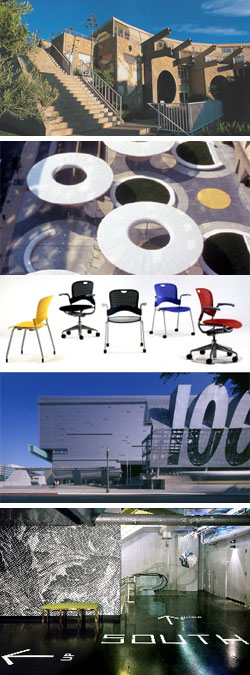 The Smithsonian’s Cooper-Hewitt, National Design has announced the winners of the seventh annual National Design Awards. The finalists and winners will be honored at an event on October 18, 2006.
"Cooper-Hewitt is delighted to once again recognize, through the National Design Awards, some of the greatest contributions to the world of design made in recent years." Cooper-Hewitt director Paul Warwick Thompson said. "Each year, the Awards grow in scope, and this October we are introducing National Design Week, a new education initiative created to promote better understanding of the role that design plays in all aspects of our lives. During National Design Week, Cooper-Hewitt will host programs and panel discussions on design, and on our website, we will launch design education content for teachers nationwide."
Awards are given in eleven categories:
- Lifetime
Paolo Soleri (previously - L+L)
- Design Mind
Paola Antonelli
- Design Patron
Craig Robins (previously - L+L)
- Corporate
Nike
- Special Jury
Syd Mead
- Architecture
Thom Mayne (1, 2, 3 - L+L)
- Communications
2x4 (Michael Rock, Susan Sellers, and Georgianna Stout)
- Fashion
Maria Cornejo
- Interior
Michael Gabellini
- Landscape
Martha Schwartz (1, 2 - L+L)
- Product
Bill Stumpf
Link: Cooper-Hewitt National Design Awards 06
32 Projects Selected by jury
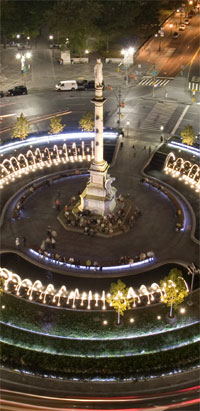 The American Society of Landscape Architects (ASLA) has announced the recipients of its 2006 Professional Awards. The jury considered over 500 entries and selected 32 projects to receive awards. The awards will be presented on October 9 at the ASLA Annual Meeting in Minneapolis.
The top "Awards of Excellence" are awarded in several categories:
Link: ASLA 2006 Professional Awards
(complete awards list and project profiles)
IMAGE: Coulmbus Circle, New York, New York, designed by Olin Partnership.
Design selected in an international competition
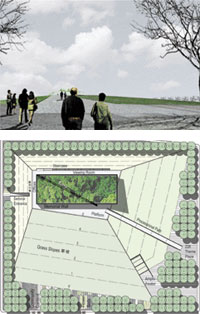 A UC Berkeley design team has won the competition for a 15-acre park in Chiayi, Taiwan, a monument to peace commemorating the 228 Incident - a tragedy which occurred on February 28, 1947, when government soldiers killed thousands of Taiwanese citizens. It was illegal to discuss the events of 1947 until 1992 when the Taiwanese government issued a formal apology.
The design team, comprised of Professor Judith Stilgenbauer and graduate students Kit Shihting Wang and Calder Gillin, named their proposal Conceal/Surface, stating: (it) is about time, growth and the inevitable revelation of historical truths. The central design element is the bamboo room, a partially sunken courtyard planted with bamboo (Phyllostachys pubescens Mazel) and enclosed by semi-translucent glass walls offering veiled views of the bamboo within. An underground glass enclosed viewing room will provide floor-to-ceiling view of the bamboo room.
Link: 228 National Memorial Park
Link: Selected proposals
Release: UC Berkeley - Professor, students win design competition for Taiwan peace park
Site specific installations at Stone Quarry Hill Art Park
 Stone Quarry Hill Art Park, one of the first outdoor sculpture parks in the country, is seeking site-specific installations from artists, architects, landscape architects who integrate notions of point of view, landscape, architecture and art. Proposals featuring collaborative and interactive concepts as well as green/organic architecture will be given special attention. Stone Quarry Hill is unique in its mission of showcasing emerging and established artists whose work focuses on the relationships between art and nature.
Deadline is September 1, 2006.
Link: Stone Quarry Hill
- Site/Sight: Landscape & Architecture
Via: Archinect
Landscape Architecture Masters Thesis by Veenu Jayaram
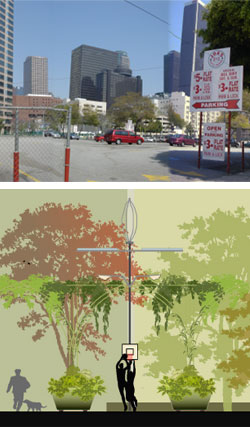 Veenu Jayaram was among the landscape architecture students I met when I sat on the jury for the BrownLAb studio at the University of Southern California Landscape Architecture program. She recently completed her graduate work, and contacted us to share her thesis project.
Examining the patchwork of surface parking lots in Downtown Los Angeles Venu saw an opportunity for intervention realizing that these parking lots occupy much of the land in the Central Business District, yet are only utilized for limited hours, and for the limited purpose of temporary vehicle storage. She proposed that parking lots can serve a more dynamic program that recognizes economic realities while serving the multiple needs of the urban environment.
The proposal takes into account the studied needs within the CBD for the existing and growing residential population in addition to the daytime workers. New infrastructure, planting and programming strategies allow the space to be more flexible while remaining compatible with the need for parking space.
Landscape architect chosen for Orange County Great Park in Irvine, California
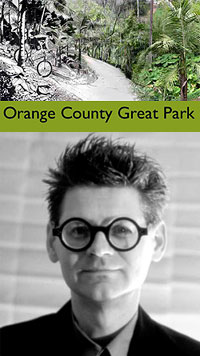 Ken Smith is ready for his prime time close up in the O.C.
As posted in Clippings earlier, the political wrangling has come to an end, and the Orange County Great Park board has selected Ken Smith's design team for the commission. The three finalists offered two compelling designs, and one competent but, to quote Chris Hawthorne, "irredeemably bland." The Smith team proposal had received high marks from the public via an online poll as well as two design juries.
The winning project team lead by Ken Smith is composed of Enrique Norton of TEN Arquitectos, artist Mary Miss, Buro Happold Engineers, Mia Lehrer + Associates, and ecologist Steve Handel.
The design concept is broken into three integrated yet distinct elements, "Three Parks in One: The Canyon, the Habitat Park, and the Fields and Military Memorial." The team states its goal to set new standards for sustainability, ecological responsibility and public space in Southern California. Ground breaking is expected this spring, with some parts of the park opening as early as 2008.
Link: Orange County Great Park
Link: Ken Smith Presentation Doc 1 Doc 2 (pdf)
Article: O.C. Register - Ken Smith selected as Great Park designer
Reference: Orange County Great Park (L+L)
A major new public space proposed for Dublin, Ireland
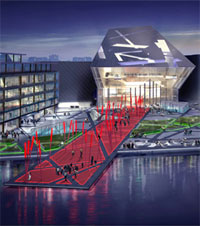 Dublin continues to grow and change at a fast clip, and with quality design leading the way.
American Landscape Architect Martha Schwartz has been selected to design a large public space in the Docklands section of Dublin. The 10,000 square meter Square will be located at the west end of Grand Canal Dock facing the River Liffey and will be one of the largest paved public spaces in the city.
Her design features a striking composition of a red "carpet" extending from the theatre into and over the dock crossed by a lush green "carpet" of paving with lawns and vegetation. The red “carpet” will be made of bright red resin-glass paving covered with red glowing angled light sticks. The green "carpet" of polygon-shaped planters will offer ample seating and will connect the new hotel to the office development across the square. The planters will feature marsh vegetation to soften the space and to act as a reminder of the historic wetland nature of the site. These will bring colour and variety to the space and act as a setting for the new buildings.
Link: Dublin Docklands Development Authority
Firm: Martha Schwartz Partners
Via: Pruned
MVRDV Moves Into Mountains
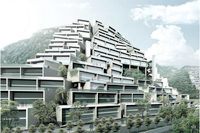 Ever commited to the unconventional, MVRDV has designed a housing complex for Liuzhou, China that once again defies convention. The location of the project is a valley where the eroding mountain face will be enveloped by a series of staggered boxed structures that will leave pockets of vegetation in an amalgam of built and natural form. In the valley itself is a wetland or constructed pond that is shown to support both vegetation and housing on its edge.
There is something parasitic about the development as it grows from the valley, and unfortunately there is neither an ecological nor slope stabilization strategy present on their Web site, but it would be interesting to know how they plan on striking a balance between the existing ecology and proposed architecture. Liuzhou is scheduled to be completed in 2007.
Link: MVRDV
Via: China Daily
Landscape — December 22, 2005
Posted by Deborah
Point Pleasant Park, Halifax N.S
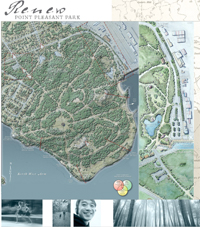 The competition to redesign Point Pleasant Park has been awarded to the firms NIP Paysage, Montreal and Ekistics Planning & Design, Dartmouth. Point Pleasant Park is a park in Halifax, Nova Scotia that has sustained damage in the way of insect infestation, ice storms and Hurricane Juan seriously damaging and degrading their coastal forest. Therefore, it is no surprise that the mandate for the competition was Regenerate, Restore and Renew focusing attention on strengthening coastal ecologies and preserving the unique heritage of the site. The panels themselves are lessons in ecology, detailing 50-year forest management and slope stabilization strategies, combined with native plantings and local materials.
Link: Point Pleasant Park
Link: Ekistics
Link: NIP Paysage
Draw attention to America's irreplaceable and diverse garden and horticultural heritage
 Historic buildings are not the only treasures on our nation's cultural endangered species list -- America 's landscape legacy of gardens is also at risk. In an effort to raise awareness for these nationally significant resources, the Washington, D.C.-based Cultural Landscape Foundation (TCLF) along with Garden Design magazine, have issued a Call for Nominations - Landslide 2006: Spotlight on the Garden.
Nominate a great American landscape. Deadline for nominations is January 31, 2006.
Link: The Cultural Landscape Foundation - Landslide 2006
Via: Archinect
BP Site Parkland / Harbourside Park wins four independant design awards
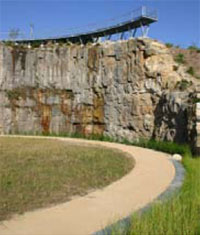 The Former BP Site Public Parkland at North Sydney (which we featured last May) was recently awarded the 'Overall Award for Excellence' by the Australian Institute of Landscape Architects New South Wales Chapter. It also won the 'Design Excellence Award' for best project in NSW, bringing the total medal count for this project to four. The project design is in the vain of the current Spanish "enviro cool" parks.
The jury stated, mcgregor+partners "clearly demonstrated an intelligent and contemporary approach to the reuse
and interpretation of an industrial site."
Link: mcgregor+partners [Thanks, Adrian!]
Link: AILA New South Wales State Awards 2005
Reference: BP Site Parkland (L+L)
Landscape — December 6, 2005
Posted by Deborah
The 6th edition at Jardins de Métis / Reford Gardens, Québec
 The names of the designers invited to take place in the seventh annual International Garden festival at Redford Gardens has been announced. They are: Pete North and Alissa North, landscape architects from Toronto, Ontario; Bosses Design (Éric Daoust, Donald Potvin, Jean-François Potvin), architects and designers from Montréal, Québ, Andy Cao and Xavier Perrot, landscape architects from Los Angeles, California; Chris Reed, landscape architect from Boston, Massachusetts (Stoss); Atelier le Balto (Marc Pouzol, Véronique Faucheur, Marc Vatinel), landscape architects from Berlin, Germany.
Link: International Garden Festival
Reference: International Garden Festival 2005 (L+L)
Landscape — November 10, 2005
Posted by James
A modern, organic parterre garden
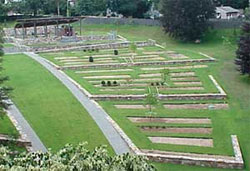 An expansion of Harvard University's Arnold Arboretum designed by Frederick Law Olmstead, the Leventritt Garden was designed by Reed | Hilderbrand Landscape Architects with Maryann Thompson Architects to display a diverse array of sun-loving ornamental shrubs and vines.
The garden site is approximately 4 acres and features an elevation change of nearly 30 feet. A system of non-reinforced three foot thick stone walls were implemented to create a series of garden terraces which provide level ground and an organizational system for horticultural display. The design is evocative of tradition of agricultural landscapes as well as French parterre gardens.
An open-air pavilion built of brushed stainless steel, tongue and groove cedar, and lead-coated copper sits atop the banks of terraces as a focal point and garden overlook. The pavilion and surrounding steel panels provide climbing surfaces for flowering vines.
Link: Leventritt Garden
Firm: Reed Hilderbrand
Firm: Maryann Thompson Architects
Link: Ordering and Terracing in the Leventritt Garden (pdf)
Link: Shrubs and Vines for the Leventritt Garden(pdf)
Designing for the 24-hour environment
 Designing for the 24-hour environment requires that the designer have an understanding of the materials that can be used to illuminate spaces shadowed by darkness. Convention points us towards traditional forms of lighting like halogen, solar, LED etc... but what of the luminescent properties of the materials themselves? Properties that include: transparency, reflectivity, retro-reflectivity, photo-luminescence, thermo-luminescence, screening, fiber-optical luminescence and fluorescence? This was the focus of a project lead by Pierre Bélanger, Assistant Professor Faculty of Architecture, Landscape & Design, University of Toronto that used night as the point of departure for a rooftop landscape architecture plan.
Link: AL&D
A green promontory overlooking the harbor for all New Yorkers to enjoy
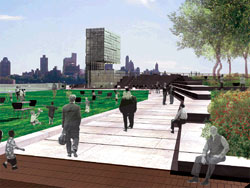 Redesigned by Rogers Marvel Architects and Ken Smith Landscape Architecture, this one acre elevated plaza at 55 Water Street in Manhattan is to be reopened today. Elevated plazas are always something of a challenge, and the previous life of this space was less than stellar despite its riverfront location with generous open sky. Indeed the original plaza with its unwelcoming street access was only built to gain a density bonus when the double-tower complex was originally built in 1972.
The Municipal Art Society and the property landlord (New Water Street Corp.) held a design competition in 2002 to revitalize the space. The design by Rogers Marvel and Ken Smith starts by marking the site with a 50-foot-high LED illuminated translucent glass beacon at the northeast corner of the site, which also serves as an additional park entrance via elevator. The primary entrance is a multilevel assent of escalators, stairs and overlooks rising from street level. Above the park unfurls as a broad events lawn of artificial grass surrounded by a stepped amphitheater, and a gently sloping landscaped "Dune," inspired by regional topography, which rises up to a "Boardwalk" terrace overlooking New York Harbor.
Visit: 55 Water Street
Landscape Architect: Ken Smith Landscape Architecture
Architect: Rogers Marvel Architects
Article: NY Times - An Elevated Plaza Finally Worth Going Up to See
Images: 55 Water Street
Images: Municipal Art Society
More: Tropolism
Landscape — October 17, 2005
Posted by Deborah
An early American Modernist landscape
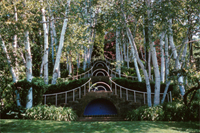 John Fletcher Steele was a one of the first American Modernists of landscape architecture. In 1907 Steele attended Harvard's Graduate School of Landscape Architecture where he was taught by none other than Frederick Law Olmstead Jr. in the Beaux Arts tradition, but later became greatly influenced by the French Modernist of his time; the Vera brothers and Gabriel Guevrekian in particular.
While his style in his professional practice remained relatively rooted in Beaux Arts principles, his writings and exhibition work showcased his Modern gleanings. During his career, Steele made a friend out of heiress Mabel Choate, daughter of Joseph Choate the prominent New York attorney, who's love of travel fed Steele's creativity and together they conspired to create his signature gardens at Naumkeag in Stockbridge, Massachusetts.
Link: Naumkeag Trustees
Link: Naumkeag Projects
Via: Garden Visit
Reference: Modern Landscape Architecture - A Critical Review (L+L)
Rediscovered 11 years ago, one of the world's oldest and rarest trees on display
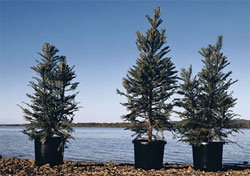 A public exhibition at the Royal Botanic Gardens, Sydney, is currently running through October 22, and will culminate in an international Sotheby's auction of the Collectors Edition trees on October 23, 2005.
The installation at Sydney's Royal Botanic Gardens will replicate the secret grove where the Pines were first discovered.The auction will feature fewer than 300 first generation Pines grown from cuttings taken from the wild population. Each Collectors Edition tree can be traced back to its parent tree in the wild. Proceeds will benefit conservation efforts of the Wollemi Pine and other rare species. In addition, six groves of five trees each will be dedicated to conservation organizations in Australia, New Zealand, the UK, Germany and Japan.
The general release of smaller Wollemi Pine pot plants will take place internationally in April 2006.
Wollemi Pine International
W.S. Tyler Wire Cloth for Architecture and Design
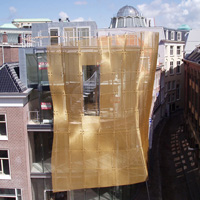 Facade, screen, ceiling, shelter, sound and fire barrier are just some the things that the architectural wire cloth series from Haver & Böecker can be. A thoroughly versatile steel mesh, it can take on harsh weather and pollution, and is often used along highways and in industry as a filter. The aesthetic qualities of architectural wire cloth make it ideal as a skin allowing subtle changes of colour and light at different angles. It also offers a myriad of options for interior application as ceilings and screens. Haver & Böecker have been producing woven wire cloth since 1887 with their first operation in Hohenlimburg, Germany and are distributed worldwide by their parent company W.S. Tyler.
Link: W.S. Tyler
Link: Haver & Böecker
A massive urban sculpture envisaged by Isamu Noguchi
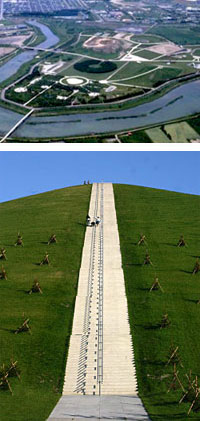 Seventeen years after Isamu Noguchi's death, his last work has been realized in the northeastern part of Sapporo as part of the city's annular greenbelt. Moerenuma Park was sculpted out of a 198 hectare waste disposal site which Noguchi specifically selected during his visit in March 1988. Noguchi completed the master plan of the park before his death later in 1988.
Noguchi believed that art and sculpture should be useful. His proposals for large-scale sculptures in the public realm date back to the 1930's, and he was especially drawn to the notion of play sculpture, though only one of his playgrounds was completed during his lifetime. Many of Noguchi's unrealized concepts were integrated into the design for Moerenuma.
The park was completed in July of 2005 under the guidance of the Isamu Noguchi Foundation, architects Shoji Sadao and Junichi Kawamura (longtime Noguchi collaborators), Kitaba Landscape Planning, Park Director Hitoshi Yamamoto and city officials.
Link: Moerenuma Park (Japanese)
Link: Green City Sapporo (Japanese)
Link: Sapporo City - Moerenuma Park and Isamu Noguchi
Link: Isamu Noguchi Garden Museum Japan
Article: Japan Times - Filling an emptiness with public play
Article: Asahi Shimbun - Ingenious Vision/Moerenuma a sculpture that doubles as playground
Related: California Scenario (L+L)
Related: The Isamu Noguchi Garden Museum (L+L)
Planar landscape phenomena
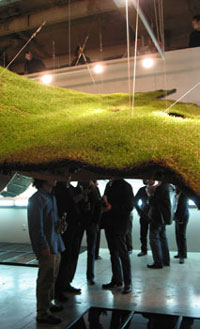 This installation by Griffin Enright Architects featured at SCI-Arc (12/03 - 2/04) consisted of over 1,000 square feet of sod laid on an hovering armature.
The concept resonates with me on a variety of levels, not the least of which is that it reminds me of a project by Nicolas and me from SCI-Arc where we created a warped landscape plane called the "Berm-Bender" which was lifted and sliced to create openings to the parking structure below... hmmmm... were they on that jury, Nico? ;-)
The ubiquitous lawn is the subject of a heuristic exercise about our cultural relationship to that thin plane of suburban carpet... exploring the tectonic nature of this plane by emphasizing its tissue-like thinness, flexibility, and texture, while commenting on its negative impacts on our larger environment.
Link: Griffin Enright Architects
Link: SCI-Arc
Parks, landscape, water, urban design...
 European Landscape Architecture is the latest Topos publication representing the best in open-space architecture including parks and squares, waterfront promenades and memorials across Europe.
All of the projects featured were completed between 2000 and 2005, making it an extremely relevant resource for professionals and students. The entries included in European Landscape Architecure were chosen from the Topos special edition International Review of Landscape Architecture and Urban Design. The book highlights work from a broad range of landscape architects, providing a good cross-section from both well-known and lesser-known firms.
Link: Topos
In-situ soil analysis
 Brownfield reclamation is on the rise, and soil analysis and remediation is becoming an art form of its own. The ability to analyze soil in-situ means considerable time and cost savings, and Niton's new XRF Analyzer series is designed to do just that. Armed with the technology to analyse soils for levels of lead, lead paint and heavy metals, it is a valuable tool that happens to be extremely portable at only 3lbs. It also has the added option of being fitted with Bluetooth wireless connection. Niton was recently awarded the IDEA (Industrial Design Excellence Award) Gold medal award for its XRF Analyzer family.
Link: Niton XRF Analyzer
Link: IDEA Awards
Landscape — September 30, 2005
Posted by James
Three firms selected as finalists for the former El Toro Marine
Corps Air Station
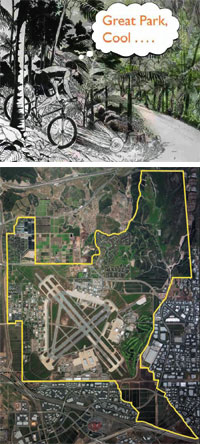 The field of seven firms selected from the original thirty-eight has now been narrowed to three finalists for the design of what would be one of California's largest urban parks. The finalists are EMBT from Barcelona, Spain, Royston Hanamoto Alley & Abey from Mill Valley, California, and Ken Smith Landscape Architect from New York, New York.
Closed in 1999, El Toro was originally slated to be the site for a new international airport. After voters killed the highly contentious airport proposal in favor of parkland, the City of Irvine spearheaded the effort to create "one of the finest metropolitan parks in America."
The Navy recently sold the property to Miami based Lennar Communities who will develop 10% of the seven square mile property and contribute money towards the development and maintenance of the Great Park.
Larry Agran, Chair of the Orange County Great Park Corporation:
Fredrick Law Olmstead designed New York’s Central Park in the mid 19th Century and inspired the creation of great metropolitan parks throughout the United States. We are conducting an international search for the Fredrick Law Olmstead of the 21st Century, and are confident that we will find a designer of his caliber for the Great Park.
Link: Orange County Great Park
Link: EMBT Arquitectes Presentation (pdf)
Link: Ken Smith Presentation Doc 1 Doc 2 (pdf)
Link: RHAA Presentation (pdf)
Link: Video of public presentations
Via: Archinect
An Exhibit of seventeen original landscapes
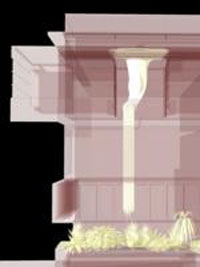 This exhibition for gardens designed to be part of the proposed 3rd floor addition to USC's architecture building is now showing at USC Verle L. Annis Architecture Gallery in Harris Hall through Saturday, October 1, 2005.
The School of Architecture's 21,000 square foot 3rd floor expansion of Watt Hall will house the School's four graduate programs. Alternating gardens and office spaces will form a ten-foot perimeter around the building. Each of the 17 gardens will be an original landscape design by an internationally renowned landscape architect. With the use of drought-tolerant and sustainable plants, the gardens will serve as a valuable tool for landscape studies and will act as the lungs for the building - allowing air to flow through the office, studio and gallery spaces.
Link: USC - Visions of Sky Gardens
Parc du Sausset and the art of patience
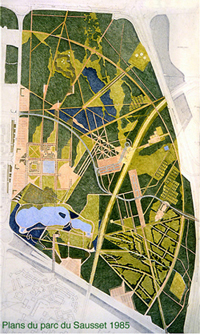 At the time of parc du Sausset's planning in 1979 the trend in France was still to create highly designed parks using exotics and built features. The competition brief for parc du Sausset was different in that it broke with tradition and specified conservation. Michel and Claire Corajoud took up the challenge, and proposed a naturalistic planting scheme that would be as much of a buffer to the growing industry and expanding communities, as it would echo the shapes of its industrial iconography and reflect an agrarian past.
Together with Jacques Coulon and a team consisting of Marc Rumelhart, Tristan Pauly, Claude Guinaudeau, Edith Gerard, Pierre Pascal Mourgue and Gerard Dufrense they took to creating a park that would challenge the instant garden mentality of the time. They planted whips instead of more mature trees, and proposed a marsh that would act as a refuge for wildlife, and treat the water infiltrating from the north through pytoremediation.
Link: parc du Sausset
Firm: Michel Corajoud
Student project for the Salford Docks site in Manchester, U.K.
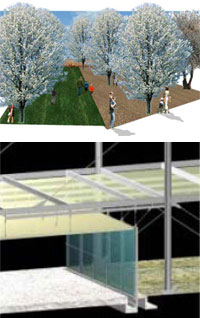 We first "met" Lorenza Casini, a student in the Materiality College at Manchester School of Architecture, when she contacted us last year regarding our post on MPreis supermarkets in the course of her research for this project. We are very pleased now to share the finished product now with you.
With an abandoned brownfield site chosen by the instructors, the studio presented an urban design and architectural design challenge: to propose a program for the site and to develop the architectural scheme.
Lorenza's proposal merges architecture, landscape, infrastructure, and food supply chains to develop an urban farmland and public space in the heart of Manchester.
"At a site where the blast furnace heat was almost unbearable you can now cool down and relax"
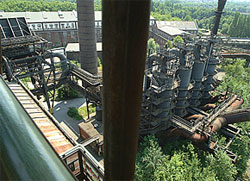 Archinect points us to an article in Stars & Stripes about the Landschaftspark "country park" at Duisburg-Nord in central Germany. We have featured the work of Peter Latz before, as well as a few other post-industrial landscape regeneration projects. The Landschaftspark no doubt inspired projects such as Amsterdam's Westergasfabriek and North Sydney's BP Site Parkland, yet it retains and reuses even more of the industrial infrastructure than either of these more recent projects.
Link: Landschaftspark
Firm: Latz und Partner
Article: Stars & Stripes - Urban decay now a family climbing getaway in Germany
Reference: Latz + Partner (L+L)
Reference: "From Ruin and Artifice, Landscapes Reborn" (L+L)
Reference: Manufactured Sites (L+L)
Transcendent freeway infrastructure - a modern gateway to Melbourne
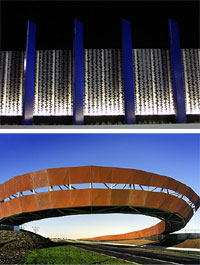 It is the rare example where infrastructure and design meet to produce an outstanding result, especially when it comes to a freeway. Here the design for noise attenuation blurs the boundaries between what are functional noise walls, sculptural features and gateways.
The project is 5 kilometers in length, passing between two distinct conditions: the Craigieburn grasslands and the expanding urban fringe. The design is a result of expressing the relationship between the freeway and these two distinct conditions.
Link: Architecture Australia - Craigieburn Bypass
Link: VicRoads - Craigieburn Bypass
Firm: Taylor Cullity Lethlean
Firm: Tonkin Zulaikha Greer Architects
Artist: Robert Owen
Via: Archinect
Via: Arquitectearte
"For one's health it is necessary to work in the garden and see the flowers growing."
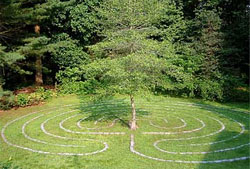 Last week we Clipped an article in the Washington Post about healing gardens, and a kind reader wrote in to tell us about the Therapeutic Landscapes Resource Center.
This not-for-profit organization is dedicated to providing information to the public about restorative landscapes, healing gardens, wellness gardens, and other research-based healthcare design. Their website features a wealth of reference materials, garden locations, and links regarding landscapes for healing.
Link: Therapeutic Landscapes Resource Center [Thanks, Lara!]
Reference: In gardens, patients find a calm place for healing (L+L)
Historic Register recognizes Ludwig Mies van der Rohe campus plan
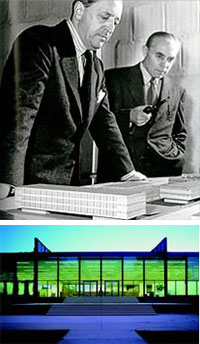 Earlier this week we featured a Clipping regarding the reopening of IIT’s Crown Hall set for this weekend. With the most recent news of the campus's historic designation, we'll take a larger look at the IIT campus.
The National Park Service has announced that the academic campus of Illinois Institute of Technology (IIT) has been added to the National Register of Historic Places. Designed by architect Ludwig Mies van der Rohe in close association with landscape architect Alfred Caldwell, the design concept of pavilions within a park setting is one of the most important examples of modern planning in the United States.
"The addition of our campus to the National Register is a reflection of the historical, cultural and architectural importance of IIT within Chicago and throughout the world," said IIT President Lew Collens.
In addition to the modernist structures by Mies and other modern architects, the school has launched a recent building campaign with new buildings by Rem Koolhaas and Helmut Jahn. Eextensive landscape restoration and extension of Caldwell's original landscape of native prarie terrain has been undertaken by Peter Lindsay Schaudt Landscape Architects.
Many links to articles and photo galleries for you to enjoy along with our own brief image montage.
Link: IIT
Link: Mies van der Rohe Society
Article: Chicago Sun Times - All of IIT named to historic register
Via: Archinect
Update 10/4/05:
Link: Coudal's Crown Hall page - film & photos
Moshe Safdie showcases Bentonville Arkansas ravine
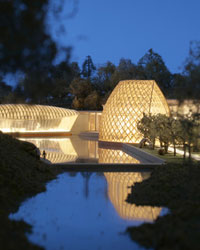 Moshe Safdie is an architect whose designs exude harmony. This is especially true of the new Crystal Bridges museum and cultural centre designed for Bentonville Arkansas.
The location chosen for the centre is a ravine fed by Crystal Springs, a sylvan setting with mature trees and steep slopes. The sides of the centre will be carved into these slopes, and galleries, libraries and cultural activity spaces will straddle the ravine itself. Two of the galleries will act as bridges that not only allow visitors to easily access the perimeter of the ravine, but have a more utilitarian function as dams that will make a set of ponds out of the interior.
Link: Crystal Bridges
Firm: Moshe Safdie and Associates
Montréal Cité Souterraine / Montreal's Underground City - SYN- Urban Exploration Workshop
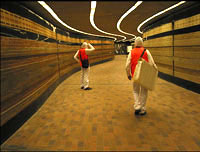 Need a reason to visit Montreal this winter? Montreal's underground city is a good enough one in my books. With its inception in 1966 the plan for the underground coincided with the opening of Montreal's Metro, and has since grown to include 1,500 offices and 1,600 boutiques. It also has numerous art installations, a skating rink, and leads you through historic and newly constructed buildings. For instance, you can go from IM Pei's Place Ville Marie to Claude Cormier's Lipstick Forest in the redesigned Palais des Congress in Old Montreal without ever surfacing.
SYN-, a collective that includes Luc Lévesque, Jean-Maxime Dufresne, Louis-Charles Lasnier and Jean-Francois Prost, have put together a unique study of the underground as part of an Urban Exploration Workshop. It highlights the underground as a viable and exciting intermodal experience. Their Web site includes maps and images.
Link: amarrages prospectus
Landscape — August 10, 2005
Posted by Sarah Rich
Forest of Dean
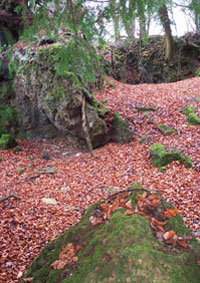 The Royal Forest of Dean sounds like it might have been Robinhood's secret hideout, tucked between two rivers in Western Gloucestershire near Wales. While the forest is one of few remaining ancient woodlands in the area, it has seen its fair share of industrial invasion; between timbering and iron mining for England's shipbuilding industry, the forest has been left with "scowles" - deep cavities in the land where resources have been dug up and removed.
A local landscape design and architecture firm called Reckless Orchard has been commissioned to design a strategy for public access into the scowles, called the Cinderbury Iron Age Settlement. The design will allow visitors to wander through the iron-red rock outcroppings and "Tolkienesque" trees, creating an ambient sense of the forest's ancient history while preserving its ecological integrity for the future.
Link: Reckless Orchard
Link: Forest of Dean
Residence and garden designed by Sant Architects and Jay Griffith as seen at CA Boom II day two
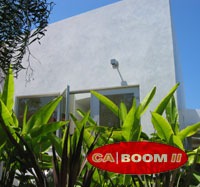 The second day of home tours started off on a good note. The Kozely/Farmer Residence by Sant Architects is designed to make great use of indoor/outdoor space. The landscape by Jay Griffith forms a lush frame for the house, and extends garden rooms from every room of the house.
The building is designed as three simple volumes that are shifted in relationship to each other to define exterior spaces as well as to modulate volume and light within the house.
Photo Gallery: Kozely/Farmer Residence
Link: Sant Architects
Link: Griffith & Cletta
Reference: CA Boom II Day One (L+L)
Reference: CA Boom II Day Two (L+L)
Reference: CA Boom II Day Threee (L+L)
Speakers Panel hosted by Land+Living at CA Boom II Day One
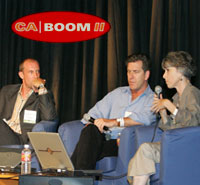 It was a pleasure to host a wonderful panel of landscape design professionals on Friday at the CA Boom Speaker Conference. A thousand thanks to my guests David Fletcher, Tom Leader and Katie Spitz for their time, effort and thoughtful presentations. Many thanks also to Sandra Bartsch and the CA Boom staff who invited me to participate and who worked so hard to produce the speakers series. And a final thank you to all who attended the presentation.
CA Boom had originally planned to provide a podcast of the Speaker Conference, alas some things must fall by the wayside when putting on a large and complicated event with limited resources. Instead we will provide a glimpse of our panel discussion with a few images from each panelist's presentation along with a bit of text to give you a taste of what was covered.
Reference: Breaking Ground: New Directions in Landscape Architecture (L+L)
A pathway above the national forest in Hainach, Germany
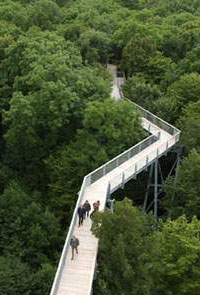 The physical act of climbing trees tends to lose its appeal when we get past our teens (well, for some people...), but now you can let the Peter Pan in you take flight in a safe way (does anyone remember that Michael Jackson interview on 20/20) by going to visit the German national forest in Hainach, Thueringen.
The bridge spans 300 meters and you find yourself about 44 meters above the forest ground (meter=yard, more or less). Apparently one is almost certain to experience bats, woodpeckers and other inhabitants of the "Buchenurwald" up close and personal, and the glazed viewing platform even protects you rugged explorers from the elements. Not so convinced about the tower design itself (bit heavy, ey?), but how cool of a tree house would this have been when you were a kid?! Oh, and Archigram... take that!
Link: Nationalpark Hainich
Link: Under Construction Photos
Dedicated to awareness and preservation of important American landscapes
 The Cultural Landscape Foundation's mission is to preserve the living heritage of American landscapes including public parks, historic sites, gardens, scenic highways, college campuses, farmland, cemeteries and industrial sites.
The TCLF website is provides a wealth of information about significant "cultural landscapes." Sections of particular interest include Landslide which profiles endangered landscapes; Pioneers which documents the lives and careers of people who have shaped the American landscape; and Classroom which aims to teach people to read the landscapes that are part of their surroundings.
Link: The Cultural Landscape Foundation
Reference: Pioneers of American Landscape Design (Land+Living)
Eminent landscape architect Robert Murase, FASLA, passes away
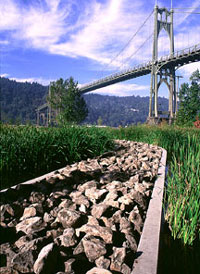
The positioning of stone in the landscape is an ancient and sacred tradition and has always interested me - from the stone walls and megaliths in Europe - to stone gardens in Japan.
• Robert Murase
We would like to pay tribute to the life of distinguished landscape architect Robert Murase who passed away suddenly this week. An article by Randy Gragg in The Oregonian chronicles Mr. Murase's life and career.
Article: The Oregonian - Robert Murase dies at age 66
Firm: Murase Associates, Inc.
Via: The Dirt [Thank you, Dave]
American Society of Landscape Archiects 2005 Professional Award winners selected
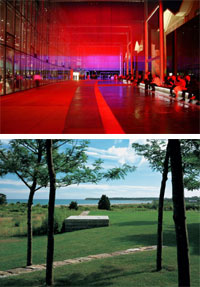 Thirty-three projects were seleced to receive awards from a field of over 520 entries.
"This year’s awards projects demonstrated the rising cultural relevance of responsible planning and good design across a range of scales and project types in the United States and abroad," said Gary Hilderbrand, FASLA, jury chair and principal at Reed Hilderbrand Associates Inc. "By bringing forward a compelling set of diverse projects, this jury showcased some of the successes landscape architects are having with the complex issues that arise for thoughtful design practices today, including the drive for clarity, expressiveness, rigor, and durability in design."
Link: ASLA 2005 Professional Awards
Making a case for native and climate-appropriate plants
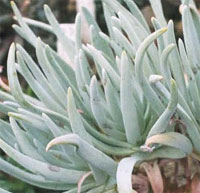 We occasionally show our southern California bias... but I am not sure why the New York Times shows theirs so often.
The New York Times published an article yesterday profiling proponents of "native" plants in California, focusing on Rene Russo's crusade to promote native species... an interest we share and which we subtly display with our side bar Dudlea image. In my experience, newspapers are infamously inept in their coverage of nature and landscape, and while this article is interesting and worth reading, I find the poor reporting to be annoying. For example:
Native plants like senecio and aloe, which fill the yard in front of Andree Matton's house in Monrovia, Calif., thrive on less water than grass.
Senecio and aloe are not native even to this continent, let alone to Monrovia, California.
Article: NY Times - Flora With a Star in Its Corner
Reference: Garden/garden (L+L)
Article by Kim Wilkie
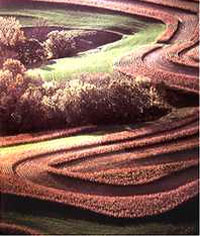 Land+Living will be hosting a speakers panel for the upcoming Speakers Conference at CA Boom later this month... more on that later... but related to the topic that said panel will discuss is this article by Richmond, U.K. based landscape architect Kim Wilkie.
The contribution which landscape architects can make at this point is immense and pivotal. Landscape architecture addresses both the built and the cultivated environment. It thinks about city as well as countryside; housing as well as agriculture; cultural history as well as nature conservation.
Mr. Wilkie has several interesting articles posted on his website which is nice to see.
Link: The Future of Landscape Architecture
Reference: Shaping the landscape of the world
Claude Cormier Architectes Paysagiestes
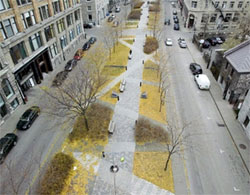 We've always found the website for Claude Cormier Architectes Paysagiestes (that's "Landscape Architects" for you non-franophones) to be rather amusing with it's theme of a landscape architect's Disneyland, excuse-moi, Courmierland in this case, with Frontierlandscape, Fantasylandscapes, Tomorrowlandscapes and Adventurelandscapes. To our dismay, the website is currently a bit low on content, but their work is interesting to browse even in abbreviated form.
What made us decide to feature Monsieur Cormier today was the discussion of our recent Shortcut post, which made us think of Cormier's design of Place d'Youville also in Montréal (shown right and below with more text).
Link: Place Youville
Firm: Claude Cormier Architectes Paysagiestes
Landscape installation
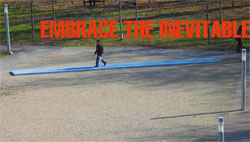 This simple landscape installation deals with the inevitable transformation of designed spaces by the people who inhabit and use them. It speaks to a larger issue in the design world in a way that resonates with us.
Montréal based architect Hal Ingberg (and fellow SCI-Arc alumnus) designed a piece that acknowledges and reinforces the traces of unplanned movements to and from a building at the Université de Montréal.
These traces mark the most natural and firect path of movement to and from the building. However, they have not been designed as part of the building's landscape strategy. Marked by the footprints of numerous building users, they are in effect blemishes, inscribed as corrections to the formalized movement sequence.
We can all personally attest to this non-orthogonal tendency as it pertains to human movement. Historically, it has been employed as an opportunity to inflect richly upon architectural space.
Link: Hal Ingberg
West 8 selected as the design team for Jubilee Gardens in London
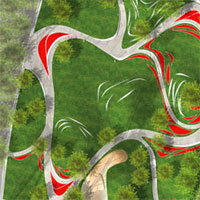 West 8’s design concept focuses heavily on developing an organic, lush and green park, with softly undulating hills. Trees and flowers will bloom throughout the year to provide a ‘botanical ambience’ for one of London’s most important green spaces. The sophisticated topography creates paths which are fluid and inviting, prime lookout points which frame dramatic, panoramic views of the Thames, the London skyline and the South Bank, and intimate spaces where people can find their own space to relax and enjoy the micro-climate. At night, a theatrical spectacle of light will subtly animate and play with the new weaving landscape.
Link: West 8 - Jubliee Gardens
Link: Jubilee Gardens
Article: LondonSE1 - Jubilee Gardens: West 8 selected by public for 'world class' park
Reference: West 8 (L+L)
Architectural tour by satellite
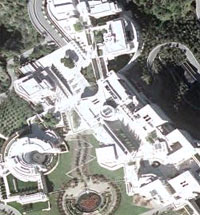 A Daily Dose of Architecture picked up the satellite imagery theme yesterday as well... must've been something in the air, or sunspots or something... and featured images of architectural landmarks yesterday.
We decided to do some reconassance as well and have a few architecture images of our own below. Let us know about your spy finds as well!
Link: The Grand Tour
Link: Google Maps
Thumbnail at right: Getty Center, Los Angeles by Richard Meier
Landscapes from space
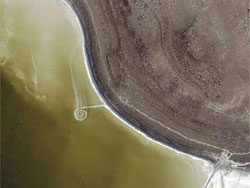 Today I saw something at Pruned, a new landscape blog that we like, that piqued my interest: satellite images of Land Art.
Pruned's post touts the merits of TerraServer, a site that I also prefer for aerial imagery and shows views of Robert Smithson's Spiral Jetty and Michael Heizer's Double Negative (beautifully manipulated images, by the way).
But, the post at Pruned inspired me to seek and share more sources for aerial landscape images.
Satellite Imagery Resources:
Related: Spiral Center for Land Use Interpretation
Related: Spiral Jetty Travelogue
Reference: Earthworks revealed (L+L)
Tom should've proposed here*
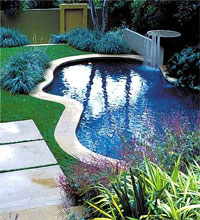 We've danced all around the work of Jay Griffith on Land+Living, but we've never dedicated a post to his firm's work. We've featured the work of his former partner Rob Steiner, the garden of his current partner Russ Cletta and we linked to an article in the LA Times Magazine that featured his design for a residence in Rustic Canyon. But for some strange reason, we have never come across Jay's website before. Well, today we did, and we want to share it with you.
Jay Griffith's work is fit for a Hollywood movie, his landscapes are dressed sets in the best sense. So it is only fitting that many of his clients are Hollywood types as well. Jay's firms have always produced stunning visual compositions of color, material and space that unfold in carefully scripted sequence.
Firm: Griffith & Cletta
"Tight of Form"
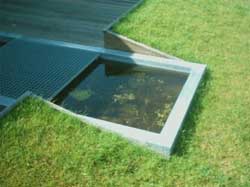 We don't speak Dutch and when we found out about landscape designer Harry de Visser's site, we immediately turned to Babelfish for the 411 in our native tongue. According to Babelfish, the garden designs of Harry de Visser are "tight of form" and we'd have to agree. He employs the technique of "beplanting" (I haven't quite figured out what the English translation of beplanting is - anyone?) and the reuse of materials such as coloured glass, zinc, galvanised gratings, wood, ordinary glass, stone and concrete.
The gardens of Harry de Visser finds their origin in the context as an expressive artist and illustrator. The designs are exclusive, monumentally and frequently minimalistisch of form, but spherical. Main point for a design is the architectonic half-measure sheathing. Architecture and garden must a relation with each other have. Entirely must radiate rest and space. By devising particular elements, every garden gets its own character. take water design, architectural elements, visibility lines, contrast, functional beplanting, reduction and environment prominent. (Babelfish)
Update: We just got word from Harry. Beplanting "means all kinds of plants that you use in a garden." Simple enough, thanks Harry!
Link: Harry de Visser
Cocoon-like garden pavillion
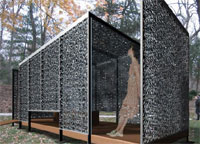 A Daily Dose of Architecture features some images of Butterflies by Della Valle + Bernheimer on display at the Philbrook Museum of Art LANDed exhibition.
Link: A Daily Dose of Architecture
More images: Della Valle + Bernheimer
Reference: LANDed (L+L)
Harborside park created from a former oil tank facility on North Sydney's Waverton Peninsula
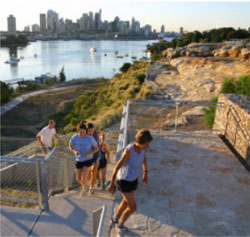 Led by landscape architect and urban designer Adrian McGregor, Sydney and Newcastle based mcgregor+partners are proponents of a new genre of environmentally focused landscape architecture which they frame within a modernist design approach.
This recent project, officially opened on March 12, 2005, is the first of three former industrial sites on the Waverton Peninsula to be transformed.
Firm: mcgregor+partners [Thanks, Tennille!]
Link: North Sydney Council BP Site Parkland
Images: Prior condition & remediation (pdf)
Images: Site construction (pdf)
Images: Opening (pdf)
USC Landscape Studio: projects by Harmil Raikhy, Kay Sales and Naomi Sanders
 The saga continues... sorry for the brief delay. I had been waiting in hopes of adding some more images which I will explain below.
And as the review continued on, we were plied with Jesus Juice... ahem... actually, we were treated to tasty homemade wine. Apparently one of the students makes batches of wine aged in her closet... quite impressive really.
This entry will complete the feature on the BrownLAb studio, and I must say that I thoroughly enjoyed the opportunity to see the work of this hardworking group of students. These small images and brief descriptions presented here are barely a glimpse into this vast project.
BrownLAb - Part I
BrownLAb - Part II
BrownLAb - Part III
Web exhibition for MoMA's landscape design showcase
 The Groundswell exhibit at MoMA may be closed, but it lives in digital form.
This website features images and information of all twenty-three projects from the show organized around an interactive world map. Six of the projects are explored in detail.
Link: Groundswell MoMA
Via: The Dirt
Reference: Groundswell (Land+Living)
Reference: More Groundswell (Land+Living)
Landscape designers from around the world compete at the Chelsea Flower Show in London
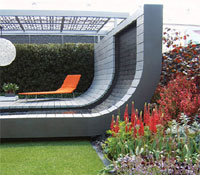 The famous annual garden show at Chelsea is now open, and the garden design winners have been announced. Here are a few of our favorites from the winners list.
Link: Chelsea 2005 awards
Link: Chelsea Flower Show 2005
Link: BBC Coverage of the Chelsea Flower Show
Reference: Chelsea 2005 (Land+Living)
USC Landscape Studio: projects by Jillian Morgan, Amy Morie and Ray Nagahata
 About half way through the review, we were treated to goodies from India Sweets and Spices... mmm mmm mmmmm. I wish I could share the same with you since we are now half way through our coverage of the studio, but sorry to say you're on your own.
Let's get back to the relevant topic. Part of the research for the studio included the study of brownfield and reclamation precedents including Westergasfabriek, the High Line, work by Peter Latz, etc. These kinds of projects are very exciting and make landscape architecture so very relevant in the world.
BrownLAb - Part I
BrownLAb - Part II
BrownLAb - Part IV
USC Landscape Studio: projects by Erin Lau, Catie Lee and Catherine McLaughlin
 Before we carry on with part deux... a quick note: the student work is not shown here in the same order in which they were reviewed. Not that this is necessarily important, but I figured that I would just point this out along the way.
Overall the student work was very developed and considered, especially given the size and complexity of the site, and the fact that there was not a prescribed program. While certain elements are shared between many of the projects, each student had a unique take on the program, remediation process and site development.
BrownLAb - Part I
BrownLAb - Part III
BrownLAb - Part IV
USC Landscape Studio: Introduction and projects by Claire Cottrell and Veenu Jayavam
 I participated on a jury for a USC landscape architecture studio as I mentioned a couple of weeks ago and had intended to do a write up last week. But (in addition to just being busy) I soon realized the challenge that lay before me as I began to sift through the notes and images that I have compiled.
The problem: how to do justice with limited time and space to all of the hard work of this group of students? Since I have already had my chance to "review" them, I will refrain from offering too many comments and will instead provide a gallery of their work.
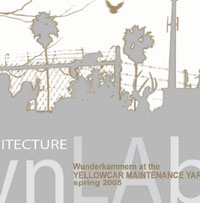
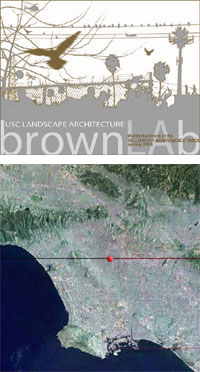
The studio was entitled BrownLAb: Wunderkammer @ the Yellow Car Maintenance Yards. The project location is a brown field site in south Los Angeles, a former maintenance yard for the defunct Yellow Car rail transit network. The industrial functions of the facility over the years have left the site contaminated.
Currently, the site is underused but does serve several functions. The MTA uses some of the remaining maintenance buildings on the south edge and a school for "at-risk" students occupies the north west portion of the site. The most active function of the site is a swap meet on the north eastern edge which functions as a community gathering place for the surrounding neighborhood.
Seeing student work is refreshing. Unlike the majority of my work in the "real world," it is all about the process of design, analysis and presentation. The limitations on creativity are basically nonexistent. David Fletcher and Tom Leader created an outstanding studio project and environment; the resulting student work was well developed and intriguing, the product of collaborative investigation and individual design development.
BrownLAb - Part II
BrownLAb - Part III
BrownLAb - Part IV
A layered garden in London
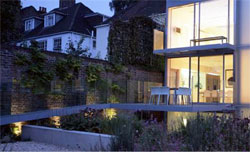 Jinny Blom is a London based landscape designer who's core interests include art, ecology, restoration and modernism. Her designs feature studied and structured plan overlaid with wild and naturalistic planting schemes.
This modern garden serves as an extension of the remodeled and expanded home by Eldridge Smerin Architects, in the Hampstead Village Conservation area of London. Inspired by the materiality of Carlo Scarpa, Ms. Blom defined the landscape as an extension of the modernist addition with concrete, glass, limestone and steel. The rich colors of the planting contrast and soften the rigid forms and materials.
Firm: Jinny Blom
Green Spaces in the Sky
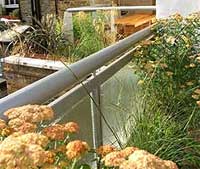 Continuing our theme of blogs from across the pond, Urban Roof Gardens is London's only multi-disciplinary team of architects and designers that focus exclusively on roof gardens and green roofs. Their website features a portfolio with gardens from around the world including Edinburgh, Amsterdam, New York, and San Francisco. I only wish I could design my ground-level garden to look as good as these.
This is the mission of Urbanroofgardens: To raise awareness of the benefits of urban roof gardens, terraces and green roofs. To collate and publish world-class research and best-practice relating to urban roof gardens. And to offer concept to completion advice and services to both the lay and the professional citizen wishing to build urban roof gardens.
Link: Urban Roof Gardens [Thanks, John!]
Maximizing a small landscape in North London
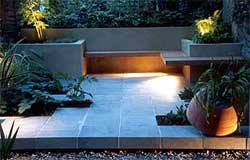 Designed by Tel-Aviv born, London based garden designer Amir Schlezinger, this contemporary woodland garden makes the most out of a small yard and extends the interior out and the exterior into the house. It is a "beautiful yet highly livable" space, a true outdoor room.
The same gray sandstone used inside the home was used as the primary paving surface in the garden to help visually merge the spaces. The irregular shaped patio and concrete planter walls with iroko benches articulate the space and create an illusion of space. Bright orange electrifies the basin of the minimal cube water feature and echoes a color used inside the house as well. The simple yet layered planting palette compliments the design perfectly.
Firm: MyLandscapes
A house inspired by the New Zealand landscape
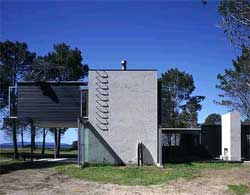 I can't recall how I came across the website of Auckland, New Zealand, based architects Fearon Hay, but it was a happy find... one look at the Coromandel House and I was hooked.
The house is beautifully linked to its site and landscape. In fact, architects Jeff Fearon and Tim Hay conceived of the house and landscape design together as an integrated whole. The plan assimilates indoor and outdoor living spaces with window walls which slide away to open the house to the extensive decks and patio spaces.
Firm: Fearon Hay Architects
Garden-as-a-sculpture and sculpture-as-a-garden
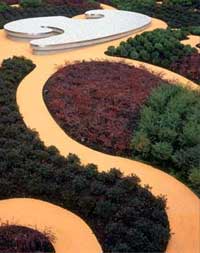 My smart cousin who is a student at Carnegie Melon University in Pittsburg tipped me off to this new campus garden designed in collaboration by artist Mel Bochner and landscape architect Michael Van Valkenburgh.
The garden is a physical manifestation of Carnegie Mellon's multidisciplinary philosophy, a communal crossroads of the arts, business, science and humanities. The garden is an intimate gathering space and a foil to the large formal lawns, quads and early 20th-century Beaux Arts architecture that dominate the campus.
The University has a wonderful website that provides extensive information about the design, the players and the plantings, as well as information about how to visit.
Link: Kraus Campo
Artist: Mel Bochner
Firm: Michael Van Valkenburgh Associates
Fresh and imaginative landscape design
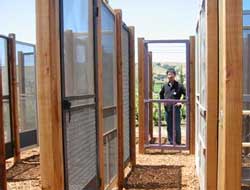 Formed in March, 2001, the Tom Leader Studio is a collaborative and experimental office designing based in Berkeley, California. Tom's work is modern and rigourous with roots based in the pioneering methodology of Peter Walker, where Tom was formerly a partner.
The Studio designs on a variety of scales and their projects span the globe, including the Shanghai University Hub which is currently being featured at Groundswell, and Break Out at Cornerstone Festival of Gardens.
Link: Tom Leader Studio
Simplicity. Defined.
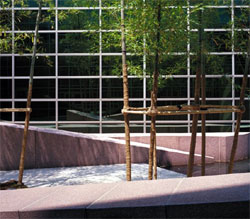 In the past, the majority of our landscape posts, with a few exceptions, focused primarily on residential projects. However, when I came across Mikyoung Kim's Contemplation Garden, I thought it would fit in quite nicely with the other posts in this category.
In this spare entrance garden, bamboo, moss, water, and granite are used to create a contemplative courtyard and sculptural pool. The granite water wall invites users to engage directly with the water before entering the contemplative area where the pool reflects the movement of the sky.
Also be sure to check out Mikyoung's "Navigations Garden".
Link: Mikyoung Kim
Eclectic Southern California gardens
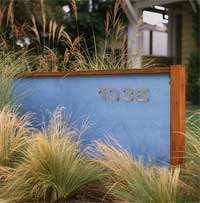 I met Rob Steiner back when he was partners with Jay Griffith... it was an interview actually... and I didn't take the job. But that is another story. I liked Rob's work at the time, and I like it now.
Steiner brings a modern sensibility to his designs which are wonderfully composed and structured architecturally to create outdoor living spaces and extend and/or transform the architecture of the house. He is especially adept in his planting plans which (to borrow from his website since this says it best) "are distinguished for their graphic quality, successional bloom, subtle modulations of tone and year-round foliage interest."
Firm: Rob Steiner Gardens
Landscape — February 23, 2005
Posted by James
Landscape design build in Seattle
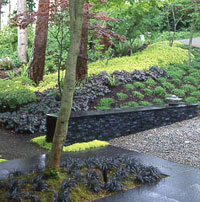 Here is a word you may not have heard since high school biology class:
Cambium (kam' bë um) a layer of formative cells located below the bark of woody plants, reproducing by division and creating
new growth.
But Cambium is also the name of the design and construction company of Seattle based landscape architect Tim Moshier. Appropriately, they will provide new growth in your garden.
Their website features a nice portfolio of five residential projects, and we are particularly impressed with their skillful selection of plants for color and texture to create striking effects. Superb design and execution.
Link: Cambium
Landscape — February 21, 2005
Posted by James
A sexy rooftop garden in Minneapolis, Minnesota
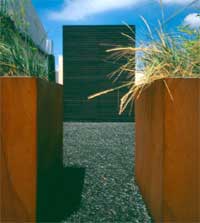 This modern garden is located on the 10th floor of a converted historic warehouse in downtown Minneapolis. The landscape was designed by oslund.and.assoc in conjunction with the project architects, Anmahian Winton as an extention of the interior spaces and as a counterpoint to the historic urban context. Storm water is collected and reused to sustain the plantings.
The garden terrace synthesizes the architecture and the landscape within a shared modernist vocabulary. The loft architecture and landscape sustain a symbiotic relationship where each is enriched by the other, managing light and form outside of the traditional garden-residence paradigm.
Link: oslund.and.assoc
Link: Anmahian Winton Architects
A garden and bridge linking two halves of a mall
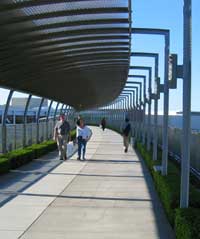 More from my trip to Orange County, this time at the throne of consumersim *gasp* a mall. They have the Gap and Hot Dog on a Stick, and hey look! They have good design too!
This is a pedestrian bridge built in 2000 connecting two parts of a large shopping mall designed by a collaborative team of Kathryn Gustafson (Gustafson Guthrie Nichol), Ellerbe Becket and Anderson & Ray.
It is an interesting solution to a utilitarian need; a pedestrian connection across a parking lot and busy street, and the mediation of a change in elevation. The bridge is called the "Bridge of Gardens," a ridiculous name probably dreamed up by the mall, but that name does at least hint towards the marriage of landscape, engineering and architecture.
I have seen this published before, but never with more than a couple small images... so check it out... I went overboard on the pics just for you.
Firm: Gustafson Guthrie Nichol - Landscape Architecture / Art
Firm: Ellerbe Becket - Architecture
Firm: Charles Anderson (formerly of Anderson & Ray) - Landscape Architecture
Firm: HNTB - Structural Engineering
Link: South Coast Plaza
Noguchi landscape in Costa Mesa, California
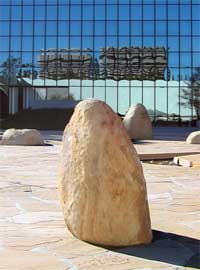 Designed by the famed American sculptor Isamu Noguchi with landscape architect Ken Kammeyer in 1980, this is a remarkable work tucked between office two towers and a parking garage.
I was in Orange County yesterday and I made a point to seek out this famous garden which I have overlooked many times before. I knew that it was hidden away somewhere amongst the office towers and car-oriented avenues, and the discovery of this calm pedestrian space upon exiting a typical parking garage was at once calming and mind-blowing.
So now, at least ten years after I was made aware of this landscape, I have finally been there... and I took lots of pictures for your perusal. This description of the garden is is far more in depth than our synopsis.
| Visit: | South Coast Plaza Town Center |
| | 611 Anton Blvd |
| | Costa Mesa, California |
| UPDATE 5/5/10: The landscape architect leads tours twice per year; contact Ken Kammeyer for upcomming dates. [Thanks, Ken!] |
Link: Noguchi Museum - California Scenario
Landscape Architect: Kammeyer and Associates
Reference: Isamu Noguchi Stamps (Land+Living)
Reference: The Isamu Noguchi Garden Museum (Land+Living)
Interventions on industrial sites and ill defined open spaces
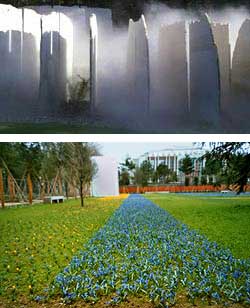 Landscape architect Peter Latz, based in Kranzberg, Germany, practices what he preaches; defining and reclaiming the landscape with an eye on ecology and social needs.
The practice of Latz + Partner focuses on "the renewal of destroyed and often contaminated sites, - a new balance in the traffic infrastructures and - the spatial and material framework of ecological programmes." Their work tackles gritty urban and industrial sites with attention to expressing the history and character of the land.
The website may be a bit cumbersome to navigate and dense, but it is packed with information and images just waiting to reward the focused browser. Plus, you can take your pick of German, English or French text... In Ordnung; all right; bien.
Link: Latz + Partner
An courtyard garden space for a Boston condominium complex
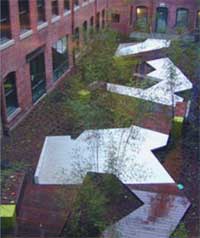 This garden occupies the inner court space of an old printing house in Boston that has been converted into residential condominium units. The design solution, by Salem, Massachusetts based Landworks Studio, creates usable communal space while at the same time providing privacy and varied views for the inner condo units.
In contrast to the regularity of the existing structure, the landscape architects employed a concept of fragmentation; in the plantings, pathways, materials, topographic undulation, etc. Groovy lighting elements transform the space at night with a yellow green glow emanating from the benches and a fiber optic web amongst the bamboo. The design provides an stylish contemporary foil to the historic building.
Link: Landworks Studio
Australian landscape firm
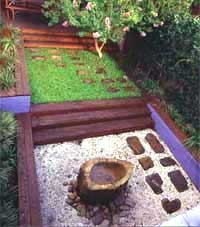 Staying Down Under for the moment, we move from lamps to landscapes.
We ran across this site for landscape designer Kristen Martin of Erskineville, New South Wales some time back. Unfortunately there is not much on the website... but we keep coming back to it.
Though the website may not be very informative or well designed and the images are few and mostly small, something in those little images speaks to us. It doesn't blow your socks off, there is just some nice understated, yet high quality design work shining through.
So please, pay a visit, won't you?
Link: Kristen Martin Landscape Architects
Graphic landscapes
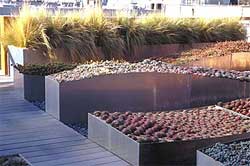 We have seen the work of this seven person San Francisco based landscape firm before in publications, but somehow just happened to stumble across the website today. The bold and graphic qualities of their designs have beautifully textural and architectural qualities.
While their website is really just an online CV, it does feature photo layouts of three residential projects. Wonderful work, we suggest that you take a gander.
Firm: Andrea Cochran Landscape Architecture
Art on the landscape
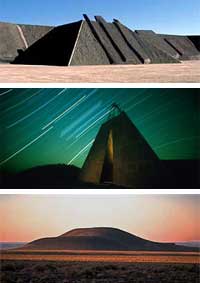 A recent article in the Guardian by Sean Thomas talks about the history of land art and three important works nearing completion: Michael Heizer's City, Charles Ross's Star Axis and James Turrell's Roden Crater (web site under construction).
While the article just barely scratches the surface of the opening question -- "Is it a monumental way to adorn the planet - or just arrogant vandalism?" -- the article is still worth a read.
Article: Guardian - This epic Earth
Other land art links:
Link: Richard Long
Link: Irish Sky Garden - James Turrell
Link: Lightning Field - Walter De Maria
Link: Robert Smithson
Link: Spiral Jetty - Robert Smithson
Reference: Andy Goldsworthy (Land+Living)
Reference:
Satell(s)iteseeing (Land+Living)
Landscape — December 22, 2004
Posted by James
Three projects by this central figure of contemporary landscape design in Southern California
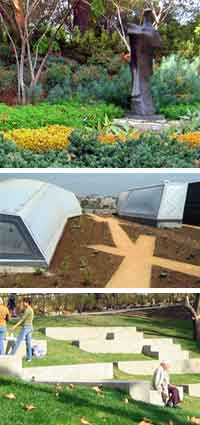 Nancy Goslee Power's name may not be as well known to the general public as say Frank Gehry, but then, the general public would most likely have trouble coming up with the name of any landscape designer *sigh*. But Nancy Goslee Power has collaborated with many "big names" including The Frank, Moore Ruble Yudell and Rem Koolhaas, and she is an important figure in contemporary landscape design. Her landscapes are modern, but not typically of the boldly sculptural type. They are architectural, but not rigidly geometric.
We recently visited three of her recent projects in Pasadena, California. She was chosen by Frank Gehry to work with him on the remodel of the Norton Simon Museum where she reworked the extensive gardens. At the new Art Center South Campus by Daly Genik she created a meadow-like roof garden. And just last week the first phase of the new Kidspace Museum designed by Michael Maltzan was opened featuring a range of outdoor exhibits, spaces and interactive gardens.
Also, an article in last week's LA Times covers the work at Kidspace and provides a detailed look at her life and career.
Firm: Nancy Goslee Power & Associates
Link: Norton Simon Museum - Garden
Link: Art Center College of Design South Campus
Reference: The Wind Tunnel (Land+Living)
Link: Kidspace Children's Museum - Back 40 garden
Article: LA Times - An artist of the alfresco
Locations: Local+Living : Pasadena
Landscape — December 16, 2004
Posted by James
An installation by Eisenman at the Museo di Castelvecchio in Verona, Italy
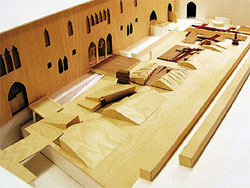 American architect Peter Eisenman has been in the news this week as his design for the Holocaust memorial in Berlin nears completion. About 500 miles to the south, another Peter Eisenman work is being displayed at the Museo di Castelvecchio, the Garden of Lost Footsteps. These two examples of topographic landscape-type installations are, to us, the most interesting work by Eisenman since his numbered houses back in the "New York Five" days. In fact, we wouldn't mind seeing more landscape design by bad boy Pete.
Link: Museo di Castelvecchio
Design: Eisenman Architects
Via: Architectural Record, 12-04 print edition
Vancouver, British Columbia based landscape architecture and urban design firm
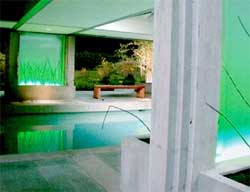 Space 2 Place works on a wide range of projects from residential garden redesign to skate parks.
Through design we transform sites (spaces) into places for our clients. Our places embody a philosophy of strong simple design that responds to the environmental and cultural processes influencing each site. Our philosophy is based upon respect - for our clients, for the environment, and for the power of design.
Link: Space 2 Place
Experiment in environmentally sensitive erosion control
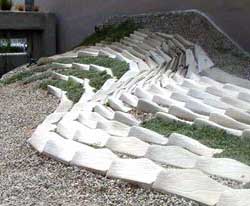 Designed by architect Marcelo Spina of Los Angeles based firm Patterns, Land.Tiles is a system composed of 118 different CNC milled and vacuum formed textured concrete blocks.
Every tile has similar sectional characteristics derived from a process of double pleating a continuous surface. The inherent complexity of the terrain's contours originates a dimensional logic of construction that through a process of subdivision, allow every tile to adjust to its site specific condition while maintaining its prototypic geometry and morphological qualities.
Designer: Patterns
1960's California stucco box house updated on a budget
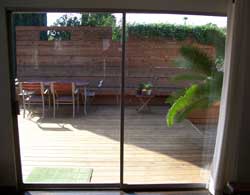
Updated and refreshed on a budget, this house in San Gabriel, California is an example of significant cosmetic transformation on a budget... specifically my budget.
Building on the simple stucco box form, the design is clean, modern and simple. Throughout the house and property, the key was to get the most bang for the buck by using a minimal palette of materials and to reuse much of the existing material on site.
Design: Studio J2L
German artist
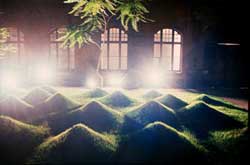 Susanne Lorenz is a Berlin based artist who's work explores the boundaries of landscape, architecture, urbanism and the public realm. Her projects include a wide variety of installations, public sculpture, objects, and architectural projects.
Link: Susanne Lorenz (German)
Striking and simple solution by Lekker Projects
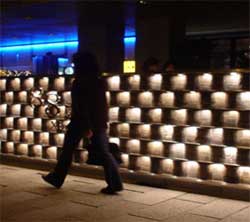 We've said it before, but we must say it again: it is the simple solutions that we often find to be the most elegant.
In this case, Lekker Projects, a small environmental design firm with offices in Shanghai and Singapore, was faced with the problem of correcting bad Feng Shui while creating a distinct signage element for the 88 Xintiandi Hotel in Shanghai. The solution was to use Chinese roof tiles (the symbol of the hotel) in an inventive way to create a simple but striking result. The form of the tiles are instantly recongnizable, but their application is inspired.
Firm: Lekker Projects
Link: 88 Xintiandi
Landscape — November 8, 2004
Posted by Anthony
Modern landscape design aesthetics meets environmental sensitivity
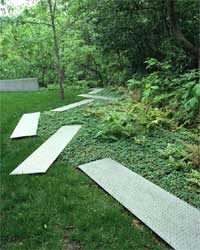 Lush modern landscape from NY based firm Michael Van Valkenburgh Associates.
The Garden on Turtle Creek, started in 1997 and completed in May 1999, is a model for the union of modern landscape design aesthetics and environmental sensitivity. Weaving new landscape elements into the sites natural systems and intense native vegetation, the garden mediates two strong contextual forces: the sophisticated glass, limestone, and concrete house, designed by Antoine Predock from 1987-1993, and the unpredictable site condition of a steep, richly vegetated slope that descends into Turtle Creek.
Link: Michael Van Valkenburg
New public park built on the site of a former gas works
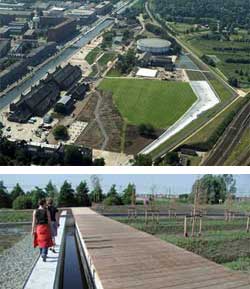 Westergasfabriek is a culture park in Amsterdam created on the brownfield site of a former gas works. The master plan and landscape was designed by Kathryn Gustafson with Francine Houben of Mecanoo. Landscape elements include a large events field and theatre square as well as many promenades, gardens, forest and ponds.
Unlike most brownfield reclamation projects, Westergasfabriek incorporated the existing buildings and structures into the project retaining the history of the site. The project is also ecologically sensitive; all soil was retained and reused on site, and solar panels now grace the frame of the former gas plant.
Link: Westergasfabriek
Firm: Gustafson Porter
Firm: Mecanoo
Link: Archined - images and text (Dutch)
A modern day Zen priest who strives to express his spiritual self through landscape
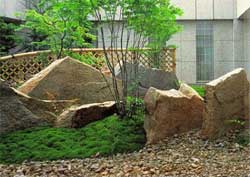 Shunmyo Masuno is not only a Zen priest, but also president and founder of Japan Landscape Consultants, an firm founded inb 1982 and known worldwide for their landscape designs.
When asked what the garden means, Shunmyo explains, the garden is a special spiritual place in which the mind dwells. The gardens he creates are the places which hold his expressions of mind.
Shunmyo refers to gardening as his spiritual training ground in his quest of a higher understanding of himself.
Link: Shunmyo Masuno + Japan Landscape Consultants Ltd.
Article: International Herald Tribune - Zen and the art of landscaping
Via: Archinect
Landscape — September 24, 2004
Posted by James
Los Angeles landscape architecture and urban design firm
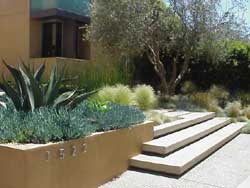 Here is some nice regional landscape design by Michael Schneider of Orange Street Studio.
Their expertise lies in transforming stylish conceptual designs into elegant outdoor spaces. And their designs are distinctively Southern Californian. From modern and minimal, Mediterranean, to tropical and desert; steel pergolas are complimented by mass plantings of ornamental and native grasses or sculptural vines and trees; cooling water elements are interwoven with succulents and aromatic plantings; spectacular pools are highlighted by playful or sophisticated lines. Orange Street Studio is valued by their clients for an eye for the unusual, attention to detail and creating the extraordinary.
Link: Orange Street Studio
Master plan seeks to encourage environmental sensitivity and celebrate cultural diversity
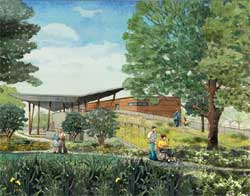 The concept for this master plan consists of four interrelated themes - A Water Synthesis, The Cultural Connection, The Green Connection (or sustainability), and Plants in Community (Plants in natural associations or ecosystems). Each of these themes are a facet of the underlying idea for the master plan, which only together form a cohesive vision of enduring sustainability.
The scope of work includes a new 15,000 square foot Reception and Administration Building by BKSK Architects.
The concept for this master plan consists of four interrelated themes - A Water Synthesis, The Cultural Connection, The Green Connection (or sustainability), and Plants in Community (Plants in natural associations or ecosystems). Each of these themes are a facet of the underlying idea for the master plan, which only together form a cohesive vision of enduring sustainability.
The scope of work includes a new 15,000 square foot Reception and Administration Building by BKSK Architects.
Firm: Conservation Design Forum - Lead consultant landscape and planning (PDF)
Firm: BKSK Architects - Architecture
Firm: Atelier Dreiseitl - Water specialists
Link: Queens Botanical Garden
Via: NY Times - A Queens Garden Gives New Meaning to 'Green'
A modern approach to suburban development ties agricultural traditions to the Midwest landscape
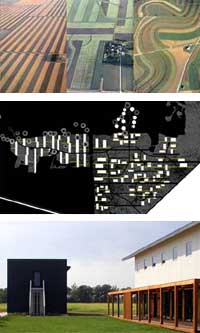 Minneapolis, Minnesota based Coen + Partners is a landscape architecture, urban design and planning firm with a modern approach that is influenced by regionalism.
It is our intent to create interfaces between cultural and natural systems with lasting social and ecological impacts. Designed spaces can articulate and highlight physical relationships in ways that bring meaning and beauty to man-altered environments.
Coen + Partners headed the planning and design for the Mayo Woodlands, a thoughtful reinterpretation of a typical residential subdivision near Rochester, Minnesota. The firm altered the inherited street and lot layout with four interventions: first, native prairie grasses overlay the site creating a uniform natural field; second, building sites for each residence were carved out of the prairie in an orthogonal layout deemphasizing the curving cul-de-sacs; third, traditional agricultural windbreaks of pine trees were laid across the site from east to west; and fourth, a series of low east/west walls and fences delineate paths connecting the neighborhoods. In addition, the colors of the houses are to graduate from off-white to grey and black as one moves through the site towards the river.
Firm: Coen + Partners
Firm: Salmela Architecture & Design
Firm: Altus Architecture
Link: Mayo Woodlands
Link: ASLA Award
Article: Star Tribune (registration required)
Landscape — September 2, 2004
Posted by James
Landscape in Highland Park, Illinois by Daniel Weinbach & Partners
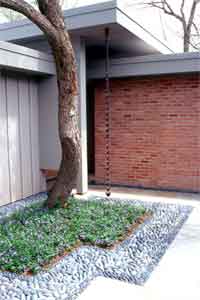 This residential landscape by Chicago based landscape architecture firm Daniel Weinbach & Partners caught our attention with its effective integration of interior and exterior spaces.
The thoughtful integration of architecture into the landscape through the use of materials and geometry is effective and beautiful. Moving away from the house, the geometry loosens and the design transitions gracefully to a more naturalistic state.
Firm: Daniel Weinbach & Partners, LTD
Fine Gardening's Guide to Pronouncing Botanical Latin
OK, this is really boring, but for those with an interest in landscape, well... you'll probably be bored as well. My compatriot here at L+L says that I butcher the Latin names of plants. Admittedly, my Latin stinks, but at least I know that Pinus, Latin for "pine," is pronounced PY-nus, unlike a certain client who was confused with a part of the male anatomy... wrong kind of wood, my dear.
Link: Fine Gardening's Guide to Pronouncing Botanical Latin
New website with more images and information
 The Cornerstone Festival of Gardens in Sonoma, California has launched a new and expanded website.
In addition to general information about the festival the new site features detailed descriptions of each of the gardens with images.
Link: Cornerstone Festival of Gardens
Reference: Cornerstone Festival of Gardens - UPDATE I (L+L)
Reference: Cornerstone Festival of Gardens (L+L)
UPDATE: An article from this weekend in the New York Times features a nice write up and slide show.
Link: Avant-Green: Landscaping as a Fine Art
Influential 20th century Brazilian landscape architect
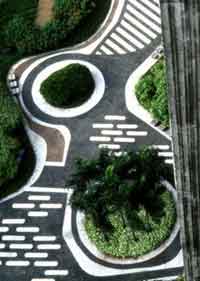 Following up on our post yesterday about contemporary Brazilian landscape architect Roberto Burle Marx, we have complied some links to websites that feature images of his works. One of the sites is in Portuguese and another in German, and both of those are somewhat difficult to navigate, but the effort is well worth while. Unfortunately, there are few images on the Burle Marx firm website (Burle Marx & Cia. continues today lead by Marx's partner Haruyoshi Ono who joined the firm in 1968), but there is a little bit of history.
"Roberto Burle Marx is internationally known as one of the most important landscape architects of the 20th century.
"An artist of multiple facets, besides being a landscape designer he was also a remarkable painter, sculptor, singer, and jewelry designer, with a sensibility that is shown throughout his work."
Firm: Burle Marx & Cia.
Visit: Sítio Roberto Burle Marx (via Maria Brazil)
Link: Burle Marx (via Brazil Gov't - Secretaria de Estado da Fazenda do Espírito Santo)
Link: Roberto Burle Marx: The Missing Link (via Hannes Loipetsberger thesis website)
Reference: Roberto Burle Marx: The Lyrical Landscape (L+L)
Susan Saarinen, daughter of famed architect Eero Saarinen, finds her creative outlet in landscape architecture
She grew up surrounded by artists and modern design masters; her mother was a sculptor, her father and grandfather were famed architects Eero and Eliel Saarinen, and her godfather was Charles Eames. Art and design have truly been part of her everyday life.
"At dinner every night, we had discussions about art or design in some form," she says. "It was a very rich environment in terms of art and design. I didn't know until much, much later how much I picked up by osmosis."
After a series of career and life changes, Susan now runs a small landscape architecture practice in Golden, Colorado.
Link: Rocky Mountain News - Artist, designer by nature
Firm: Saarinen Landscape Architecture
The mid-century designs of famed landscape architect Robert Royston
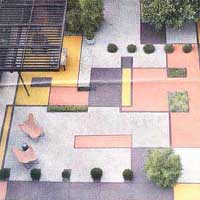 We love the work of Bay Area landscape architect Robert Royston who was one of the pioneers of modern landscape design. He was partners with Garrett Eckbo and Ed Williams in a firm that shaped the California School of landscape design. The firm continues to this day as Royston Hanamoto Alley & Abey. This online portfolio provides a glimpse into the early work of Robert Royston and his influential designs.
Link: Postwar Portfolio - Robert Royston
Firm: Royston Hanamoto Alley & Abey
A master planning approach to landscape design serves up a system of healthful opportunities
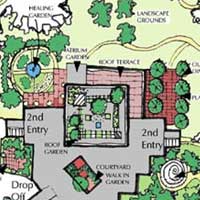 A feature at ArchNewsNow by Jack Rubinger looks at environments for healing and the master planning for seven Samaritan Health Services facilities in Oregon. Macdonald Environmental Planning of Portland and Bend, Oregon, facilitated a process that went beyond just the physical facilities to shape an overall philosophy and vision for Samaritan Health Services.
Link: ArchNewsNow
Firm: Macdonald Environmental Planning, p.c.
Reference: Resources about healing gardens (L+L)
A comparison of native and traditional gardens.
 In Los Angeles where the population is increasing but the water supply is not, there's been a push as of late to give residents ideas on how to conserve. Back in May, we mentioned how LA's Dept. of Water & Power was offering free shade trees to residents in an effort to cut down on future power bills. Now, the Metropolitan Water District, has provided the City of Santa Monica with a $20,000 grant to help them develop a water-conservation garden experiment called "Garden/garden."
"Garden/garden is composed of two adjacent front yards showing two different approaches to garden design. The "California-friendly" garden showcases native plants, a dry creek bed and efficient irrigation. While the adjacent "Traditional" garden includes more typical features brought to Santa Monica from the east. The native garden requires about 75% less water and maintenance than the traditional garden."
If anyone has any more info on this project or knows of a website with more pictures and/or information, please let us know.
Link: Garden/garden
Related: Trees for a Green LA
Garden festival featuring an array of noted landscape designers opened today
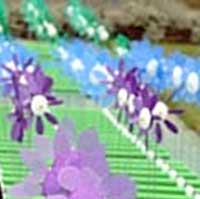 The San Francisco Chronicle ran a nice article by Judy Richter about the new Cornerstone Festival which we featured last month.
Eventually Cornerstone will have 28 to 30 gardens with each remaining one or two years. "It will be like a museum with temporary exhibits," Hougie said.
Cornerstone features cutting-edge design, "the kind that may or may not be suitable for home gardens" but that will challenge people to think, he said. Intended to appeal to both gardeners and artists, "it's a place to be inspired. You won't see the ordinary."
Link: Cornerstone Festival of Gardens
Link: San Francisco Chronicle
Reference: Cornerstone Festival of Gardens (L+L)
2004 Professional Awards Recipients Selected
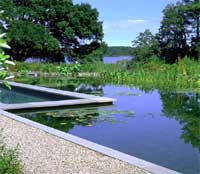
The American Society of Landscape Architects (ASLA) has announced the recipients of its 2004 Professional Awards. The awards will be presented during the ASLA Annual Meeting, October 29-November 2, in Salt Lake City.
Some nice browsing... lots of images and links.
Link: ASLA 2004 Professional Awards
Reference: ASLA 2004 honorees announced
Mondern retreat is embeded in the Texas landscape and recalls the local ranch vernacular
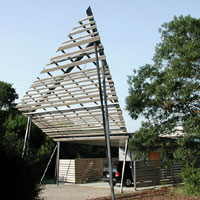 Sited to enhance the various landscapes of forest and meadow of a former ranch, the design vacillates freely between interior and exterior with broad covered porches serving as living and circulation space. Other built elements extend into the landscape including boardwalks and two water features, which attract birds and evoke functional cattle and irigation troughs. Over the years native grasslands and wetlands on the property have been restored by the owners. The only manicured portion of the landscape is a rectangular field of water conserving buffalo grass bordered on two sides by the "L" shaped house.
Architecture Firm: buildingstudio
Landscape Firm: MESA Design Group
Via: Architectural Record
Better four years late than never
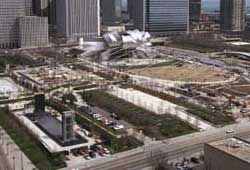
Chicago's new 24.5 acre Millennium Park is be unveiled next week with the grand opening ceremony on July 16th and festivities planned throughout the weekend.
The park has its share of designer credentials with Frank Gehry, Kathryn Gustafson and Anish Kapoor just to name a few.
Link: Millennium Park
Link: Public Building Commission of Chicago
Link: Millennium Park - unofficial site
Link: Archinect (Pritzker Pavilion photo gallery)
Landscape architect Catherine Mosbach creates a new garden at the Bordeaux Botanical Garden
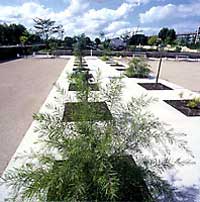 The new Bastide Garden at the Bordeaux Botanical Garden in France by landscape architect Catherine Mosbach is designed to deal with issues of biodiversity, renewable natural resources and the dynamics and mutation of landscapes. The concept is that of the artificial "botanical object" for the layout of the gardens.
a-matter has a nice article about the garden with photos and plans.
Link: a-matter
Visit: Jardin Botanique Bordeaux: La Bastide
Not Your Grandma's Garden Festival
 Inspired by the famous garden festival at Chaumont in France, Chris Hougie teamed with Peter Walker to create an American avant-garde garden show. The Cornerstone Festival of gardens is located in Sonoma Valley, California, about a 40 minute drive north of San Francisco.
The show features well known landscape architects and designers such as: Peter Walker; Lutsko Associates; Mark Rios; Ken Smith; Walter Hood; Martha Schwartz; Andy Cao; Mario Schjetnan; and Pamela Burton.
Link: Cornerstone Festival of Gardens
Via: ASLA Landscape Architecture News Digest
Princess of Wales Memorial Fountain to be dedicated next week
 The delayed and (naturally) controversial memorial to Princess Diana has been completed and will be officially dedicated July 6th by Queen Elizabeth. The design by American landscape architect Kathryn Gustafson was selected by the memorial committee in a design competition. Culture Secretary Tessa Jowell has described the memorial as such: "Like the Princess herself, the fountain is open and approachable. In some areas it offers a welcoming space for families and paddling children, in others a shady spot for quiet contemplation."
Link: BBC News
Link: The Guardian
Link: Royal Parks Press Room (detailed description of design and construction process)
Firm: Gustafson Porter
Master of complexity and spaciality in the landscape
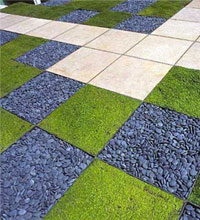 Well known and broadly published landscape architect Ron Herman has designed gardens for celebrities such as Joe Montana and Neil Young and for corporations and institutions such as Oracle and the National Gallery in Washington D.C. He studied with California landscape greats Garret Eckbo and Lawrence Halprin at Berkeley and went on to graduate school in Japan. These influences can easily be seen in his creative, expansive and dynamic landscapes.
We respect his attention to detail as well as his ability to manipulate space and layer a landscape in such a way that it feels larger than it actually is.
Firm: Ron Herman Landscape Architect
Longtime Chicago mayor has vowed to make his city the greenest in the nation.
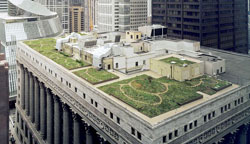 Lisa Chamberlain at Metropolis writes:
"On March 30, 2003, in the dead of night, a bulldozer lumbered through downtown Chicago toward its much celebrated lakefront. Dispatched by Mayor Richard M. Daley with a police escort, it turned onto a 90-acre peninsula, home to a tiny airport known as Meigs Field, and without warning, plowed giant Xs into the airport’s single runway, rendering it useless. Chicagoans were stunned by this seemingly bizarre act of destruction. Mayor Daley said the war in Iraq and fears about airport security were the reasons for bulldozing the runway. This brass-knuckles move, however, stranded 16 airplanes—infuriating the corporate community and cementing Daley’s reputation as an autocrat. Of course, it’s not unheard of for unilateral action to be justified in the name of national security, even if the real motive turns out to be quite different. So what was the mayor’s strong-arm tactic really about?
Believe it or not, a simple park."
Link: Metropolis
Washington Post writer Joel M. Lerner writes about the increase in requests for "natural" solutions to landscape opportunities and problems amongst his columns. In the article, he covers native plants, annuals and perennials, pest management, and more.
"When you work in a field for a long time, it can seem that the same things happen, day after day. But occasionally, it's a good idea to sit back and take a look at what has been going on. A couple of rainy days recently gave me some time to look over the topics of my roughly 400 columns and identify some new threads in the landscape fabric. For instance, I noticed an increasing desire in recent years for "natural" solutions to landscape opportunities and problems. Here is more on that topic and other topics of increasing current interest."
Link: Washington Post
Australian landscape architecture firm headed by Richard Weller and Vladimir Sitta
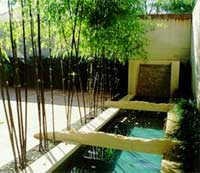 An impressive portfolio of bold landscape designs, theoretical writings, and sketches. Their website is a bit cumbersome and layered, but well worth the effort.
Whilst Room 4.1.3's central expertise is landscape architecture it specifically encourages and supports interdisciplinary and diverse modes of production and discourse. Room 4.1.3 is concerned with translating ecological and poetic readings of places into urbane, innovative, built forms which are intellectually labyrinthine. Therefore, the work is both monstrous and joyous, both popular and personal.
Firm: Room 4.1.3.
Daly Genik's new building for Art Center College of Design in Pasadena, CA
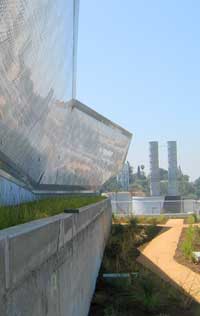 Speaking of roof gardens (we always end up with some kind of theme running through our posts) the newly opened building at the Art Center College of Design South Campus features a planted roofscape designed by Nancy Goslee Power. We made a visit a couple weeks ago and took some pictures... should've charged the battery... but oh well...
The first major exhibition to be held in The Wind Tunnel is happening right now: a region-wide exhibition of all the artists graduating the MFA programs at Art Center, CalArts, Claremont Graduate University, Otis, UCI, UCLA, UCSD and USC.
Also see the article in Metropolis about Art Center's long range campus plans... which, we are relieved to know... include work by Frank Gehry. Too bad he doesn't build much.
Architect: Daly Genik
Landscape Architect: Nancy Goslee Power & Associates
Link: Article in Metropolis
Show: Supersonic Jun 12 - Aug 21, 2004
This innovative project is the only one of its kind in the world.
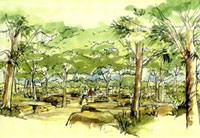 "The Australian Garden will open in 2005. Designed by Landscape Architects, Taylor Cullity Lethlean with Paul Thompson, it will feature the remarkable Sand Garden, an expansive and open garden reminiscent of sparsely vegetated landscapes and the Rockpool Waterway which explores the role of water in shaping the landscapes of Australia, and particularly the beauty of water moving over a predominantly flat land. Also featured will be Display Gardens and the Dry River Walk, where visitors can encounter the beginnings of water flow in our landscape."
Link: The Australian Garden
Firm: Taylor Cullity Lethlean
Designers of landscapes and interior plantscapes
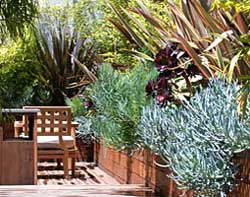 Bay Area designers Davis Dalbok and Tim O'Shea collaborate on landscape designs for gardens and interiors with "a fusion of unique Pacific Rim-styled sensibilities." While we don't necessarily have a problem with the rustic Asian touches used in a sort of interior-design-mode of display, that is not the aspect of Living Green that appeals to us. Rather it is the arrangement, juxtaposition and layering of textures, and colors of their plant material choices that we admire.
Living Green
SOM, James Turrell and Brown Sardina create a sustainable building of landscape and light
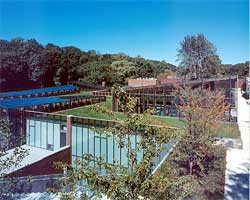 Roger Duffy of Skidmore, Owings & Merrill integrated landscape and architecture in a new building for a private high school in Greenwich, Connecticut, with light artist James Turrell and landscape architects Brown Sardina. The landscape weaves through the building in the form of courtyards, and the roof is literally an extension of the landscape as the sloping site allows the roof of the merge with the ground plane. Transparent glass facades and light cupolas on the rooftops of each structure flood the building with daylight.
In addition to the extensive use of daylight, other sustainable design initiatives include the use of recycled materials, a waste management plan, storm water and irrigation systems, and high quality air and energy systems.
Via: Architectural Record
Firm: Skidmore, Owings & Merrill
Firm: Brown Sardina
Link: Hydrotech Garden Roof system
Landscapes in Wicklow County, Ireland, open May though July
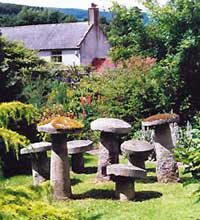 It has been said... or at least the Wicklow visitors bureau has coined the phrase... that Ireland is the Garden of Europe, and Wicklow is the Garden of Ireland. And it is true that the natural beauty of this mountainous region south of Dublin is a sight to behold. The temperate climate provides the perfect environment for spectacular gardens as well. Each summer gardens of all sizes and types, from historic formal gardens to contemporary landscapes and from botanic gardens to small cottage yards, are open to the public as part of the Wicklow Gardens Festival. Perhaps just as appealing is the opportunity to explore the landscape of beer gardens and pubs after hours.
Link: Wicklow Gardens Festival
Westonbirt Festival of the Garden
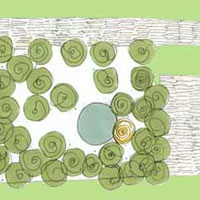 The Brits love their gardens, and the U.K. is awash with garden festivals each summer. There were some wonderful designs last year and this year's designs seem quite compelling as well.
Link: Westonbirt Festival of the Garden
Vasconcelos Library to get complimentary gardens
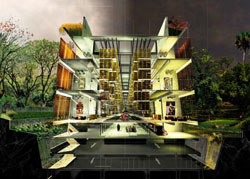 "The urban jungle that is Mexico City will soon be blessed with two oases of calm. The plan is to complement the city's new José Vasconcelos Library scheme with an adjacent botanical garden. The library itself is the work of a team of Mexican architects, Alberto Kalach, Juan Palomar, Gustavo Lipkau and Tonatiuh Martínez. Locals see it as Mexican president Vicente Fox's answer to France's Bibliothèque Nationale de France. Once finished, the library will house more than two million volumes."
Via: Wallpaper
Link: www.conaculta.gob.mx
Photo documentation of the natural and built Japanese landscape
 A photographic documentation of the travels in Japan of two scholarship winners; Roche Scholarship winner Colin Franzen and SOM Traveling Fellowship recipient Zane Karpova. Four "sections" cut across the island were chosen as paths of travel and documentation. The images are keyed to these lines of investigation revealing a wonderful array of landscape, architecture, culture and space.
Link: Franzen and Karpova Japan Sections
Via: A Daily Dose of Architecture
Revisiting Owens Lake
 While this might not really fall under the guise of Modern Lifestyle & Design, this is actually an issue that we've followed over the years and if you're an LA resident, an issue that has had an enormous impact on modern LA society. As noted on our about page, we're avid snow sports enthusiasts and during our pursuits for Sierra Nevada snow, we pass by Owens Lake several times each month. It's nice to read about the efforts the LA DWP is making to restore Owens Lake in a publication such as Metropolis.
"Today, parts of Owens Lake look like a sandy desert floor, parts are under a few inches of water tinted red from algae, and still other parts are covered with a thick salt crust. The lake is the largest stationary source of pollution in America; its amount of wind-blown dust violates EPA standards of particulate matter 20-30 times a year. The EPA’s standard is 150 micrograms per cubic meter; levels measured at the lakeshore reach 12,000.
Now the DWP is trying to reverse the damage it did to Owens Lake. The Department has tapped into the aqueduct to re-direct up to a quarter of the flow back into the lakebed, and is using a combination of shallow flooding and managed vegetation to bring the water body within EPA standards. The project is scheduled to end in 2006 with 29.8 square miles treated.
Link: Metropolis
Related: Trees for a Green LA
Images: © Krystal Chang
Durfee Garden and Bartlett Court on the University of Massachusetts Amherst Campus, and the Plastic Garden
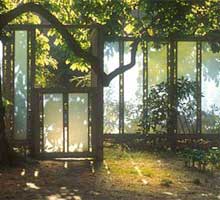 We were taken with these modern gardens by landscape architect Dean Cardasis, Associate Professor at University of Massachusetts, Amherst and the Director of the James Rose Center. The playful yet refined use of built elements of the Durfee Garden and the Plastic Garden create special outdoor spaces year-round. Bartlett Court is a contemplative garden that highlights the geology and traditions of New England with a serene style reminiscent of Japanese gravel gardens.
Link: Dean Cardasis
Visit: UMass Amherst
Long overdue and contentious memorial to those who served is dedicated
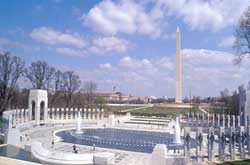 The design submitted by Friedrich St.Florian, an architect based in Providence, R.I., was selected from a group of six semi-finalists in an open, national competition.
Pictures: National WWII Memorial website
Link: New York Times article
Calm dawns in the awessome use of green
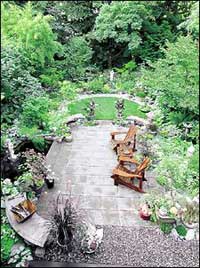 A fantastic Pacific Northwest garden full of birch, locust, and fir trees, placed first in the 11th-annual Pacific Northwest Competition for Home Gardeners out of a field of 94 entrants.
"WHEN JIM AND Charlene Geiszler step onto the upper-level porch of their Shoreline home, they can sink into rattan chairs and relax in complete privacy amid a woodland setting of Japanese maples, vine maples, bamboo, decorative grasses and ferns. A gurgling waterfall in one of two modest pools disguises the rumble from the outside world, including nearby Interstate 5."
Link: Seattle Times Magazine, Pacific Northwest
Photographs: © MIKE SIEGEL
Landscape designers from around the world compete at the Chelsea Flower Show in London
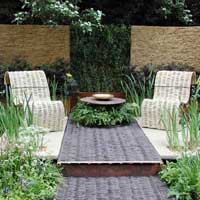 The Chelsea Flower Show is the premier garden show in the United Kingdom and features talented landscape and garden designers from around the world. Designs are showcased in a series of garden categories, and landscapers take the opportunity to show off inventive ideas and to highlight everything from sustainability to low-allergy gardening.
Link: Chelsea Flower Show 2004
Link: BBC coverage of the Chelsea Flower Show
Public gardens in northwest Ohio.
So... you're going to Cleveland... we don't need to know why (family, wedding, business... pleasure?!, whatever). Instead of sending our sympathies, we decided to pass along this list of gardens to visit while doing your time.
Link: Cleveland.com
Disclaimer: We really don't have a problem with Cleveland. We are just poking fun lightheartedly for some cheap amusement. Viva Cleveland!
A southern California love affair that knows no bounds
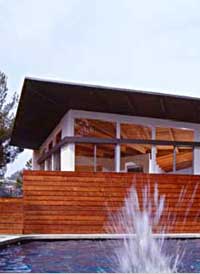 And on the left coast, the weekend's edition of The Los Angeles Times Magazine is dedicated to the swimming pools. (No photos in the online version... get with it, LA Times.) Among the articles are:
Step Into Liquid
Fly over L.A., and you see them—mile after liquid mile of dots and squares pressed like jewels into the landscape. By the latest count from the American Water Works Assn., between half a million and 700,000 pools adjoin single-family homes in Southern California. And yet as suited as they are to our hot, dry climate, they weren't always so common here.
Link: LA Times
Architecture 2004
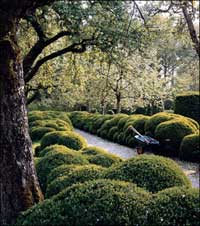 This weekend's edition of the The New York Times Magazine is dedicated to Landscape architecture. Among the articles are:
The Constant Gardener:
"It is probably safe to say that for most people, landscape architecture -- specifically, the design of large private gardens -- is the province of the wealthy, or at least the well-off. Even for the most avid amateur gardener, the idea of bringing in big machines to alter the contours of the earth, planting avenues of trees or trimming boxwoods into topiary conjures a world in which sweat equity is small change."
Via: Archinect
Link: NY Times
Image: © NY Times
Historic New Jersey landscape is being restored
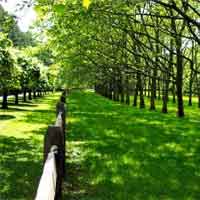 "Greenwood Gardens is a new nonprofit, public garden located in Short Hills, New Jersey, approximately twenty miles west of New York City. Since the early twentieth century, the twenty-two acre Greenwood Gardens has been a private retreat of formal Italianate gardens graced with colorful Arts and Crafts tiles, mossy pebbled walks and vistas stretching into the lush surroundings of South Mountain Reservation."
Link: Greenwood Gardens
Via: The New York Times
Mobil garden for a Venice rental
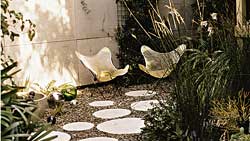 "Sure, it seems crazy dropping cash to spruce up a place you rent, especially when you plan to move, well, one of these years, after you've saved enough dough for a down payment. But where is it written that just because you live lease to lease, you have to put up with peeling paint, closet doors that don't close, refrigerators that reek -- or even a dusty, desolate, debris-strewn excuse for a yard?"
Via: Budget Living
Designer: Russ Cletta - Estate Gardens
All Photos © Deborah Jaffe
Updated 03/28/07
Scottish land sculpture takes top prize
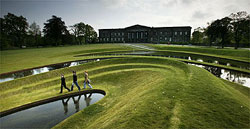 "A wriggly earth bank set around three sinuous ponds, which transformed a flat patch of scrubby grass in front of the Scottish National Gallery of Modern Art in Edinburgh, last night won the £100,000 Gulbenkian museums prize, the richest single prize in the arts."
Via: The Guardian
Link: Gulbenkian Prize
Link: Scottish National Gallery of Modern Art
One of the leaders of the modern movement in American landscape architecture.
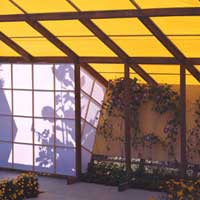 "In 1953 he began building one of his most significant designs, the Rose residence in Ridgewood, New Jersey (which is now open to the public, see link below). The design clearly expresses Rose's idea of fusion between indoor and outdoor space as well as his notion that modern environmental design must be flexible to allow for changes in the environment, as well as in the lives of its users."
Link: James Rose Center
Visit: Ridgewood
Article by Maria Cook, The Ottawa Citizen
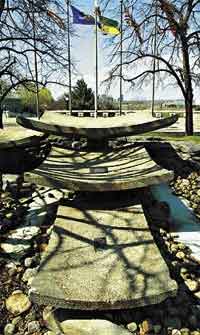 "Created in the 1960s, this often overlooked urban gem is still a work of artistry and breathtaking vistas."
"It's a brilliant public space," says Mr. Zvonar (landscape architect), who works for the federal department of public works in the heritage conservation section. "It has so many moods and characters. It's a work of incredible artistry."
Landscape Architect: Don Graham
Article: The Ottawa Citizen
A fantastic garden!
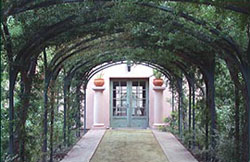 "Lotusland is a unique 37-acre estate and botanic garden situated in the foothills of Montecito to the east of the city of Santa Barbara. The gardens now covering the estate were created by Madame Ganna Walska, who owned the property from 1941 until her death in 1984. Before her death, Madame Walska established the nonprofit Ganna Walska Lotusland Foundation, which now preserves this unrivaled botanical treasure."
Link: Lotusland
FLYART DESIGNS turns the outdoors into useable and beautiful exterior spaces.
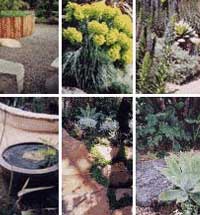 A small design/build landscape firm in the Los Angeles area that does some interesting work. And check this out... sounds like it could have been written by Land+Living:
"The design philosophy at FLYART DESIGNS is rooted in the idea that residential landscapes are an extension of the home. Gardens should reflect the personalities of those who use them and how they use them. By thoughtful plant selection and material composition."
Very nice, Mr. Gabor.
Link: FLYART DESIGNS
UPDATE - The firm has now evolved into a design-build practice Gabor+Allen
Landscape Architecture and Urban Design
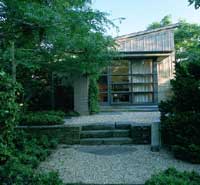 "The American Society of Landscape Architects (ASLA) announced the recipients of its 2003 Professional Awards. Of the 436 entries submitted, the nine-member jury selected 33 projects to receive awards. The awards were presented during the ASLA Annual Meeting, October 30-November 3, in New Orleans."
Link: ASLA 2003 Awards
Dutch urban design and landscape architecture firm
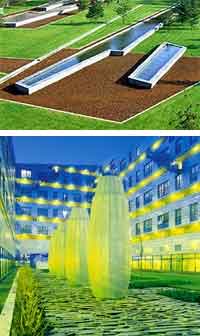 The Netherlands has been leading the charge in the world of architecture over the last several years, and the landscape work of this firm is right out in front as well producing some of the most interesting contemporary landscapes.
West 8 is skillful at the juxtaposition and arrangements of materials; hardscape, plantings and objects. Like their compatriot, architect Rem Koolhaus, they are interested in the extremes of scale creating designs that are both bold and subtle. Their work blurs the boundaries between landscape, infrastructure, architecture and engineering, and often transforms the common and banal into the extraordinary.
Firm: West 8
A museum's decision to destroy a work of art
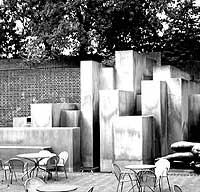 "Nationwide our modern built landscapes are in danger. The designs of Lawrence Halprin, a leader in landscape architecture for decades, are particularly vulnerable at this time. Halprin recently received the National Endowment for the Arts gold medal from the President Bush. Despite this national recognition for design excellence, the Virginia Museum of Fine Arts included demolition of Halprin's sculpture garden in its $100-million building expansion plan designed by London-based architect Rick Mather."
Via: The Recent Past Preservation Network
Contemporary gardens as art and frame
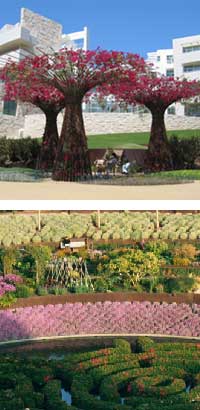 The gardens and landscape of the Getty Center are easily the largest and most easily accessible example of contemporary landscape design in the Los Angeles area, if not the western United States.
The Getty Center complex spreads like an Italian hill town on the slope of the Santa Monica Mountains and is interwoven with a vast array of garden and landscape environments, all set within a vast sea of native chaparral and oak trees. Within the complex itself are two typologies of landscape: the architectural landscape designed by the Olin Partnership and the legendary Emmet L. Wemple, and the commissioned work of art that is the flowing sculptural Central Garden by artist Robert Irwin with Spurlock Poirier.
Continue to the next page for a brief photo tour and further description of the landscapes.
Landscape Firm: Olin Partnership
Landscape Firm: Emmet Wemple and Associates
Central Garden description: Robert Irwin
Landscape Firm: Spurlock Poirier
Architecture Firm: Richard Meier & Partners
Book: Robert Irwin Getty Garden
Book: Seeing the Getty Center Buildings & Gardens
Garden descriptions: Landscaping at the Getty Center