Green
One giant step for eco-friendly back to school gear
 So you've got a kid, and you want to be "green," but let's face it, this is easier said than done. You have plastic this-and-that, one-use items, all of those school supplies, disposable lunch bags... etc., etc., etc. Sourcing environmentally responsible children's products is a royal pain!
What if one day your kid's tree-hugging school requires that you send waste-free lunches?! This is what happened to Renata Bodon who found it challenging to find safe and high-quality reusable lunch ware. Fortunately for you, Renata decided not only to solve her problem, but yours as well.
Meet One Small Step--your one stop shop offering a bevy of waste-free, lead-free, BPA-free, Phthalate-free, and PVC-free lunch and school supplies as well as items for babies and toddlers. And to top it off, One Small Step not only selects items with an eye for design, but also donates 10% of their gross returns to non-profits and partnering schools... you can even register your fave.
Link: One Small Step
Green — August 31, 2007
Posted by James
Sign the petition for cleaner air

You gotta fight for your right to cleaner air!
The U.S. Environmental Protection Agency (EPA) recently announced changes in ozone pollution standards that fall short of what the scientific community recommends. In response to this news, and to the lobbyists working against tougher air quality standards, non-profit public interest law firm Earthjustice has created a project called Adopt The Sky to raise awareness about this issue.
Visitors to the site can add their own personalized message about the issue and "adopt" a square mile of sky above the U.S. to pledge their support for cleaner air.
Sign the petition... its free, people.
Link: Adopt the Sky
Behind the scenes prefab production tour in Los Angeles
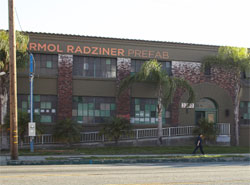 LA based architecture firm Marmol Radziner has launched full scale production of their award-winning, green, modern prefab homes... and they are offering tours of their new modular factory. Of course they intend for this to be a preview for petential prefab homeowners, but I am sure a few of you prefab geeks will slip your way in just to chek it out.
The "Utah House 1" design is currently in production. Marmol Radziner Prefab's 65,000 square foot factory accommodates the fabrication of 20 prefab modules at once, including a cabinet shop, metal shop, and door and window shop.
Two tour dates are currently offered:
Sunday, September 24, 2006, noon to 5pm
Sunday, December 3, 2006, noon to 5pm
Mandatory RSVP to rsvp@marmolradzinerprefab.com or (310) 689-0089. Free to the public. Children must be over 12 years of age.
Link: Marmol Radziner Prefab
Link: Marmol Radziner + Associates
A social oasis in the urban environment... she's electric
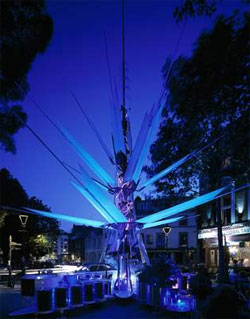 Nothing to do with the UK national treasure... the London Oasis is a temporary structure on Clerkenwell Green installed as part of national Architecture Week. It is a kinetic sculpture by architect Laurie Chetwood designed to demonstrate sustainability and renewable energy while providing entertainment, a place for meeting and tranquil space for Londoners. Self-sufficiently powered by solar cells, a hydrogen fuel cell and wind, the Oasis interacts with the environment around it. Shade providing "branches" open and close in response to the weather. Enclosed pods at the base provide a place of seclusion for people to rest with "cleaner cooled air and relaxing sounds." At night the Oasis acts as a beacon in the cityscape with lights which repsond to the movements of people around it. It even uses rainwater it has collected for irrigation and cooling.
Link: London Oasis
Firm: Chetwood Associates
More: MSNBC - Urban 'Oasis' of clean energy lands in London
Interlocking system puts fabric scraps to use
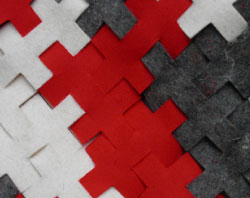 San-Francisco-based designer Galya Rosenfeld has created a system that uses fabric scraps which can be attached and configured without glue, stitching, buttons, etc. to create a wide variety of objects. One of her creations from this ingenious system are Modular Pillows. The beauty of the system is that there are practically infinite configurations of colors and forms - damaged pieces can be replaced and the entire object can be disassembled and recycled.
Galya will be featured at HauteGREEN later this month.
Link: Galya Rosenfeld
Via: Treehugger
Top ten examples of sustainable architecture in the U.S.
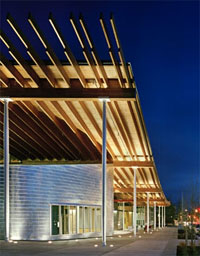 The American Institute of Architects (AIA) and its Committee on the Environment (COTE) have selected the top ten examples of sustainable architecture and green design solutions that protect and enhance the environment. The projects will be honored on May 3 during a presentation at the National Building Museum in Washington and again in June at the AIA 2006 National Convention and Design Exposition in Los Angeles.
The 2006 COTE Top Ten Green Projects address environmental conservation and the notion of sustainable development with designs that integrate architecture, technology, and natural systems. They make a positive contribution to their community, improve comfort for building occupants, and reduce environmental impacts through strategies such as: reuse of existing structures, connection to transit systems, low-impact site development, energy and water conservation, use of sustainable or renewable construction materials, and design that improves indoor air quality.
Link: AIA/COTE 2006 Top Ten Awards
Custom contemporary furniture from reclaimed lumber
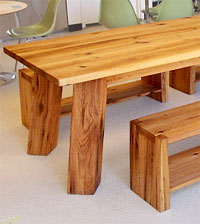 Andrew Moe is a
designer/craftsman and founder of a new green design company based in Brooklyn, New York. Moe builds custom contemporary furniture crafted from reclaimed lumber from old structures.
Andrew Moe is a
designer/craftsman and founder of a new green design company based in Brooklyn, New York. Moe builds custom contemporary furniture crafted from reclaimed lumber from old structures.
I love the quality of old wood, let's face it... new lumber just isn't the same... old wood provides a richness and quality unachievable with new material. And of course recycling old material saves trees and room in landfills. I am drawn mostly to the pieces which recall some sense of the past use of the materials - chunky beams and planks crafted into simple forms providing a nice contrast of rustic and modern.
Link: Moe Design Studio [Thanks, Andrew!]
Putting alternative construction study into practice
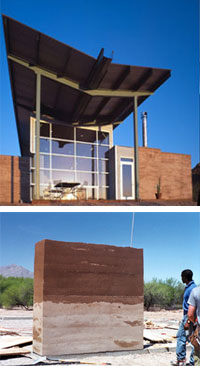 At the University of Arizona in Tucson, Mary Hardin has established a sort of desert Southwest counterpart to Mockbee's famed Rural Studio, blending architecture education and practice into a practical laboratory of experimentation and discovery.
Ms. Hardin's academic and professional activities involve community outreach and the design of affordable housing. She leads students in the exploration of alternative construction methods - such as rammed earth, paper bale and straw bale - and is presently researching the strength and other qualities of rammed earth in partnership with UA Civil Engineering faculty. She has written and published a number of papers about design/build studios and the projects done with her students.
Professor Harden has also designed a beautiful modern rammed earth home with Richard Eribes, Dean of the College of Architecture, Planning, and Landscape Architecture at UA, which we spotted over at Earth Architecture.
Link: University of Arizona D+B
Link: Mary Hardin
Article: AridLands - Rammed earth constructions
Book: Stylus Publishing - From the Studio to the Streets
Related: Design Matters: Best Practices in Affordable Housing
A free book that shows how to attain Platinum LEED on a conventional budget
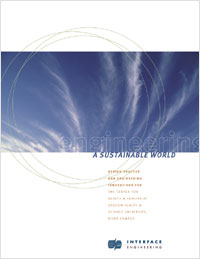 Portland based Interface Engineering has published an illustrated guide demonstrating how to achieve Platinum-LEED on conventional building budget in a FREE 48-page book which uses their current project for Oregon Health and Science University as a case study.
Busting a key economic myth, Interface Engineering of Portland, Oregon (has) engineered a top-level green building on a conventional budget, opening the way for other large scale projects to achieve high performance at standard cost. The firm also released an illustrated guide sharing the secrets and principles behind the project, formally known as The Center for Health and Healing at the River Campus of Oregon Health & Science University.
Link: Green Building Breakthrough
Via: Groovy Green - Green Building: Delivering Champagne on a Beer Budget
Center for Health and Healing project team:
Architect: GBD Architects
Engineer: Interface Engineering
Project Import Export serves up something different
 With so much furniture on the market today it's sometimes hard to find something different. The furniture from PIE Project Import Export is not only different, but features work from some very talented and experienced designers from around the globe. Their merchandise represents some of the best work that is coming out of small young independent firms today that use modern methods and natural, environmentally friendly materials. PIE is setting out to explore the idea of 'living space' in an attempt to heighten the Modern lifestyle experience.
Link: PIE
An alternative to Portland Cement
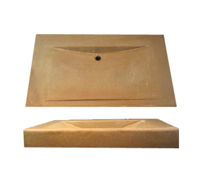 Lithistone is an environmentally friendly alternative to Portland Cement that Ryan Waxman and Brett Fitzgerald use to fabricate countertops, sinks and decorative products. Lithistone will not contribute to indoor air pollution through off-gassing because it uses natural organic high colorfast pigments from Bioshield earth pigments, and non-toxic sealers and glosses. Lithistone is made from a variety of aggregates including crushed slate, granite, quartz, sea shells, marble and limestone. Furthermore, it can be carved, cast or sculpted. Lithistone provides natural contrast to a contemporary interior.
Link: Lithistone
Creative conversions of underused buildings
 LoftyHeights is a new project started by Oliver Bollmann that looks at adaptive reuse and green building practices in the San Francisco Bay area that aspires to become a clearinghouse where architects, city officials, investors, home owners and real estate agents come together to post and learn about local, and potentially sustainable, building opportunities. The focus of the project is the existing urban environment, often underused or abandoned, the message is the idea that urban density is more sustainable. The site has been in existence since July 2005.
What we're committed to at LoftyHeights is to bring forth the creative conversions of underused buildings, buildings that sit idle after the dot.com crash or others, including warehouses, industrial, R&D and offices, into living homes that create community while remaining kind to our dwindling resources. Creating a quality of space for the owners out of an everyday structure, using green practices, encouraging proximity and density.
Link: LoftyHeights
Wallpaper and paint for the eco-stylish
 Farrow and Ball wallpapers and paints are beautiful, tactile and unparalleled in quality and finish. Think of them as hand-crafted products that use time-tested palettes for their line of paints, and employ a 19th century method of dragging and stripping for their papers. Sound old-fashioned? Maybe, but Farrow and Ball wallpapers, Emulsions, Exterior Masonry and Eggshell paints are environmentally preferable with low VOC emissions; the same goes for their papers.
As a user (ok, F&B addict) I can testify to the fact that there is little to no smell after an application, and the matt finishes allow light to blend with the colour rather than reflect off of it. There are over 100 Farrow and Ball colours to choose from, most of them with unconventional names and descriptions like Dead Salmon and Pigeon, but they do not custom blend, which can be a downside for some. On the plus side, Farrow and Ball paints are to be stirred not shaken and they don't separate when left to stand. Furthermore, most distributors offer free (with purchase) in-home consultation. Sample pots are available, and recommended, before committing to a colour.
Link: Farrow and Ball
Water-retentive paving blocks
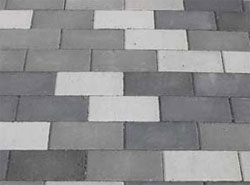 It looks like your run-of-the-mill paving block, the same kind you can pick up at your local home improvement store. But these "Eco-Pavers" manufactured by Matsuo Corp. of Ibaraki, Japan can actually retain water and, used en-mass, greatly reduce the heat island effect of large areas of paving.
Made of recycled construction materials, Eco-Pavers are specially cast to wick up water through capillary action. The pavers actually mimic plant transpiration to provide natural cooling; surface temperatures of the blocks can be lower than the air temperature by 2° - 3° C (3.5° - 5.5° F) and lower than the surface temperature of ordinary blocks by 10° C (18° F) or more.
Link: Matsuo Corp (Japanese)
Article: Daily Yomiuri
Via: Treehugger - Matsuo Corp's "Eco-Paver", Water Retentive Blocks
In-situ soil analysis
 Brownfield reclamation is on the rise, and soil analysis and remediation is becoming an art form of its own. The ability to analyze soil in-situ means considerable time and cost savings, and Niton's new XRF Analyzer series is designed to do just that. Armed with the technology to analyse soils for levels of lead, lead paint and heavy metals, it is a valuable tool that happens to be extremely portable at only 3lbs. It also has the added option of being fitted with Bluetooth wireless connection. Niton was recently awarded the IDEA (Industrial Design Excellence Award) Gold medal award for its XRF Analyzer family.
Link: Niton XRF Analyzer
Link: IDEA Awards
Bonded Logic harnesses the warmth of denim
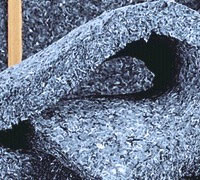 You might not think of denim as a suitable building material, but its rugged fibers have been the choice of labourers since the 16th century given that its durable, comfortable and warm. Bonded Logic recognized denim's primary benefits and used it to create a sustainable and effective insulation.
UltraTouch is a natural cotton-based fiber insulation made from 85% post-industrial recycled fibers that harnesses the warmth and woven density of denim. It does not emit VOCs and is resistant to fungi. It also meets the highest ASTM testing standards, and contains no chemical irritants. Furthermore, UltraTouch's unique manufacturing process creates a three dimensional infrastructure that traps, isolates and controls sound waves reducing sound from traffic, airplanes, radios, television, and conversation.
Link: UltraTouch
Tinted particleboard and fiberboard interior finish panels
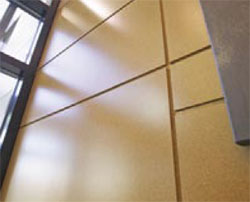 Made by Columbia Forest Products, these eco-friendly composite panels are suitable for cabinetry, furniture, tabletops and wall paneling.
There are two products in the line, each with their own aesthetic textural qualities: either FSC-certified M3-grade particleboard or WOODSTALK® wheat straw agrifiber panels. There is
no added formaldehyde and the panels are finished with a durable, zero-emissions UV cured acrylic finish.
The material has been used by architect
Todd Saunders for the design of the BlueSkyMod prefabricated housing unit recently written up in The Globe and Mail.
Link: Columbia Forest Products
(The product is not listed on website, but they still make it
Link: EcoColors Brochure (pdf)
Via: Treehugger
The GreenSpec® Guide to Residential Building Materials
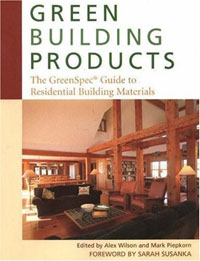 From the publisher:
Here's a comprehensive directory of green building products for home building and remodeling featuring more than 1,400 descriptive listings for products from ag-fiber panels to zero-VOC paints. All phases of residential construction are covered, from sitework to flooring to renewable energy. Products are grouped by function, and each chapter begins with a discussion of key environmental considerations and what to look for in a green product.
Editors: Alex Wilson and Mark Piepkorn
Link: Green Building Products (BuildingGreen)
"An urban strip extending use over time"
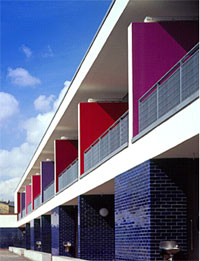 Located in the South London suburb of Tulse Hill, Brixton, the school acts as a community hub both visually and physically. The original project brief called for a building of high quality to house a complex program of multiple educational needs.
The building employs sustainable design features including natural ventilation via wind chimneys, natural lighting, a green roof planted with sedum and an insulation material made from recycled newspaper.
The school was created with a total design approach pairing architects AHMM with Martin Richman (an artist known for his work with light manipulation), furniture designer Andrew Stafford, and graphic designer Morag Myerscough.
Link: Better Public Buildings
Link: School Works Lessons From Jubilee School (pdf)
Article: BBC - Lessons of a well-designed school
Photo Gallery: BBC In Pictures: Jubilee school
Architecture Firm: Allford Hall Monaghan Morris (AHMM)
Furniture Design: Andrew Stafford
Artist: Martin Richman
Graphic Design: Studio Myerscough
Parc du Sausset and the art of patience
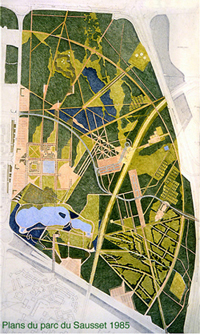 At the time of parc du Sausset's planning in 1979 the trend in France was still to create highly designed parks using exotics and built features. The competition brief for parc du Sausset was different in that it broke with tradition and specified conservation. Michel and Claire Corajoud took up the challenge, and proposed a naturalistic planting scheme that would be as much of a buffer to the growing industry and expanding communities, as it would echo the shapes of its industrial iconography and reflect an agrarian past.
Together with Jacques Coulon and a team consisting of Marc Rumelhart, Tristan Pauly, Claude Guinaudeau, Edith Gerard, Pierre Pascal Mourgue and Gerard Dufrense they took to creating a park that would challenge the instant garden mentality of the time. They planted whips instead of more mature trees, and proposed a marsh that would act as a refuge for wildlife, and treat the water infiltrating from the north through pytoremediation.
Link: parc du Sausset
Firm: Michel Corajoud
Student project for the Salford Docks site in Manchester, U.K.
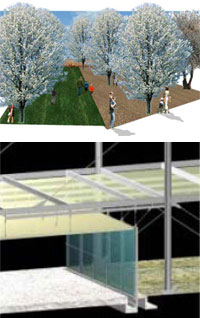 We first "met" Lorenza Casini, a student in the Materiality College at Manchester School of Architecture, when she contacted us last year regarding our post on MPreis supermarkets in the course of her research for this project. We are very pleased now to share the finished product now with you.
With an abandoned brownfield site chosen by the instructors, the studio presented an urban design and architectural design challenge: to propose a program for the site and to develop the architectural scheme.
Lorenza's proposal merges architecture, landscape, infrastructure, and food supply chains to develop an urban farmland and public space in the heart of Manchester.
Green, Misc — August 30, 2005
Posted by Deborah
Bold moves, bold colours, bold design.
 The new Pop Series guitars from RKS take guitar lust to a whole new level. These brightly coloured electric beauties carry the names Rockwork Orange, Pink Lipstick and Fine Lime are hand-crafted from maple and alder, and have CNC machine aircraft aluminum alloy ribs with chrome hardware finishes.
Founded by industrial designer Ravi Sawhney and Rock and Roll Hall of Fame inductee Dave Mason this young company takes design, quality and sustainability seriously. In a recent move driven by the concern surrounding the use of non-renewable materials for their guitars, RKS tried to reduce the total amount of tone wood typically used in guitar production, and then sought domestic woods instead of opting for the more traditional rain forest varieties. The result is as good for the environment, as it is music to the ears.
Link: RKS Guitars
Via: BusinessWeek Online
Coffee roasted for friends
 As a biodiesel user and advocate, I try to keep up with the latest advancements in the rapidly growing movement. Something unheard of just jumped on my radar and I'm completely intrigued: a coffee roaster that runs on biodiesel! The Vermont Coffee Company in Bristol, VT, has just invested $100,000 in the development and manufacturing of a smokeless coffee roaster that runs entirely on biodiesel and utilizes its exhaust emissions as additional fuel. Both efficiency and environmental-friendliness have exponentially increased for the company, which already sells exclusively organic, fair-trade beans.
Link: The Addison Independent
Winning entry in the "Cradle to Cradle" International Design Competition
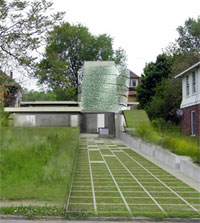 We've talked about Cradle-to-Cradle quite a bit here at L+L, but have never featured the winning professional entry in the C2C Home Competition. Designed by Matthew Coates and Tim Meldrum with Brendan Connolly, Rich Franko, Kristine Kenney, Julie Petersen and Ron van der Veen, the concpet embraces environmental responsibility, social responsibility and community interdependence as a complete manifestation of the guiding principles and design issues laid out in the competition brief.
The design is thoroughly modern in appearance and function while embracing the neighborhood and natural context of Roanoke, Virginia. The large "front lawn" of native vegetation wraps up to become a vegetated roof system which collects and filters storm water for use in the house. The horizontal plan is pierced by the vertical "core" which acts as a stack ventilation tower as well as the energy collection armature. The core is clad with a spinach-protein based photosynthetic plasma cell skin that is able to generate enough power to share with the neighborhood.
Link: Cradle To Cradle Home
Via: Future Feeder
More: Archidose
Reference: C2C Home Competition Winners (L+L)
Reference:
Designing the Future (L+L)
New eco-chic apparel for urban surfer girls
 In an era of values-based consumerism, companies are going for integrated marketing, where aesthetics and integrity go hand-in-hand. High-end fashion companies are going green and green clothing companies are targeting hipsters. On par with this blurring of boundaries, Ailin surfwear company has just launched out of the fashion-mecca of Manhattan, hoping to present a line that brings urban sophistication to an outdoorsy industry.
Link: Ailin
The new Halley VI Research Station puts design on ice
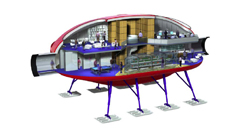 Buildings that walk and wear "puffa-jackets"? If you thought the Halley V Research Station from 1956 was getting a little drab and dated, then the proposals for the new Halley VI Research Station will delight your intellectual and aesthetic sensibilities.
The project is commissioned by the British Antarctic Survey or BAS a collective of scientists that have been in the business of researching Antarctic conditions for 60 years. The truth is if you are going to be sent to a land as unforgiving as the Antarctic, it no doubt helps to be deposited in something as smart and stylish as Halley VI.
Link: Halley VI
Via: Metacool
Eco-friendly home by David Hertz as seen at CA Boom II day two
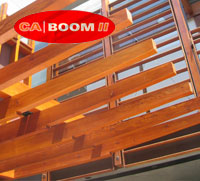 I have been a fan of this house since the first portion was built some years ago, and was able to tour the expanded home last year at CA Boom. When I saw that the home would be featured again this year, I was not disappointed... actually I was excited to have the chance see it again. I hyped this tour above all others to Anthony as CA Boom approached, and upon our visit, his enthusiasm matched mine as is evident in the wealth of images in our extended photo gallery.
Photo Gallery: McKinley Residence
Link: Syndesis / David Hertz AIA
Article: Outside
Reference: CA Boom II Day One (L+L)
Reference: CA Boom II Day Two (L+L)
Reference: CA Boom II Day Three (L+L)
Socially and environmentally responsible furnishings
 SCI-Arc people seem to be everywhere I look lately.
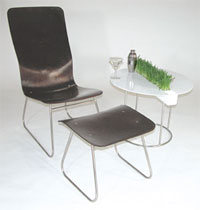
Ann Arbor based designer Jonas Hauptman is a part-time faculty member at SCI-Arc, and has just launched a line of environmentally responsible chairs and tables.
The seats are from a composite of reconstituted North American Aspen Tree flakes and a formaldehyde-free adhesive system in a process inspired by the process used to produce shipping pallets. The seats are available in a variety of stock clear and satin tinted finishes. The steel tables feature a heavy duty high gloss white powder coat finish and are suitable for outdoor use.
Link: Hauptman Products Inc.
Via: Inhabit
A mountain home proves that ecological design and good architecture are not mutually exclusive, nor necessarily mutually beneficial, but are in fact one and the same
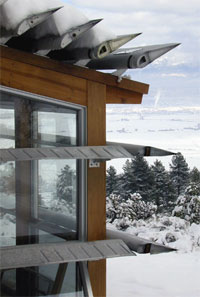 Berkeley based Arkin Tilt Architects is an award-winning firm specializing in energy and resource efficient design. Their design for this mountain home on the eastern slope of the Sierra Nevada mountain range responds to the rugged sloped site and house is virtually energy independent. The design was given a Green Project Award in 2005 2005 by the AIA Committee on the Environment (COTE).
Built using alternative construction techniques, solar technologies and salvaged materials, the house is arranged around a shaded courtyard which serves as the point of entry and provides outdoor space protected from both the summer sun and the winter winds. The structure appears to grow organically out of the site with a planted roofs emerging from grade to cover the garage and guest wing. The main portion of the house rises up from the site with varied roof planes reminiscent of the mountains forms beyond. The house is oriented not only to frame dramatic views of the Carson Valley, but also take advantage of passive solar gain and natural ventilation.
Firm: Arkin Tilt Architects
Link: AIA/COTE - Eastern Sierra House
A contemporary, eco-friendly, accessible home
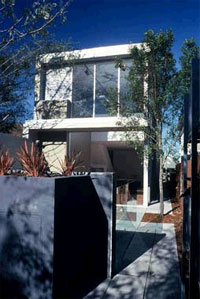 An article in the Sydney Morning Herald by Anne Susskind profiles this remodeled home designed by sustainability focused Kennedy Associates of Sydney.
Front of the semi-detached home was retained with contemporary two storey addition at the rear. The garden continues the space out the back with a courtyard and features an innovative water recycling system as a design feature.
Three rain water tanks and 'green wall' gray water treatment system enable the house to use 75% less water for the town water system. The house is heated and cooled using a solar powered system by Sun Lizard.
Firm: Kennedy Associates Architects
Article: smh.com - The art of space
Harborside park created from a former oil tank facility on North Sydney's Waverton Peninsula
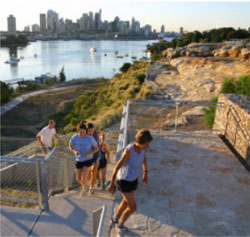 Led by landscape architect and urban designer Adrian McGregor, Sydney and Newcastle based mcgregor+partners are proponents of a new genre of environmentally focused landscape architecture which they frame within a modernist design approach.
This recent project, officially opened on March 12, 2005, is the first of three former industrial sites on the Waverton Peninsula to be transformed.
Firm: mcgregor+partners [Thanks, Tennille!]
Link: North Sydney Council BP Site Parkland
Images: Prior condition & remediation (pdf)
Images: Site construction (pdf)
Images: Opening (pdf)
A layered garden in London
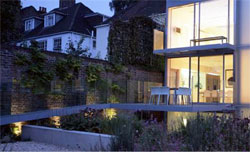 Jinny Blom is a London based landscape designer who's core interests include art, ecology, restoration and modernism. Her designs feature studied and structured plan overlaid with wild and naturalistic planting schemes.
This modern garden serves as an extension of the remodeled and expanded home by Eldridge Smerin Architects, in the Hampstead Village Conservation area of London. Inspired by the materiality of Carlo Scarpa, Ms. Blom defined the landscape as an extension of the modernist addition with concrete, glass, limestone and steel. The rich colors of the planting contrast and soften the rigid forms and materials.
Firm: Jinny Blom
Minimalist, sustainable, functional
 This slick smoke detector has been talked about quite a bit, but it is such a simple and graceful solution that it warrants yet another plug.
Created by brothers Jason and Geoffry Rosenblatt of San Francisco, the Modern Smoke Detector has a minimal profile and uses sustainable technologies... no radioactive material here as in other smoke detectors.
It is designed to lie recessed and flush-mounted into gypsum board finished wall or ceiling surfaces. Custom painting is available.
Link: Architectural Devices
UPDATE (12-11-06) - Now available. The first shipment has sold out, orders for the second shipment are currently being accepted.
Note: Land+Living does NOT sell these. You must contact the manufacturer, Architectural Devices, for sales information.
Green — May 10, 2005
Posted by James
Newsweek interview with leading ecological architect William McDonough
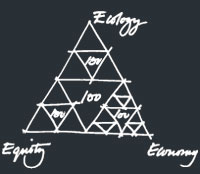 Architect William McDonough continues to garner attention for his "cradle-to-cradle" vision of an industrial revolution that uses nature as a model, completely rethinking the current concepts of recycling and production.
Imagine buildings that generate more energy than they consume and factories whose waste water is clean enough to drink.
Our job is to dream—and to make those dreams happen.
Article: Newsweek - Designing the Future
Link: William McDonough
Reference: Cradle to Cradle (Land+Living)
Reference: "Cradle To Cradle To Washington" (Land+Living)
Related: What Can I Do? (Land+Living)
Green — May 6, 2005
Posted by James
Individual Actions That Make a Difference
 WAIT! READ THIS! I know that you are scrolling right on past this post... but this is required reading for Land+Living... HOLD ON! Really... keep reading.
You may, like us, care about the environment and the well being of the planet, but often find it to be difficult to "live green," the response is always, that's great but what can I do? Don't despair... you can change the world by your actions, no matter how small.
Whoa, now that seems awfully optimistic. Well, if you like, please continue reading my explanation of my green optimism... but, you can skip my explanation and get right to the assignment by following the link below for a very helpful, non-preachy article with suggestions and tips for what you can actually do.
Read it. No really. Bookmark it or print it for later, or screw the work you should be doing and read it now, but please read it... and pass it on.
Article: Natural Capitalism, Inc. - But, What Can I Do? (pdf file)
Link: Natural Capitalism Solutions - Recommended Resources
Link: Rocky Mountain Institute
Book:
Natural Capitalism - Creating the Next Industrial Revolution
Green Spaces in the Sky
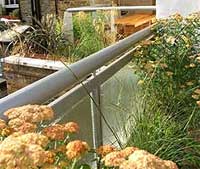 Continuing our theme of blogs from across the pond, Urban Roof Gardens is London's only multi-disciplinary team of architects and designers that focus exclusively on roof gardens and green roofs. Their website features a portfolio with gardens from around the world including Edinburgh, Amsterdam, New York, and San Francisco. I only wish I could design my ground-level garden to look as good as these.
This is the mission of Urbanroofgardens: To raise awareness of the benefits of urban roof gardens, terraces and green roofs. To collate and publish world-class research and best-practice relating to urban roof gardens. And to offer concept to completion advice and services to both the lay and the professional citizen wishing to build urban roof gardens.
Link: Urban Roof Gardens [Thanks, John!]
Glass tableware
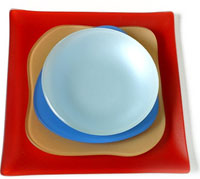 These glass plates, bowls and platters are handcrafted by Pittsburgh based Riverside Design Group of post-industrial / pre-consumer recycled glass.
There are 10 shapes / sizes which are available in 12 luminous colors and are made for every day use - food, dishwasher and microwave safe.
Link: Riverside Design Group
Via: Mettaefficient
Paolo Soleri's experimental city in the Arizona high desert
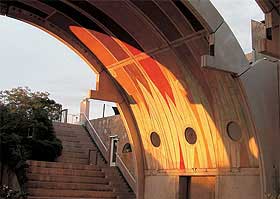 I visited Arcosanti in 1998 on an extended field trip through Arizona while pursing my masters degree, and was reminded of this trip while reading an article in the Arizona State University student newspaper.
What a crazy place... crazy, and incredibly interesting. During our two day stay at Arcosanti, we learned about the concept of Arcology, explored the site, and partied all night with the locals.
Paolo Soleri is an Italian architect who was an apprentice of Frank Lloyd Wright in the late 1940's. Soleri later developed the concept of Arcology, the fusion of architecture and ecology, an alternative urban development form. In 1970 construction began on Arcosanti, a prototype town for 5,000 people (there are currently about 60 residents).
...a highly integrated and compact three-dimensional urban form that is the opposite of urban sprawl with its inherently wasteful consumption of land, energy and time, tending to isolate people from each other and the community.
I bet Mr. Greenhut would freak. ;-)
Link: Arcosanti
Link: Cosanti Originals
Article: ASU Web Devil - In your own backyard: No roads, no conservatives (via The Dirt)
Green — February 21, 2005
Posted by James
"It's Not Easy Cleaning Green"
I was just talking about this issue with my wife the other day... household cleaning products in the United States suck!
Now, this topic isn't exactly sexy or fun, but you need to use something to keep your home clean... especially if you are lucky enough to own one of these slick modern glass and concrete houses that we like to feature. And trying to find good products that aren't detrimental to your health and the larger environment is a challenge. A post at Cascadia Scorecard Weblog points us to a website that can help you locate eco-friendly products. And of course, our good friends at Treehugger have a couple of suggestions as well.
Link: Eco-Labels
Via: Cascadia Scorecard Weblog - It's Not Easy Cleaning Green
Urban regeneration is Manchester U.K.
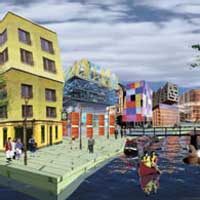 This project adjacent to Manchester’s city center aims to regenerate the former Cardroom housing estate, which itself was an urban renewal effort in the 1970's to reclaim an abandoned industrial sector. Poor planning contributed to the demise of Cardroom Estate, but a bold new framework by Alsop hopes to learn from the past while looking forward.
The area has been re-dubbed New Islington, and a new splashy flashy website (as noted at Archinect) details the concept for the new project and history of the neighborhood. Sustainability and context is the name of the game.
Link: New Islington
Designer: Alsop
Developer: Urban Splash
Reference: Urban Splash (Land+Living)
The Steps to Green Architecture
 Eric Corey Freed is a San Francisco based architect and founder of organicARCHITECT, a firm dedicated to the design and creation of buildings that embody ecological & social responsibility.
Eric's forthcoming book, The Inevitable Architect: The Steps to Green Architecture, shows other architects how to become green.
Free downloads from the book are available on his website. Chapters titles include: Green Building Specifications, Green Guidelines for your Home, How to Sell Your Clients on Green Buildings, etc.
Link: organicARCHITECT - The Inevitable Architect: The Steps to Green Architecture
Via: Enviropundit
Green — February 7, 2005
Posted by James
"The Kids Are Alright in Green Housing Competition"
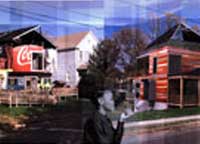 The winners of the Cradle-to-Cradle Home Competition have been selected and Metropolis magazine reports on the winning student entries. Their designs are scheduled to be built starting in May 2005.
The first prize student winner, Sean Wheeler transformed recycled billboards and train cars into the comfortable, flexible “pMod”: a portable, modular dwelling that combines the upgradeable adaptability of the PC with pleasingly domestic elements like roof gardens, courtyards, and porches.
Article: Metropolis - The Kids Are Alright in Green Housing Competition
Link: Cradle-to-Cradle Home Comptetition Winners
Reference: "Cradle To Cradle To Washington" (Land+Living)
Sustainable fencing/screening/cladding
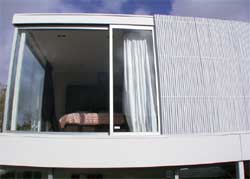 Bamboo is becoming increasingly used as an alternative wood flooring material, but it's most obvious (and traditional) use is somewhat overlooked in contemporary design.
Of course, bamboo fences are a Japanese design cliché, but Mark Mortimer has taken on bamboo as a material, not a design theme. His Auckland, New Zealand based company Bamusero produces bamboo fencing, furniture and special projects and employs various techniques to expand the possibilities of the material. Why not use bamboo as an architectural cladding material? Nice work!
Link: Bambusero
Via: Grow-a-Brain
Interventions on industrial sites and ill defined open spaces
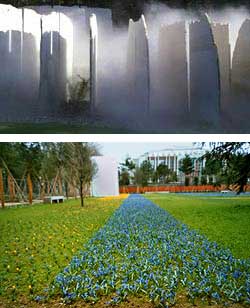 Landscape architect Peter Latz, based in Kranzberg, Germany, practices what he preaches; defining and reclaiming the landscape with an eye on ecology and social needs.
The practice of Latz + Partner focuses on "the renewal of destroyed and often contaminated sites, - a new balance in the traffic infrastructures and - the spatial and material framework of ecological programmes." Their work tackles gritty urban and industrial sites with attention to expressing the history and character of the land.
The website may be a bit cumbersome to navigate and dense, but it is packed with information and images just waiting to reward the focused browser. Plus, you can take your pick of German, English or French text... In Ordnung; all right; bien.
Link: Latz + Partner
Green, News — January 12, 2005
Posted by James
Could "sustainability planning" actually harm long term sustainability?
 A paper by Peter Gordon of the University of Southern California takes an interesting look at sustainable planning and policy and suggests that long term sustainability may be hampered by some current "solutions."
Perhaps a bit academic for L+L? Nah... it pays to be informed. Take a break from the eye candy and read up.
Link: Sustainability Planning: First, Do No Harm (500k PDF file)
Link: USC Urban Initiative
Via: Planetizen
Vancouver, British Columbia based landscape architecture and urban design firm
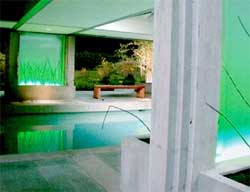 Space 2 Place works on a wide range of projects from residential garden redesign to skate parks.
Through design we transform sites (spaces) into places for our clients. Our places embody a philosophy of strong simple design that responds to the environmental and cultural processes influencing each site. Our philosophy is based upon respect - for our clients, for the environment, and for the power of design.
Link: Space 2 Place
Green, News — December 3, 2004
Posted by James
Green continues to make news
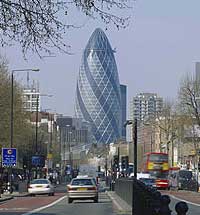 An article in the Economist talks about the use design and technology to reduce environmental impact, cut costs and provide better places to work. Cited projects include the "Gherkin" in London by Foster and Partners, the Condé Nast Building in New York by Fox & Fowle Architects, and the new World Trade Center Freedom Tower by SOM's David Childs with Studio Daniel Libeskind.
Article: The Economist - The rise of the green building
Contemporary bamboo home accessories
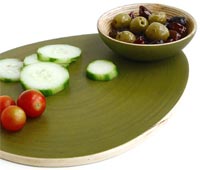 Lately, it seems as if bamboo products are popping up everywhere and obviously for good reasons: It's a fantastic material to work with and it replenishes itself in half the time as other wood (yes, we know it's technically a grass). On that note, Ekobo has an entire product line crafted from bamboo. Trays, bowls, and stools to name just a few.
Made of eco-friendly bamboo, ekobo is a line of contemporary tableware designed in France and hand-crafted in Vietnam in respect of the rules of equitable commerce.
Designer: ekobo
Link: illico design [Thanks, Thomas!]
Australian Year of the Built Environment showcase of prefabricated housing types
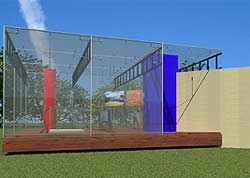 Six prototype houses each designed to be constructed of a different material - concrete, steel, cardboard, timber, glass and clay -
were designed by an architect in collaboration with the appropriate trade association or research institute.
Six prototype houses each designed to be constructed of a different material - concrete, steel, cardboard, timber, glass and clay -
were designed by an architect in collaboration with the appropriate trade association or research institute.
The objective of the exhibition is to promote new ways of providing affordable, environmentally sustainable, prefabricated housing in Australia that are also futuristic and innovative in their design.
The idea of an exhibition or prototype house is to break the boundaries of convention and to offer a vision of what the House of the Future might be like.
Link: YBE2004 Houses of the Future
Article: Infolink.com.au - Houses of the future on show in the present
An Interview with Bert Gregory
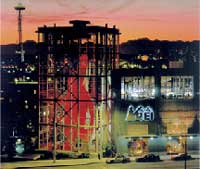 "BetterBricks talked with Bert Gregory, President & CEO of Mithun, a Seattle-based architecture, design and planning firm and a national leader in resource sensitive and sustainable design."
"Mithun is probably best known for its design of the REI stores and IslandWood, the innovative environmental learning center on Bainbridge Island, Washington. Bert served as design team leader for both of those projects."
Link: BetterBricks
Firm: Mithun
Master plan seeks to encourage environmental sensitivity and celebrate cultural diversity
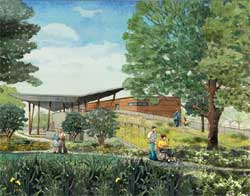 The concept for this master plan consists of four interrelated themes - A Water Synthesis, The Cultural Connection, The Green Connection (or sustainability), and Plants in Community (Plants in natural associations or ecosystems). Each of these themes are a facet of the underlying idea for the master plan, which only together form a cohesive vision of enduring sustainability.
The scope of work includes a new 15,000 square foot Reception and Administration Building by BKSK Architects.
The concept for this master plan consists of four interrelated themes - A Water Synthesis, The Cultural Connection, The Green Connection (or sustainability), and Plants in Community (Plants in natural associations or ecosystems). Each of these themes are a facet of the underlying idea for the master plan, which only together form a cohesive vision of enduring sustainability.
The scope of work includes a new 15,000 square foot Reception and Administration Building by BKSK Architects.
Firm: Conservation Design Forum - Lead consultant landscape and planning (PDF)
Firm: BKSK Architects - Architecture
Firm: Atelier Dreiseitl - Water specialists
Link: Queens Botanical Garden
Via: NY Times - A Queens Garden Gives New Meaning to 'Green'
Green, News — September 9, 2004
Posted by James
The only way is up when looking for new habitats for urban wildlife
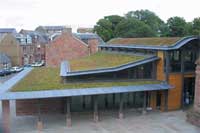 "Green roofs are a new fashion in nature conservation, promoted enthusiastically by the wildlife campaigner Dusty Gedge, of Livingroofs.org."
"With an estimated 24,000 hectares of roof space in London alone - an area 28 times the size of Richmond Park - the potential of green roofs is clear. As brownfield sites are developed, the only direction left for wildlife in many areas is up"
Article: Independent Digital (UK) - Room at the top
Link: Livingroofs.org
Reference:
Roofscapes (Land+Living)
A modern approach to suburban development ties agricultural traditions to the Midwest landscape
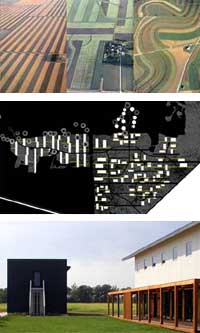 Minneapolis, Minnesota based Coen + Partners is a landscape architecture, urban design and planning firm with a modern approach that is influenced by regionalism.
It is our intent to create interfaces between cultural and natural systems with lasting social and ecological impacts. Designed spaces can articulate and highlight physical relationships in ways that bring meaning and beauty to man-altered environments.
Coen + Partners headed the planning and design for the Mayo Woodlands, a thoughtful reinterpretation of a typical residential subdivision near Rochester, Minnesota. The firm altered the inherited street and lot layout with four interventions: first, native prairie grasses overlay the site creating a uniform natural field; second, building sites for each residence were carved out of the prairie in an orthogonal layout deemphasizing the curving cul-de-sacs; third, traditional agricultural windbreaks of pine trees were laid across the site from east to west; and fourth, a series of low east/west walls and fences delineate paths connecting the neighborhoods. In addition, the colors of the houses are to graduate from off-white to grey and black as one moves through the site towards the river.
Firm: Coen + Partners
Firm: Salmela Architecture & Design
Firm: Altus Architecture
Link: Mayo Woodlands
Link: ASLA Award
Article: Star Tribune (registration required)
Green — September 3, 2004
Posted by Anthony
Guide to green home remodeling
Billed as the "resource for beautiful, safe, and local remodeling", the Green Home Guide has resources for those of you wishing to remodel your home with environmentally sound products. While it tends to focus on Northern California, the ideas presented in the Guide should be useful wherever you are located.
"GreenHomeGuide is a community-based resource for advice and information about environmentally sound home remodeling. We connect green building experts with each other, and with homeowners who want to green their own homes. We believe the passion and expertise of the green professional community desperately needs to be shared – to advise, inspire, and challenge each other. The Guide is a forum for this communication and growth to occur between all the various interested parties – homeowners, builders, architects, designers, retailers, and manufacturers."
Link: Green Home Guide
Via: World Changing
Do urban trees really help reduce pollution and clean the air?
Yup.
The answer may not be as surprising as this fact quoted in the article: New York City has 5 million trees.
Link: Environmental News Network
Costs of building green are far less significant than a range of other factors that affect building cost
An article at BuildingGreen.com outlines the results of a new report by Davis Langdon Adamson (a construction cost planning and management services firm) indicating that building green is a minor factor in the cost of construction.
Link: BuildingGreen.com
Smart Products. Modern Living.
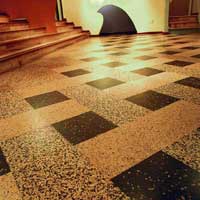 "A collaborative design and product showroom featuring sustainable products and modern design.
Three architects developed alterego to make environmentally sensitive and modern products otherwise inaccessible to the general public available through a showroom environment. The design aspect of the company delivers a functional approach, providing clientele with the aesthetic of modern products and the design expertise of licensed architects."
Link: Alter Ego
Amorphous silicon solar technology
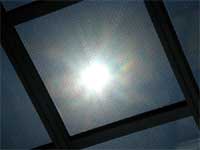 Moving right along with the green theme: a building material.
PV-TV is a revolutionary new building material that transforms any glazed surface into an environmentally sound power station by day and a full colour screen by night.
Whoa! Now THAT is cool.
Via: Metropolis
Manufacturer: MSK Corporation
"Green buildings" sound great. But can we afford them?
A brief article by Neal Peirce answers these questions by looking at real projects as well as the attitudes and policies that shape our built environment.
Link: Washington Post Writers Group
Davis, California based firm with an office in a renovated Airstream trailer
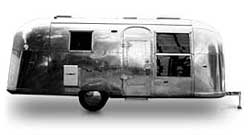 Design-build is becoming more and more common in the United States from large scale commercial and institutional projects down to small residential remodels. It is a return to a kind of practice where a "master builder" orchestrates the entire process rather than the rather disjointed design-bid construction industry prevalent today.
MAK is an example of a Design-Build firm doing some interesting work including the remodel of an Airstream trailer for their own office space. They also have a very nice website that details the process of design-build and shows some examples of their work. In addition, MAK is committed to environmental sustainability; just an example of the flexibility and innovation common in design-build.
Firm: |M|A|K| Design+Build
Via: Archinect
"To be smart we need only to be less stupid."
A David Letterman inspired "Top 10" list from Jerald Schnoor, editor of the American Chemical Society publications, about the harmful policies of the United States.
Link: ACS - Top 10 Stupid Environmental Policies (PDF)
Mondern retreat is embeded in the Texas landscape and recalls the local ranch vernacular
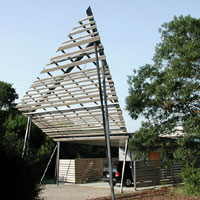 Sited to enhance the various landscapes of forest and meadow of a former ranch, the design vacillates freely between interior and exterior with broad covered porches serving as living and circulation space. Other built elements extend into the landscape including boardwalks and two water features, which attract birds and evoke functional cattle and irigation troughs. Over the years native grasslands and wetlands on the property have been restored by the owners. The only manicured portion of the landscape is a rectangular field of water conserving buffalo grass bordered on two sides by the "L" shaped house.
Architecture Firm: buildingstudio
Landscape Firm: MESA Design Group
Via: Architectural Record
Even the most eco-friendly home may do more harm than good.
 Article by Linda Baker over at Salon.com that discusses the relevence of green building techniques on super-sized homes:
"Here's what the green residential landscape looks like in the 21st century. In the United States, advances in green-building technologies have to compete with the proliferation of 3,000-square-foot-plus homes -- simultaneous trends that underscore one of the key paradoxes of sustainable development in the United States.
"In spite of everything we've done to make the building envelope more efficient," O'Brien said, "we're still using more energy in our homes." Nadav Malin, the editor of the monthly newsletter Environmental Building News, agrees. Most of the green features people are incorporating into their homes represent ecological improvements in the 10 to 50 percent range, he said via e-mail. But even a 50 percent reduction in the ecological footprint, Malin noted, "would be totally offset by a doubling of the house size."
Continue reading at Salon.com (get the free day pass to read)
Link: Salon.com (Registration Req'd)
Landscape architect Catherine Mosbach creates a new garden at the Bordeaux Botanical Garden
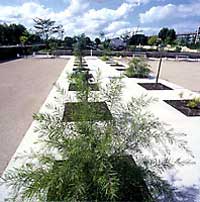 The new Bastide Garden at the Bordeaux Botanical Garden in France by landscape architect Catherine Mosbach is designed to deal with issues of biodiversity, renewable natural resources and the dynamics and mutation of landscapes. The concept is that of the artificial "botanical object" for the layout of the gardens.
a-matter has a nice article about the garden with photos and plans.
Link: a-matter
Visit: Jardin Botanique Bordeaux: La Bastide
Vegetated roof cover, eco-roof, green roof... call it what you will
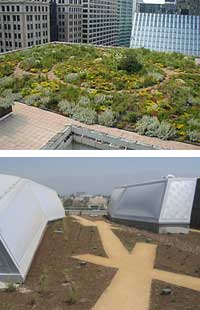 There has been a lot of talk recently about planted roofscapes. We have featured a few projects recently that have employed green roofs, and just today we have run across two news articles: one features a Toronto resident has created a roof garden on top of his garage, and the other a commercial building in Washington D.C. And of course there is the Ford Motor Company factory complex which has been renovated with a 10 acre planted roofscape.
There are multiple benefits to green roofs from this insulation value for the building to larger environmental issues such as the urban "heat island" effect, not to mention the design possibilities.
So for your browsing pleasure, here is a compilation of some links that we have found regarding green roofs... enjoy:
Article: Globe and Mail
Article: Washington Post
Article: MSNBC (Ford Factory)
Link: Ford's River Rouge Factory
Link: Roofmeadow
Link: Hyedrotech
Link: Green Roof Plants
Link: Creating a green roof (Interesting to read... dare to do-it-yourself?)
Reference:
Green Crusade
Reference: The Wind Tunnel
Reference:
Greenwich Academy Upper School/ Library building
A sustainable urban dwelling in Minneapolis
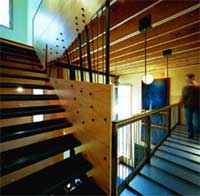 Locus Architecture has created an updated bungalow style home constructed in a manner that reduces the waste and negative environmental impact inherent in standard construction practices. And... it's for sale!
It’s a synthesis of fanciful urban loft and practical family basecamp. Kaleidoscopic art and green design. Radical new techniques and reused materials. Welcome to nowhaus 01: the first in a series of singular homes that celebrate modern, sustainable city living—conceived and built by LOCUS Architecture. This dramatic rebirth of a 1950s rambler near Cedar Lake manifests our core principles—and some of our most intriguing ideas.
Link: NowHaus
Firm: Locus Architecture
Architects and students challenged to design the seminal single-family home of the 21st century
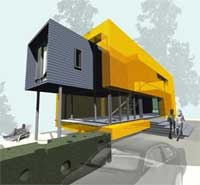 This competition sponsored by the AIA Committee on Design produced some interesting results. Entrants were asked to "explore the impact of their designs relative to sustainability, economics, and social issues." First place (design shown at right) was awarded to a team composed of Jeffrey S. Lee, AIA; David Hill, Assoc. AIA; Matthew Konar; Jennifer Olson; Nelson Tang; Marni Vinton, and Holly Williams.
Link: AIArchitect
Longtime Chicago mayor has vowed to make his city the greenest in the nation.
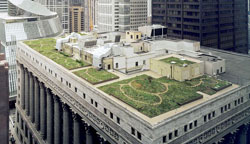 Lisa Chamberlain at Metropolis writes:
"On March 30, 2003, in the dead of night, a bulldozer lumbered through downtown Chicago toward its much celebrated lakefront. Dispatched by Mayor Richard M. Daley with a police escort, it turned onto a 90-acre peninsula, home to a tiny airport known as Meigs Field, and without warning, plowed giant Xs into the airport’s single runway, rendering it useless. Chicagoans were stunned by this seemingly bizarre act of destruction. Mayor Daley said the war in Iraq and fears about airport security were the reasons for bulldozing the runway. This brass-knuckles move, however, stranded 16 airplanes—infuriating the corporate community and cementing Daley’s reputation as an autocrat. Of course, it’s not unheard of for unilateral action to be justified in the name of national security, even if the real motive turns out to be quite different. So what was the mayor’s strong-arm tactic really about?
Believe it or not, a simple park."
Link: Metropolis
Washington Post writer Joel M. Lerner writes about the increase in requests for "natural" solutions to landscape opportunities and problems amongst his columns. In the article, he covers native plants, annuals and perennials, pest management, and more.
"When you work in a field for a long time, it can seem that the same things happen, day after day. But occasionally, it's a good idea to sit back and take a look at what has been going on. A couple of rainy days recently gave me some time to look over the topics of my roughly 400 columns and identify some new threads in the landscape fabric. For instance, I noticed an increasing desire in recent years for "natural" solutions to landscape opportunities and problems. Here is more on that topic and other topics of increasing current interest."
Link: Washington Post
SOM, James Turrell and Brown Sardina create a sustainable building of landscape and light
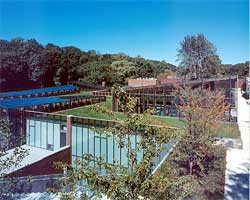 Roger Duffy of Skidmore, Owings & Merrill integrated landscape and architecture in a new building for a private high school in Greenwich, Connecticut, with light artist James Turrell and landscape architects Brown Sardina. The landscape weaves through the building in the form of courtyards, and the roof is literally an extension of the landscape as the sloping site allows the roof of the merge with the ground plane. Transparent glass facades and light cupolas on the rooftops of each structure flood the building with daylight.
In addition to the extensive use of daylight, other sustainable design initiatives include the use of recycled materials, a waste management plan, storm water and irrigation systems, and high quality air and energy systems.
Via: Architectural Record
Firm: Skidmore, Owings & Merrill
Firm: Brown Sardina
Link: Hydrotech Garden Roof system
How to make a business case for sustainable design
 Back in March, again in April, and upcoming in June, the EPA, the IDSA Design Foundation, and J. Ottman Consulting sponsored workshops for changing perceptions of sustainable design. An excerpt from the article:
"More than just evaluating products, the mission of the workshop is to demonstrate how producing green can be a win-win strategy, increasing a company's profits while positively distinguishing it from the competition. Ottman and Doering offered some simple "swift approaches" to environmental design: Use recycled materials; increase energy efficiency and substitute alternative energy when possible; reduce toxicity by using "known" and stable compounds; extend product life, moving away from disposable products by creating goods that are durable, upgradeable, and repairable; and provide the product as a service or on a lease basis where the consumer keeps the product through its useful life, and the manufacturer reclaims it for disassembly or refurbishment."
Link: ID Online
One man’s journey -- From greedy real estate developer to a founder of the green building movement.
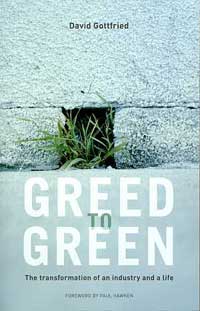 A new book by David Gottfried, president of sustainable development consulting company WorldBuild Technologies.
Excerpt from the Foreword by Paul Hawken:
To say this book is about the power of one person to change the world, though true, would be a cliché. This book is not about David, sustainability, or even green buildings. It is about the mystery of change. Although it is axiomatic that everything changes, it is a mystery as to how things change. What we have here is a first-person and animated account of how things did change. When you read it, you will draw your own conclusions. Yes, his is a story of pluck and determination, to be sure. And it is one of timing, hard work, and manufactured luck. But above all, it is a story of conviction. Not the conviction that makes others wrong, but more an affirmation: of what is right and what is possible.
Green to Green
Molded recycled 100% wastepaper wall tiles
 "Tangent tiles allow you to customize the acoustic and aesthetic properties of any environment. Three-dimensional and reconfigurable, they can be assembled in a variety of patterns. These tiles fit almost any wall or ceiling area and are made from 100% post and pre-consumer waste paper. Tangent tiles are easy to recycle when no longer needed. They are durable, can be painted with water-based paints and are easy to install."
Link: MioCultureLab
Designers: Jamie Salm, Esther Chung
Australia's first five-star-rated eco-sustainable office building
"Lend Lease's radical new building is cool, eco-friendly and there's not a hairshirt in sight, writes Elizabeth Farrelly." Unfortunately, we can not find pictures of this project, but this article in the Sydney Morning Herald is still worth a read. Designed in-house with Peddle Thorp collaborating
Link: Syndey Morning Herald
Green — May 21, 2004
Posted by James
Online sustainable design tool
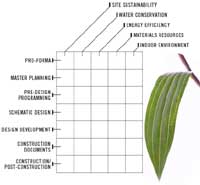 "Knock, knock. The Green Matrix has you, Neo." Sorry... bad, bad, bad.
Bay Area architecture firm, Ratcliff, has developed a web based green design tool. Developed as a professional resource for the firm, the Green Matrix cross-references "topics of sustainability with the standard phases of project design" and provides informative links and references.
Ratcliff is currently sharing this information generously as a public service.
Link: Green Matrix
Link: Ratcliff Architecture, Planning, Interiors
Ecosmart Materials
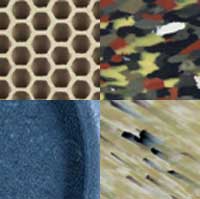 "The Rematerialise vision is to compile and maintain a versatile collection of 'Eco-Smart' materials, which by their very
nature provide a range of environmentally responsible alternatives to other resource hungry materials. By tapping into
both post-consumer and post-industrial waste streams, scrap and refuse otherwise destined for landfill is recycled and
reused which reduces waste and maybe more importantly saves natural resources. It is unfortunate that many of
these often-exciting new materials never make it into the wider market place and are tragically discontinued. Due to
a lack of demand they just disappear!"
"The Rematerialise vision is to compile and maintain a versatile collection of 'Eco-Smart' materials, which by their very
nature provide a range of environmentally responsible alternatives to other resource hungry materials. By tapping into
both post-consumer and post-industrial waste streams, scrap and refuse otherwise destined for landfill is recycled and
reused which reduces waste and maybe more importantly saves natural resources. It is unfortunate that many of
these often-exciting new materials never make it into the wider market place and are tragically discontinued. Due to
a lack of demand they just disappear!"
Link: Rematerialise
Best practice examples of a high-performance, sustainable design approach.
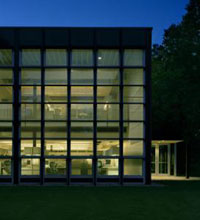 "The American Institute of Architects (AIA) and its Committee on the Environment (COTE) have selected 10 examples of architectural and "green" design solutions that protect and enhance the environment. The selected projects address significant environmental challenges with designs that integrate architecture, technology, and natural systems. The top ten projects make a positive contribution to their community, improve comfort for building occupants, and reduce environmental impacts through strategies such as: reuse of existing structures, connection to transit systems, low-impact site development, energy and water conservation, use of "green" construction materials, and design that improves indoor air quality."
Link: AIA Top Ten
We go to Dwell to find the answer.
Over at Dwell, the user, "Junkyard", asks the question, "I'm just curious what everyone's definition of "sustainable" is.""It seems to me most things in life end up being sustainable if economics are a consideration. Things get used until it's too expensive to use them then something else gets used. That doesn't mean that the first thing neccessarily got used to extinction, just that it's not economically viable to use so it gets passed on or passed up. I'm starting to think that people are using the word sustainable as a purely asthetic reference, i.e. "I wish those old WalMart buildings were more sustainable, then they wouldn't be so ugly."
Link: Dwell
Green — May 18, 2004
Posted by Anthony
Live in LA? Cool your home with free shade.
 Do you live in LA? Do you want to cut down on cooling costs? Did you know the the Los Angeles Department of Water & Power has a program where they will give you free shade trees?
"As part of its ongoing commitment to environmental initiatives that reduce energy use, improve air quality, and beautify local communities, LADWP offers Trees for a Green LA, which is adding thousands of shade trees to Los Angeles’ neighborhoods and communities just like yours. LADWP is providing residential customers with free shade trees and the knowledge to plan for, plant and protect them."
Cool.
Link: L.A. Dept. of Water & Power
Remaking the Way We Make Things
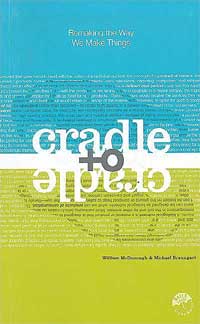 "Guided by this principle, McDonough and Braungart explain how products can be designed from the outset so that, after their useful lives, they will provide nourishment for something new. They can be conceived as "biological nutrients" that will easily reenter the water or soil without depositing synthetic materials and toxins. Or they can be "technical nutrients" that will continually circulate as pure and valuable materials within closed-loop industrial cycles, rather than being "recycled" -- really, downcycled -- into low-grade materials and uses. Drawing on their experience in (re)designing everything from carpeting to corporate campuses, McDonough and Braungart make an exciting and viable case for putting eco-effectiveness into practice, and show how anyone involved with making anything can begin to do so as well."
Authors: William McDonough, Michael Braungart
Link: Amazon
Environmentally Sustainable Camping Shelter
 "Ecoshack (Headed by SCI-Arc faculty member Stephanie Smith) is sponsoring a competition to design an environmentally sustainable camping shelter - a 'green' tent - that explores nature, culture and experience. Open to anyone with innovative ideas inspired by Southern California's 'green' lifestyle. Winners will be prototyped on a 5-acre site in Joshua Tree, California."
Via: SCI-Arc
Link: Green Tent
Link: ecoshack
New York Times article by Motoko Rich
Energy-efficient materials and appliances start to show up in affordable housing.
"Until recently, green design was a preoccupation of those who could afford to tinker with geothermal wells, air-filtration systems and solar panels. But green features are now appearing in places like Harlem and the Bronx, as energy-efficient materials and appliances, and the resulting economies, start to show up in affordable housing."
Link: NY Times