32 Projects Selected by jury
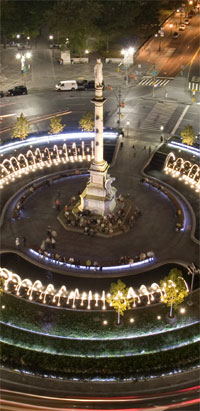 The American Society of Landscape Architects (ASLA) has announced the recipients of its 2006 Professional Awards. The jury considered over 500 entries and selected 32 projects to receive awards. The awards will be presented on October 9 at the ASLA Annual Meeting in Minneapolis.
The top "Awards of Excellence" are awarded in several categories:
Link: ASLA 2006 Professional Awards
(complete awards list and project profiles)
IMAGE: Coulmbus Circle, New York, New York, designed by Olin Partnership.
Top ten examples of sustainable architecture in the U.S.
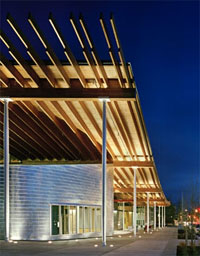 The American Institute of Architects (AIA) and its Committee on the Environment (COTE) have selected the top ten examples of sustainable architecture and green design solutions that protect and enhance the environment. The projects will be honored on May 3 during a presentation at the National Building Museum in Washington and again in June at the AIA 2006 National Convention and Design Exposition in Los Angeles.
The 2006 COTE Top Ten Green Projects address environmental conservation and the notion of sustainable development with designs that integrate architecture, technology, and natural systems. They make a positive contribution to their community, improve comfort for building occupants, and reduce environmental impacts through strategies such as: reuse of existing structures, connection to transit systems, low-impact site development, energy and water conservation, use of sustainable or renewable construction materials, and design that improves indoor air quality.
Link: AIA/COTE 2006 Top Ten Awards
An open competition to design a chair, sofa or stool that reflects our time
 Even though the function of a chair as an aid to sitting has not really changed over time, its design has evolved in parallel to society. It has reflected the developments in technology, architecture, and industrial design. Furthermore, chairs have been a social, aesthetic, and symbolic statement. Chair design has been a declaration of attitudes, ideas, and viewpoints.
During the XX Century there were some chair designs that succeeded to reflect the society of their time. Some of the best known examples are Charles and Ray Eames' molded plywood chairs, Alvar Alto's No. 41 Chair or Marcel Breuer's B3 Chair. Their highly innovative designs responded both to ergonomics and manufacture processes.
As our society has changed we are looking for a chair design that succeeds in communicating the XXI Century personality.
This is an open competition to design a chair, sofa, or stool that reflects our time.
My chair is a reflection on style, trend, attitude, and culture.
Link: Luvo
UPDATE (5-14-06) - winners have been announced
I love malls... really...
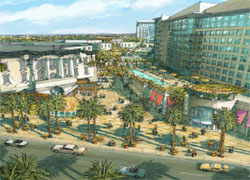 There is nothing more glamorous for an architect than designing America's malls... except perhaps designing 13,000 square foot faux-Tuscan additions to 9,000 square foot even-more-faux-Tuscan houses... ahem.
This project in Anaheim, California, has been in the proposal stage for years, and it appears that it is finally going to move forward. Situated right across the street from Disneyland, the architects absolutely had to out do themselves... and indeed they have turned architecture on its head. Don't believe me? Let's take a closer look just for shits and giggles...
Link: GardenWalk
Via: Curbed (LA style) - Anaheim Approves New Tourist Trap
2006 Pritzker Architecture Prize Laureate
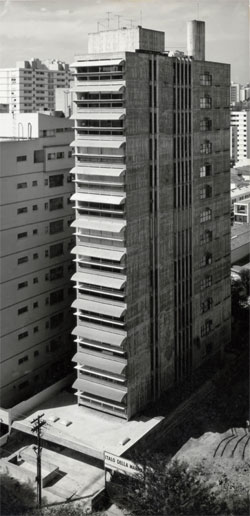 Paulo Mendes da Rocha of Brazil was announced today as the winner of the 2006 Pritzker Prize winner. The 77-year old architect is Brazil's second Pritzker laureate joining Oscar Niemeyer who was honored in 1988.
In announcing the jury’s choice, Thomas J. Pritzker, president of The Hyatt Foundation, said:
Mendes da Rocha has shown a deep understanding of space and scale through the great variety of buildings he has designed, from private residences, housing complexes, a church, museums and sports stadia to urban plans for public space. While few of his buildings were realized outside of Brazil, the lessons to be learned from his work, both as a practicing architect and a teacher, are universal.
The formal ceremony will be held on May 30, 2006 in Istanbul, Turkey.
Mendes da Rocha began his career in the 1950's and was part of what was then considered the avant-garde in São Paulo, known loosely as creators of the Paulist brutalist architecture. During a career that spans six decades, he has maintained his own practice, taught for many years at the University of São Paulo, and contributed to the professional community through his work as president of the Brazilian Institute for Architects.
Following is a sampling of Mendes da Rocha's work.
Link: The Pritzker Architecture Prize
Link: Paulo Mendes da Rocha Pritzker Prize Photo Book (PDF)
Designer of ‘Human Environments’
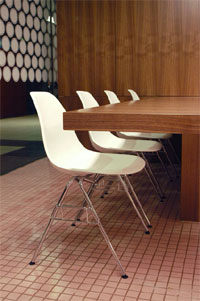 Albano Daminato is an interior architect and designer based in Singapore. His recent projects have included small scale hotels, private residences, retail stores, restaurants, bars and cafes, from overall concepts through to the design of furniture, objects and even uniforms.
His work is rigorous and architectural in approach as is evident in the form, detailing, spatiality and materiality of his projects. There is a duality to Albano's work; it is subtle yet strong, minimal yet complex.
Link: Albano Daminato
Ready-made living units from South Africa
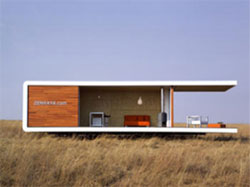 OK prefab junkies, here is your exotic South African prefab fix. Though we saw a bunch of prefab at CA Boom, it was basically stuff we had seen before, but this wasn't there, and it is new to us.
Designed by architect Eric Bigot, the concept behind the company is to make building a house as simple as buying a car. The concept behind the design is simplified minimal mode of living in a space 3.4 meters wide. The design is expandable from a studio unit at 6 meters in length up to a 2 bed/2 bath sized home at 23.6 meters long as well as variations in between. Conceivably a double-wide configuration of units is possible as well.
Link: ZenKaya [Thanks, Dave!]


 Toronto is home to a diverse group of designers working under the collaborative effort of VEST Collective.
 As
As