September 2005
Landscape — September 30, 2005
Posted by James
Three firms selected as finalists for the former El Toro Marine
Corps Air Station
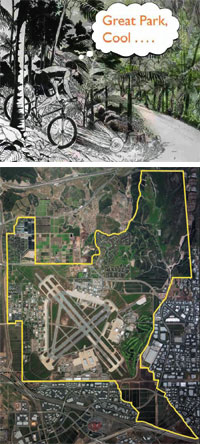 The field of seven firms selected from the original thirty-eight has now been narrowed to three finalists for the design of what would be one of California's largest urban parks. The finalists are EMBT from Barcelona, Spain, Royston Hanamoto Alley & Abey from Mill Valley, California, and Ken Smith Landscape Architect from New York, New York.
Closed in 1999, El Toro was originally slated to be the site for a new international airport. After voters killed the highly contentious airport proposal in favor of parkland, the City of Irvine spearheaded the effort to create "one of the finest metropolitan parks in America."
The Navy recently sold the property to Miami based Lennar Communities who will develop 10% of the seven square mile property and contribute money towards the development and maintenance of the Great Park.
Larry Agran, Chair of the Orange County Great Park Corporation:
Fredrick Law Olmstead designed New York’s Central Park in the mid 19th Century and inspired the creation of great metropolitan parks throughout the United States. We are conducting an international search for the Fredrick Law Olmstead of the 21st Century, and are confident that we will find a designer of his caliber for the Great Park.
Link: Orange County Great Park
Link: EMBT Arquitectes Presentation (pdf)
Link: Ken Smith Presentation Doc 1 Doc 2 (pdf)
Link: RHAA Presentation (pdf)
Link: Video of public presentations
Via: Archinect
A modern rammed earth house rooted in rural Australian vernacular
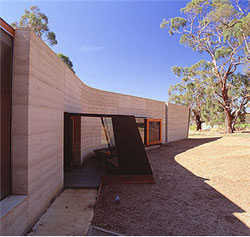 Designed by Melbourne-based John Wardle Architects, this house is located on the Mornington Peninsula outside of Melbourne.
Designed as an exploration between the site and the lives of the owners, the house embraces the site and surrounding landscape. Built primarily of rammed earth with elements of timber framing and steelwork, the elements recall Australian rural vernacular structures. While the design is decidedly modern, there is an almost arts and crafts attention to detailing and use of material.
Firm: John Wardle Architects (Site not Firefox friendly)
Article: Architecture Australia - July/August 2004 - Grafts and Crafts
Via: Earth Architecture
Bonded Logic harnesses the warmth of denim
 You might not think of denim as a suitable building material, but its rugged fibers have been the choice of labourers since the 16th century given that its durable, comfortable and warm. Bonded Logic recognized denim's primary benefits and used it to create a sustainable and effective insulation.
UltraTouch is a natural cotton-based fiber insulation made from 85% post-industrial recycled fibers that harnesses the warmth and woven density of denim. It does not emit VOCs and is resistant to fungi. It also meets the highest ASTM testing standards, and contains no chemical irritants. Furthermore, UltraTouch's unique manufacturing process creates a three dimensional infrastructure that traps, isolates and controls sound waves reducing sound from traffic, airplanes, radios, television, and conversation.
Link: UltraTouch
An Exhibit of seventeen original landscapes
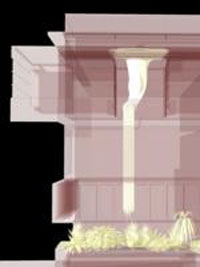 This exhibition for gardens designed to be part of the proposed 3rd floor addition to USC's architecture building is now showing at USC Verle L. Annis Architecture Gallery in Harris Hall through Saturday, October 1, 2005.
The School of Architecture's 21,000 square foot 3rd floor expansion of Watt Hall will house the School's four graduate programs. Alternating gardens and office spaces will form a ten-foot perimeter around the building. Each of the 17 gardens will be an original landscape design by an internationally renowned landscape architect. With the use of drought-tolerant and sustainable plants, the gardens will serve as a valuable tool for landscape studies and will act as the lungs for the building - allowing air to flow through the office, studio and gallery spaces.
Link: USC - Visions of Sky Gardens
Limited edition rugs designed by Akira Isogawa
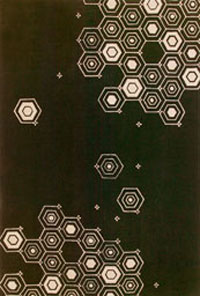 Australian fashion designer Akira Isogawa has designed a limited edition collection of rugs with bold graphic patterns with a decidedly Eastern influence.
The rugs are hand-knotted cut and loop pile of 100% New Zeland Wool or New Zealand Wool & Viscose. Naturally, the rugs come with a designer price tag starting at $4990 Australian (approx. $3,800 US).
Link: Designer Rugs - Akira Range
Designer: Akira Isogawa
Via: The Age - Rugging up
Books — September 27, 2005
Posted by James
Building On An Elevated Surface
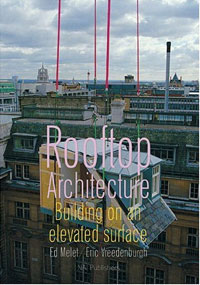 Excerpted from the publisher:
The land in big cities has be used more intensively, but the possibilities are limited. One of the leading options for the future is the use of the flat roofs of residential buildings and office blocks as a building site.
This book analyses and describes the opportunities for realizing projects of this kind, as well as the potential difficulties, using interesting examples of construction on top of existing buildings in the Netherlands and abroad. It will therefore be influential in establishing a benchmark for architecture and urban planning that is a necessity if rooftop architecture is to have a serious future.
Editor: Eric Vreedenburgh
Link: NAi Publishers
Link: Amazon
Via: Things
Related:
Up on the rooftop (L+L)
Art, Kitchen — September 27, 2005
Posted by Deborah
Simplicity x function = popularity
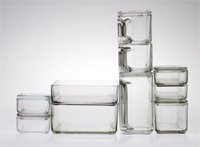 A funny thing happened while browsing though the many aisles of Hot Property, a mecca for things Modern in the city of Toronto, I spied some glass containers that were in a locked cabinet. I have been on the hunt for glass containers, with plastic getting so much bad press these days, and inquired as to their price. The shop-keep told me that while he wasn't sure of their exact price, they were in fact "thousands, and thousands of dollars". It turns out that they were original Wilhelm Wagenfeld Kubus stacking containers from ca. 1935.
Wagenfeld studied at the Bauhaus school and produced these simple containers after he left. They were manufactured as sets of seven, with interchangeable lids that were meant to be used as both storing and serving pieces. In true Bauhaus style serial repetition and function led to their extreme popularity, hence the myriad of replicas available on the market today.
Link: Metropolitan Museum
Contemporary reinterpretations of treehouses
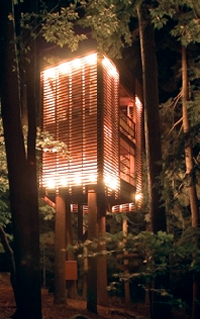 Treehouses have grown-up and are winning awards for excellence in design and innovation. If the idea of treehouse as family dwelling conjures up images of the Swiss Family Robinson, then prepare yourself for the following reinterpretations.
In 2003 Lukasz Kos, a masters student at the University of Toronto's School of Architecture & Design, took honourable mention at the OAA awards for his Muskoka, ON. treehouse, an elegant slatted structure that scales the trees and lets light radiate down it's core.
More recently, Joel Sherman of jls Design produced his AIA award-winning Steel Tree House in Lake Tahoe, CA, a sprawling residence that is cleverly engineered to work with snow loads and sloping terrain. Then there is Marcio Kogan's BR House in Araras, RJ that was built up to the canopy, and allows trees to puncture through the roof at points creating a contemporary elevated living space.
Link: Lukasz Kos
Link: Marcio Kogan
Via: Nelson Kon fotografias
Link: jls Design
Via: Dexigner
Tinted particleboard and fiberboard interior finish panels
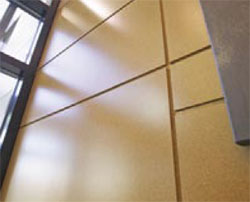 Made by Columbia Forest Products, these eco-friendly composite panels are suitable for cabinetry, furniture, tabletops and wall paneling.
There are two products in the line, each with their own aesthetic textural qualities: either FSC-certified M3-grade particleboard or WOODSTALK® wheat straw agrifiber panels. There is
no added formaldehyde and the panels are finished with a durable, zero-emissions UV cured acrylic finish.
The material has been used by architect
Todd Saunders for the design of the BlueSkyMod prefabricated housing unit recently written up in The Globe and Mail.
Link: Columbia Forest Products
(The product is not listed on website, but they still make it
Link: EcoColors Brochure (pdf)
Via: Treehugger
Le Corbusier series of DVDs now available
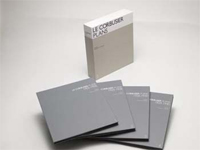 Can't get enough Corbusier? The Fondation Le Corbusier and Codex Images International - Birkhäuser are offering a series of DVDs that chronicle the work of Le Corbusier from 1905-1964. Broken into series of 4 sets, October heralds the arrival of the second set of 5 DVDs covering the years 1930-1945. The complete set features roughly 300 projects that will no doubt serve as an important archive for researchers, students and enthusiasts.
Each project is accompanied by expert commentary and fully printable images. Fortunately for us they were not shy about including shreds of plans either. Series one: 1905-1930, a 4 DVD set, is currently available, but at the rather steep price of € 1600 or € 5800 for the series (approximately $1300 and $7000 US), it's probably best to harass your local library or university into making the purchase.
Link: Order Form
Link: Codex Images (Japanese/English Site)
Link: Fondation Le Corbusier
Via: arcspace
Face-to-face lounging for two
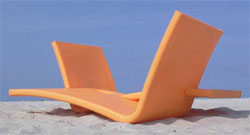 Architect and designer, Michael Hilgers, created the dialounge as part of an exclusive collection for the label rephorm. The dialounge is available in orange, olive, and cream and features cupholders along with a place for your magazines.
"The communication- chaiselongue dialounge is manufactured in PE in the rotational-moulding process. It is wheatherproof, can be dismantled, is stackable and has integrated cupholders as well as space for magazines.
for Club, Lounge, Pool, Hotel, Garden, Bar, Patio, Beach, Livingroom...."
Link: dialounge [Thanks, Michael!]
The exhibition of architecture through the form of the pavillion
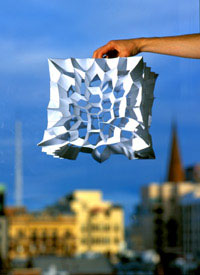 This exhibition presented across two venues at Monash University near Melbourne: the Monash University Museum of Art on the Clayton campus and Faculty Gallery on the Caulfield campus. The show opened September 7th and runs through October 29, 2005.
Pavilions for New Architecture presents the creative practices of a dynamic group of contemporary architects who have emerged on the architectural scene over the past decade.
Taking the pavilion as its subject, and as a lens through which to view the practice of architecture, Pavilions for New Architecture offers a significant opportunity for the open expression of architecture at a scale that is at once playful and provocative, speculative and rhetorical.
Link: Monash University Museum of Art - Pavillions for New Architecture
Review: The Age
Furniture — September 20, 2005
Posted by Deborah
Proving that contemporary handcrafted furniture is not oxymoronic
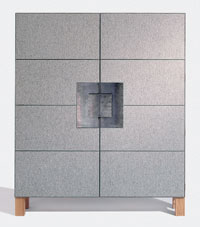 If you are looking for a handcrafted piece of furniture with high aesthetic value, and the kind of substance that will take 4 people an hour to haul up a staircase, then the Lambert company is for you. With it's head office in Mönchengladbach Germany, the Lambert company trains it's craftspeople to reproduce their unique designs in various locations around the world, and herald themselves as the custodians of traditional arts and crafts. They stress the use of natural materials, dowels and wax finishes, but yet have a penchant for clean lines and little to no embellishments leaving their pieces looking thoroughly contemporary. While there may be variations in what is available from distributors, what is constant is the high quality and design of each piece. Gunther Lambert will no doubt be highly desired as collectibles in the decades to come.
Link: Lambert
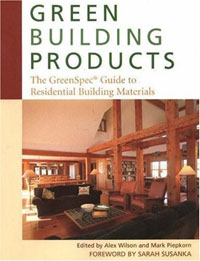
The GreenSpec® Guide to Residential Building Materials
 From the publisher:
Here's a comprehensive directory of green building products for home building and remodeling featuring more than 1,400 descriptive listings for products from ag-fiber panels to zero-VOC paints. All phases of residential construction are covered, from sitework to flooring to renewable energy. Products are grouped by function, and each chapter begins with a discussion of key environmental considerations and what to look for in a green product.
Editors: Alex Wilson and Mark Piepkorn
Link: Green Building Products (BuildingGreen)
"An urban strip extending use over time"
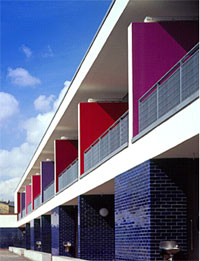 Located in the South London suburb of Tulse Hill, Brixton, the school acts as a community hub both visually and physically. The original project brief called for a building of high quality to house a complex program of multiple educational needs.
The building employs sustainable design features including natural ventilation via wind chimneys, natural lighting, a green roof planted with sedum and an insulation material made from recycled newspaper.
The school was created with a total design approach pairing architects AHMM with Martin Richman (an artist known for his work with light manipulation), furniture designer Andrew Stafford, and graphic designer Morag Myerscough.
Link: Better Public Buildings
Link: School Works Lessons From Jubilee School (pdf)
Article: BBC - Lessons of a well-designed school
Photo Gallery: BBC In Pictures: Jubilee school
Architecture Firm: Allford Hall Monaghan Morris (AHMM)
Furniture Design: Andrew Stafford
Artist: Martin Richman
Graphic Design: Studio Myerscough
Art — September 15, 2005
Posted by Deborah
Models made for the camera
 Model making and photography have a symbiotic relationship. In model making the idea is to create something that resembles real life, but there's no doubting that it is a model when it is in front of you. But add a camera and some light, and that which is real becomes less obvious. Minimiam is a project that plays with our minds as much as it plays with its subject. The team of Akiko Ida and Pierre Javelle have produced a series of unordinary and extraordinary photos from their unusual models that delight as much as they confuse. While there's no doubting the cupcake is in fact a cupcake, the camera allows us to entertain the possibility of a cupcake world and cupcake workers.
Link: Minimiam
Via: Design Sponge
Furniture — September 14, 2005
Posted by Anthony
A personal refuge
 Mike from Mike and Maaike dropped us a line tonight to let us know about their Windowseat lounge chair. Billed as a "sub-architectural space", the lounge features a wrap-around design offering a bit of privacy.
"Along with this new sense of space comes the dynamic play between being inside vs. outside as well as new social or asocial behavior when the chair is introduced into public settings. When used in multiples, the Windowseat Lounge opens up a wide range of possibilities. By directing the chairs towards each other, people can engage in a semi-private conversation. By directing the chairs away from each other, strangers can create their own individual space, ideal for reading, relaxing, or people-watching."
Link: Mike and Maaike [Thanks, Mike!]
Martha Sturdy and the art of casting resin
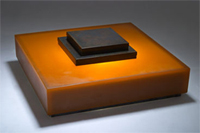 Martha Sturdy is a Vancouver BC master of casting resin. People who have worked with resin say that it is a substance that you love to hate, and hate to love and that the unexpected is bound to happen, which is not always a good thing. But Sturdy, who graduated from the Emily Carr Institute of Art + Design back in the early 80's, has spent years dedicating her professional career to the control and manipulation of resin, a dedication that has yielded polymeric magnificence at a very large scale.
Link: Martha Sturdy
Parc du Sausset and the art of patience
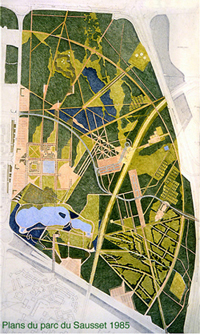 At the time of parc du Sausset's planning in 1979 the trend in France was still to create highly designed parks using exotics and built features. The competition brief for parc du Sausset was different in that it broke with tradition and specified conservation. Michel and Claire Corajoud took up the challenge, and proposed a naturalistic planting scheme that would be as much of a buffer to the growing industry and expanding communities, as it would echo the shapes of its industrial iconography and reflect an agrarian past.
Together with Jacques Coulon and a team consisting of Marc Rumelhart, Tristan Pauly, Claude Guinaudeau, Edith Gerard, Pierre Pascal Mourgue and Gerard Dufrense they took to creating a park that would challenge the instant garden mentality of the time. They planted whips instead of more mature trees, and proposed a marsh that would act as a refuge for wildlife, and treat the water infiltrating from the north through pytoremediation.
Link: parc du Sausset
Firm: Michel Corajoud
Prével brings the chalet to downtown Montreal
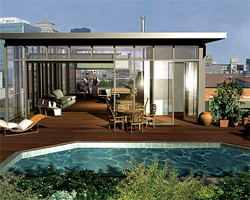 As Montreal enjoys a burst of activity in the housing market developers are looking for properties that can combine all of the elements that make Montreal unique like history, style, and cityscape. Prével's Le Loft does just that by taking a contemporary approach to the reinterpretation of the Lowney candy factory, home of the Cherry Blossom. The Lowney factory sits on the edge of Old Montreal, a stylish and trendy neighbourhood adjacent to the waterfront and downtown Montreal. While the layout and spa-like finishes are typical of most new condos today, what makes Le Loft stand out from the rest is the 4 season urban chalet situated on the roof. The chalet is a glass and steel structure that provides shelter from Montreal's harsh winter, and stunning views of the waterfront and city.
Link: Le Loft
Furniture — September 8, 2005
Posted by Anthony
Multiple Personality Disorder
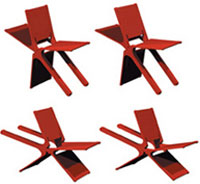 The Flip chair is a prototype chair from Shawn Bruce that offers different seating arrangements depending on the situation. In it's most conservative way, it is a simple 100 degree incline chair. Yet at night, flip it over and it lets its hair down, becoming a 110 degree lounge chair. Each seating position offers two arrangments so you're sure to be comfortable one way or another.
Building on the Flip is the Flip Storage (below). The Flip Storage is nearly identical to the Flip yet it adds a functional storage bay for your handbag, magazines, coat...anything you might need to conveniently stash.
Both the Flip and Flip Storage are made from injection molded polystyrene with rubber feet.
Link: Flip
Books — September 8, 2005
Posted by Deborah
World Class Architects Show How It's Done
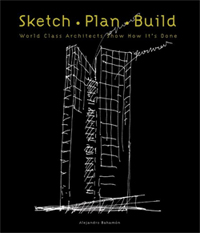 There is a certain rush that comes from participating in the genesis of a great idea, and yet there is much to be learned from watching an idea unfold on the pages of Alejandro Bahamon's book Sketch Plan Build. In Sketch Plan Build, 30 architects let you in on the creative and technical processes that led to the final plan and construction of major works. Beautifully illustrated, this book provides rough sketches and digital renderings that allow you to understand the thoughts and influences of each featured architect creating a behind the scenes companion to the final product. Building after building is detailed over 500 pages that highlight the mastery and variety of approaches to drawing, model making and photography giving you a front row seat to the metamorphosis of a single simple idea into a project
of great complexity.
There is a certain rush that comes from participating in the genesis of a great idea, and yet there is much to be learned from watching an idea unfold on the pages of Alejandro Bahamon's book Sketch Plan Build. In Sketch Plan Build, 30 architects let you in on the creative and technical processes that led to the final plan and construction of major works. Beautifully illustrated, this book provides rough sketches and digital renderings that allow you to understand the thoughts and influences of each featured architect creating a behind the scenes companion to the final product. Building after building is detailed over 500 pages that highlight the mastery and variety of approaches to drawing, model making and photography giving you a front row seat to the metamorphosis of a single simple idea into a project
of great complexity.
Author: Alejandro Bahamon
Link: Sketch Plan Build
Student project for the Salford Docks site in Manchester, U.K.
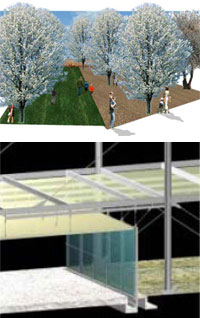 We first "met" Lorenza Casini, a student in the Materiality College at Manchester School of Architecture, when she contacted us last year regarding our post on MPreis supermarkets in the course of her research for this project. We are very pleased now to share the finished product now with you.
With an abandoned brownfield site chosen by the instructors, the studio presented an urban design and architectural design challenge: to propose a program for the site and to develop the architectural scheme.
Lorenza's proposal merges architecture, landscape, infrastructure, and food supply chains to develop an urban farmland and public space in the heart of Manchester.
Super Potato does block 7
 A 'city within a city' is a phrase used in Japan to describe a cluster of buildings connected by industry type, restaurants, recreational facilities and occasionally residences. Shiodome Shiosite is one of Tokyo's newest complexes consisting of skyscrapers that house media giants like Nippon Television and Dentsu Inc., one of the largest advertising agencies in Japan.
The Caretta Shiodome is 51 floors of Dentsu inc. office space, restaurants and bars, museums and retail. However, stop at the 7th floor and find something different: an open concept project called My City designed by the interior design firm Super Potato Co. using 11 materials salvaged from the city to build walls and add texture and detail.
Link: Super Potato
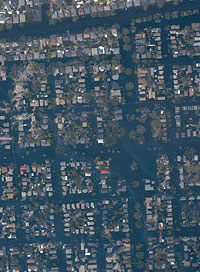 This last week has been a busy one for us outside of Land+Living, not to mention the obvious distraction of hurricane Katrina and her catastrophic aftermath. Fortunately, none of us here at Land+Living has been directly affected by proximity to the disaster.
Also needless to say, there has been no shortage of news coverage of the disaster. Our good friends at Archinect have done a great job of aggregating information on the web related to the hurricane in addition to posting places for people in architecture related fields or studies to find opportunities. We highly recommend visiting their emergency information page to stay abreast of things.
Link: Archinect Emergency
Link: NY Times - Internet mapping
Link: NY Times - Impact maps