June 2005
Socially and environmentally responsible furnishings
 SCI-Arc people seem to be everywhere I look lately.
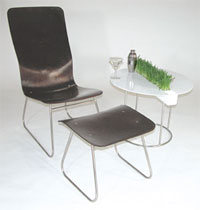
Ann Arbor based designer Jonas Hauptman is a part-time faculty member at SCI-Arc, and has just launched a line of environmentally responsible chairs and tables.
The seats are from a composite of reconstituted North American Aspen Tree flakes and a formaldehyde-free adhesive system in a process inspired by the process used to produce shipping pallets. The seats are available in a variety of stock clear and satin tinted finishes. The steel tables feature a heavy duty high gloss white powder coat finish and are suitable for outdoor use.
Link: Hauptman Products Inc.
Via: Inhabit
Landscape installation
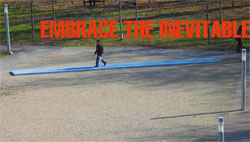 This simple landscape installation deals with the inevitable transformation of designed spaces by the people who inhabit and use them. It speaks to a larger issue in the design world in a way that resonates with us.
Montréal based architect Hal Ingberg (and fellow SCI-Arc alumnus) designed a piece that acknowledges and reinforces the traces of unplanned movements to and from a building at the Université de Montréal.
These traces mark the most natural and firect path of movement to and from the building. However, they have not been designed as part of the building's landscape strategy. Marked by the footprints of numerous building users, they are in effect blemishes, inscribed as corrections to the formalized movement sequence.
We can all personally attest to this non-orthogonal tendency as it pertains to human movement. Historically, it has been employed as an opportunity to inflect richly upon architectural space.
Link: Hal Ingberg
"Form follows feminine"
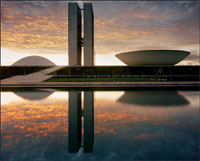 Funny how sometimes you are just not ready to seem something until you are in the right mindset. Way back in May, the New York Times Magazine published their Architecture 2005 issue which included a lengthy piece by Michael Kimmelman profiling the life and career of Brazilian modern master Oscar Niemeyer.
Our fascination this past weekend with images from Brazil has put us in the frame of mind to digest this retrospective, and we highly recommend it to you.
Article: NY Times Magazine - The Last of the Moderns
Link: Slideshow
A traditional terrace house transformed
 Sydney based firm Dale Jones-Evans Pty Ltd Architecture is committed to design that is of its place and time, a modern architecture that is truly Australian.
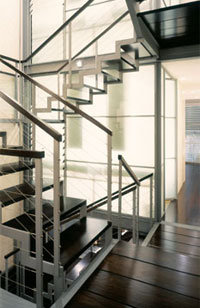
For this re-envisioned terrace house in Sydney, Dale Jones-Evans completely gutted the structure and inserted a new steel framed building into the shell. The center of the house features a vertical floating stairwell and illuminated glazed bathroom core. The floor plane extends out at the rear terminating at a sunken black 'grotto' pool, which is wrapped in a fluid woven metal sculptural veil.
Link: The Water House
Firm: Dale Jones-Evans Pty Ltd Architecture
Images of Brazil's architecture, urban landscape, etc.
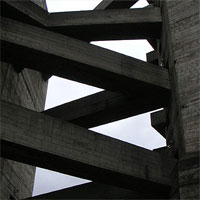 I have a penchant for this kind of photo documentation... it reminds me of architecture school (thank you, Mary Ann Ray).
Photo blogger Thomas Locke Hobbs features some very interesting and beautiful photos of his travels and experiences in Brazil; everything from buildings and urban vistas to culinary delights and signage/graffiti. There are also photos of men in drag and tighty-whities, not that there’s anything wrong with that...
Link: Thomas Locke Hobbs
Via: Cityrag
Thumbnail at right: SESC Pompeia, designed by Lina Bo Bardi, São Paulo.
West 8 selected as the design team for Jubilee Gardens in London
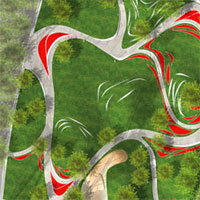 West 8’s design concept focuses heavily on developing an organic, lush and green park, with softly undulating hills. Trees and flowers will bloom throughout the year to provide a ‘botanical ambience’ for one of London’s most important green spaces. The sophisticated topography creates paths which are fluid and inviting, prime lookout points which frame dramatic, panoramic views of the Thames, the London skyline and the South Bank, and intimate spaces where people can find their own space to relax and enjoy the micro-climate. At night, a theatrical spectacle of light will subtly animate and play with the new weaving landscape.
Link: West 8 - Jubliee Gardens
Link: Jubilee Gardens
Article: LondonSE1 - Jubilee Gardens: West 8 selected by public for 'world class' park
Reference: West 8 (L+L)
Events — June 22, 2005
Posted by James
Innovative Garden Structures
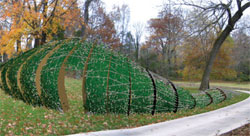 This exhibition at the Philbrook Museum of Art in Tulsa, Oklahoma, runs April 24 - October 16, 2005.
Architects from across North America were invited to submit design proposals for a contemporary vision of a traditional architecture type - the garden pavilion. The winning designs will be constructed and will "land" on Philbrook grounds as a six-month open-air exhibit, allowing audiences of all ages to explore and experience architecture-as-art in the landscape. The project will highlight Philbrook Gardens with structures that are in harmony with the landscape, introduce audiences to a variety of contemporary architectural forms, demonstrate that good design can be both affordable and friendly to the environment and enhance public awareness of promising, emerging architects.
Link: Philbrook Museum of Art
Originally posted 3/31/2005
UPDATE: The Archinect Image Gallery features some nice images of the installed designs.
Architectural tour by satellite
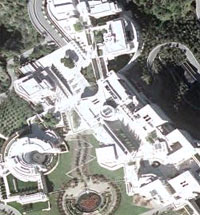 A Daily Dose of Architecture picked up the satellite imagery theme yesterday as well... must've been something in the air, or sunspots or something... and featured images of architectural landmarks yesterday.
We decided to do some reconassance as well and have a few architecture images of our own below. Let us know about your spy finds as well!
Link: The Grand Tour
Link: Google Maps
Thumbnail at right: Getty Center, Los Angeles by Richard Meier
Student work from the north-east
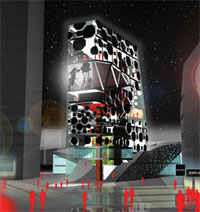 We find student design work to be incredibly interesting because of how it reflects the design world and speaks to the future.
The Architect's Newspaper features the work and thoughts of students from architecture schools in the "tri-state" (New York, New Jersey, Connecticut) area. Professors at 13 schools were asked to select one outstanding project from the last academic year. Check it out.
Link: The Architect's Newspaper - Kids These Days
Via: Archinect
Landscapes from space
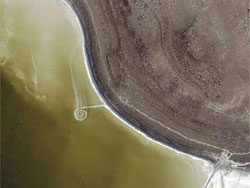 Today I saw something at Pruned, a new landscape blog that we like, that piqued my interest: satellite images of Land Art.
Pruned's post touts the merits of TerraServer, a site that I also prefer for aerial imagery and shows views of Robert Smithson's Spiral Jetty and Michael Heizer's Double Negative (beautifully manipulated images, by the way).
But, the post at Pruned inspired me to seek and share more sources for aerial landscape images.
Satellite Imagery Resources:
Related: Spiral Center for Land Use Interpretation
Related: Spiral Jetty Travelogue
Reference: Earthworks revealed (L+L)
Design / build remodel of industrial space into loft apartments in Tel Aviv
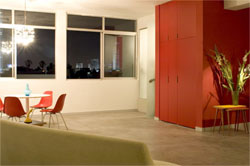 Designed and built by Tel Aviv, Israel based partnership U-I, Avi Laiser and Amir Shwarz, the lofts were built in an old diamond polishing factory that was vacant for more than 10 years. The project is aimed at a young population who look for contemporary rental spaces in the center of Tel Aviv’s business/industrial district, and desire a creative lifestyle.
The lofts were built on a very low budget in a speed time of 4 months using a flexible wall construction method that allows joining two spaces or more to create larger spaces in the future. The polished concrete floors are continuous and each unit got a colored wall or box that defines the usages of the open space. Right now the project is fully occupied with happy tenants.
UPDATE (7-29-09): Avi Laiser now has his own firm AR/Arch. We're not sure what Amir is up to these days.
Tom should've proposed here*
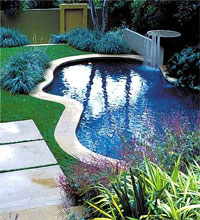 We've danced all around the work of Jay Griffith on Land+Living, but we've never dedicated a post to his firm's work. We've featured the work of his former partner Rob Steiner, the garden of his current partner Russ Cletta and we linked to an article in the LA Times Magazine that featured his design for a residence in Rustic Canyon. But for some strange reason, we have never come across Jay's website before. Well, today we did, and we want to share it with you.
Jay Griffith's work is fit for a Hollywood movie, his landscapes are dressed sets in the best sense. So it is only fitting that many of his clients are Hollywood types as well. Jay's firms have always produced stunning visual compositions of color, material and space that unfold in carefully scripted sequence.
Firm: Griffith & Cletta
Built to last
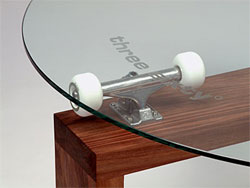 Now here's something that I can appreciate. The Three Sixty Table from Sports Utility Furniture. A table made with skateboard trucks and wheels. So cool. There was once a time when a skateboard was practically attached to my feet at all times. I skated everywhere and everything. It's not too often that a piece of furniture evokes such great childhood memories but for some reason, this piece is doing it for me. I see kids skating everywhere these days and it's fairly common to see contests on TV so I can't say I'm no longer exposed to skating since I see it in some form almost daily, but for some reason, this table gets me stoked and makes me want to hop on a board and go skate some vert.
Link: Sports Utility Furniture
Via: Sensory Impact
Images of the Lotus House by Kengo Kuma
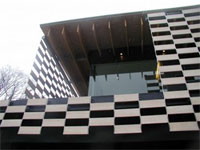 Nine images of the Lotus House by Tokyo based Kengo Kuma and Associates were recently posted at Archinect.
Kengo Kuma deftly balances the physical and the ephemeral, with a keen sense of the relationship between materials. Among the many awards he has received are the Spirit of Nature Wood Architecture Award, the International Stone Architecture Award and the AIA DuPONT Benedictus Award for Water / Glass.
Link: Archinect - Kengo Kuma Lotus House
Firm: Kengo Kuma and Associates
Book: Kengo Kuma: Selected Works
Material Reuse
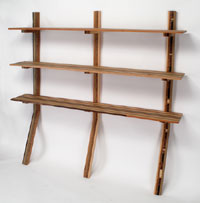 We received an email from Carlos over at Scrapile alerting us to several new pieces in their 2005 collection. Images we received include a wall-mounted shelving system, a circular table with tripod legs, and accessory boxes in several sizes. Scrapile produces their products out of discarded wood from local wood shops. Thanks, Carlos!
Email: ScrapileNYC
Related: Scrapile L+L
Lighting — June 15, 2005
Posted by Anthony
Energy efficient lighting solutions
 We love getting tips. Especially when they are for such inventive and witty pieces like these light fixtures from Italian manufacturer Tecnodelta. Most of Tecnodelta's fixtures come in wall, floor, hanging, and table variations and Tecnodelta uses the most advanced technology in the production of its lighting devices – fibre optics, LEDs, electroluminescent sheets – in addition to the traditional technologies.
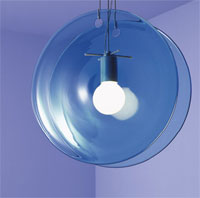
The Bahiana (2004, featured at right) is formed by two pieces of Murano glass held together with a pair of hooks and separated by the bulb socket.
Link: TECNODELTA [Thanks, Marcus!]
News — June 15, 2005
Posted by James
Q + A with "thought leader" Thom Mayne
 Architecture's bad-boy-cum-shining-star has garnered quite a bit of attention recently... something to do with winning the Pritzker Prize perhaps?
I.D. online features an interview with architect Thom Mayne of Morphosis.
A cult figure for 30 years, architect Thom Mayne says he’s surprised now to find himself in the mainstream.
Check it out.
Article: I.D. online - Q + A - Thom Mayne
A new variation of residential courtyard architecture
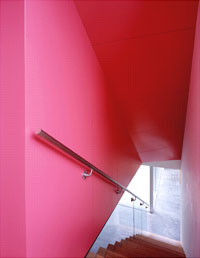 Designed by Los Angeles based architects Sharon Johnston and Mark Lee, the Sale House was designed to engage an early Morphosis project, the 2-4-6-8 house, in Venice, California (circa 1978-1981). The reconceptualized site concept created an internal configuration around exterior courtyard living spaces.
Living spaces were designed as an open and flow and are transparent to the outside. Taking cues from the colorful Morphosis building, each private interior room was "conceived as a unit of color, lined with resin panels of bright pink, turquoise and yellow orange."
Link: Johnston Marklee & Associates Sale House
Frank Lloyd Wright's Marin County Civic Center - Part II
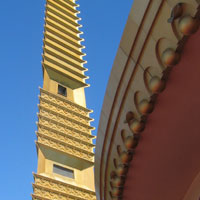 I mentioned previously that I became engrossed in research while putting this together. The most fascinating find on the web was Frank Lloyd Wright Resources (linked below) page hosted by the Marin County Library. This page includes a nice historical brief, photo gallery including images of the design and construction process, a project chronology and a listing of FLLW resources in the library's collection.
But what enthralled me the most was the voices of the Civic Center page which features clips in mp3 format of speeches by Frank Lloyd Wright from 1957 and 1958 and interviews with other architects, politicians and journalists who were involved with the project.
Before Wright's death on April 9, 1959, he had finished the supervision of drawings for the main building and the master plan for the site. In this section we will finish our exploration of Wright's design, and take a look at some of the changes and developments after his passing.
A stunning photo by William Allin Storrer depicts and early view of the Hall of Justice. The photo captures a landscape in keeping with what Wright had experienced before additional landscaping and trees were added to the site.
Link: Marin County Library FLLW Resources
Photos: Lee Sandstead
Photos: Picture the Scene
Photos: Digital Imaging Project
Photos: Digital Imaging Project (Post Office)
Part I - Three hills bridged with graceful arches
Events — June 9, 2005
Posted by James
The 6th edition at Redford Gardens in Quebec
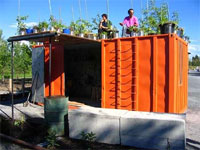 The 6th International Garden Festival will run from June 24 to October 2, 2005, at Redford Gardens in Grand-Métis, Québec.
On display will be new designs by seven selected designers from Australia, France, the United States and Canada as well as four gardens created for the fifth edition of the Festival.
Link: International Garden Festival
Visit: Jardins Métis, Redford Gardens
Poor man's La-z-boy
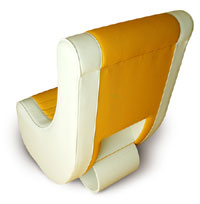 Last month, we learned about Adriean Koleric's Edith Mailbox and liked its style. We decided to check back in and see what was up with the site and went looking for any new product updates/info. The site is still under construction but the background image caught our attention. Being the curious blokes that we are, we fired off an email to Adrien to get the scoop on the new design. Here's what we heard back:
"The piece you're asking about is called 'SUGAR'. It's an adjustable lounger that's upholstered in vinyl over 3" foam. The yellow/orange band in the middle has a textured finish like scales on a fish, the white is a typical smooth texture. The pipe in the back acts as a support which fits into either of the 2 openings to create a laid back setting or more of an upright. I sometimes refer to it as a 'poor mans la-z-boy'. The pipe itself is pvc wrapped in vinyl as well. I also use it as a magazine holder."
Along with the updated website, Adriean will be adding a few more pieces to I T E M's product lineup in the coming weeks so keep an eye out for them. We certainly will.
Link: I T E M
Related: Edit Mailbox (L+L)
Frank Lloyd Wright's Marin County Civic Center - Part I
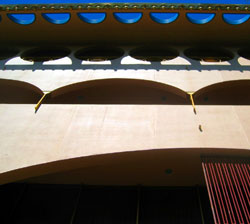 A couple of weekends ago, I was in Marin County, California, and I realized that while I have seen it from the freeway, I have never actually visited Frank Lloyd Wright's Marin County Civic Center.
Serendipitously, Frank Lloyd Wright was born on this day in 1867, and (most) of the photos I took at the Civic Center are the only ones that my malfunctioning digital camera did not corrupt. So today seems like a good day to share those photos, as well as some information about this important work by Frank Lloyd Wright.
I developed a childhood fascination with Wright's architecture nearly 20 years ago (ok, yes, I was an archi-geek even then), and spent much of my early self-guided architectural education reading as much as I could about Wright. While I continued this interest into my college years, I became much more interested in European modernism and new architecture, leaving my interest in Wright more or less latent until last week. As I began to put together what I intended as a very brief photo gallery of the Marin County Civic Center, I found myself engrossed in the research of details and history of the project. While by no means exhaustive, we have a two-part look (through photos and abundant linkage) at the Marin County Civic Center as it was planned, as it is now, and as it may be in the future.
| Visit: | Marin County Civic Center |
| | 3501 Civic Center Drive |
| | San Rafael California |
| | 415.499.6646 |
Photos: Marin County Civic Center Photographs
Book: An Architecture for Democracy: the Marin County Civic Center by Aaron Green
Part II - Marin Again
Limited-edition street banners
 Apparently I'm not alone in the notion of seeing a museum banner hanging from a streetpole and thinking how great that would look hanging in my living room. BetterWall took that idea and turned it into a business. On their website, you can purchase banners advertising an Ansel Adams gallery at the Art Institute of Chicago or Warhol's exhibition at the San Francisco Museum of Modern Art. But these aren't just reproductions of those banners, they are the real deal.
" All of BetterWall’s beautiful banners are the real McCoy! They have been displayed on streetlamp posts and museum facades in cities across the country. Made of vinyl or heavy-weight canvas, the banners are well-equipped to withstand outdoor display.
All banners are in excellent condition with no rips, tears, fading or large blemishes. Minor surface blemishes or other slight signs of wear do not detract from the beauty of the images and add to the banners’ value and authentic charm. Some banners have wind-slits, small half-moon shaped cuts that allow the banners to withstand high wind without ripping."
To date, BetterWall has helped their museum partners keep 10 tons of vinyl out of landfills. Also, by purchasing a banner from BetterWall, you are also supporting the arts, as a percentage of proceeds is returned to the museum featured on the banner. Great idea, guys!
Link: BetterWall [Thanks, Nora!]
Art — June 7, 2005
Posted by Anthony
Emphasizing light, line, and color
 Most photographers that specialize in landscape photography tend to focus on sharp images showing crisp detail and perfect exposure. On the other hand Frank Grisdale prefers just the opposite. He prefers the handheld exposure to the tripod, allowing colors to merge and overlap each other, "drawing with light" as he calls it.
"Most photographs are the result of shooting long hand held exposures. As the camera moves in my hands, real life's fine details begin to merge, overlap, and cancel out on the film, resulting in work which might have been drawn or painted by an early Impressionist."
Intriguing work, Frank!
Link: Frank Grisdale Photography
Award winning architecture in San Diego, California
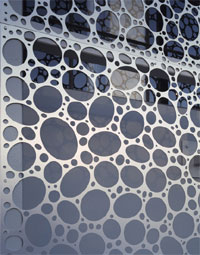 An article in today's San Diego Union-Tribune covers the 2005 San Diego AIA Awards program and quotes LA architect Lawrence Scarpa saying:
"I've served on a lot of (design awards) juries. I was shocked and pleasantly surprised to find this many quality projects.
"There's something going on in San Diego that's right."
In addition to Lawrence Scarpa, the jurors were Michael Folonis of Michael W. Folonis, AIA and Associates and Ralph Johnson, FAIA, firm-wide design principal at Perkins+Will.
Article: SD Union-Tribune - There's something going on
Link: AIA San Diego Design Awards
"Tight of Form"
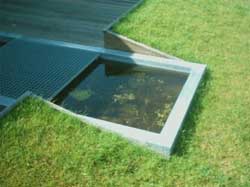 We don't speak Dutch and when we found out about landscape designer Harry de Visser's site, we immediately turned to Babelfish for the 411 in our native tongue. According to Babelfish, the garden designs of Harry de Visser are "tight of form" and we'd have to agree. He employs the technique of "beplanting" (I haven't quite figured out what the English translation of beplanting is - anyone?) and the reuse of materials such as coloured glass, zinc, galvanised gratings, wood, ordinary glass, stone and concrete.
The gardens of Harry de Visser finds their origin in the context as an expressive artist and illustrator. The designs are exclusive, monumentally and frequently minimalistisch of form, but spherical. Main point for a design is the architectonic half-measure sheathing. Architecture and garden must a relation with each other have. Entirely must radiate rest and space. By devising particular elements, every garden gets its own character. take water design, architectural elements, visibility lines, contrast, functional beplanting, reduction and environment prominent. (Babelfish)
Update: We just got word from Harry. Beplanting "means all kinds of plants that you use in a garden." Simple enough, thanks Harry!
Link: Harry de Visser
A mountain home proves that ecological design and good architecture are not mutually exclusive, nor necessarily mutually beneficial, but are in fact one and the same
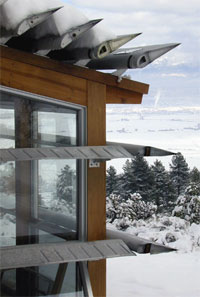 Berkeley based Arkin Tilt Architects is an award-winning firm specializing in energy and resource efficient design. Their design for this mountain home on the eastern slope of the Sierra Nevada mountain range responds to the rugged sloped site and house is virtually energy independent. The design was given a Green Project Award in 2005 2005 by the AIA Committee on the Environment (COTE).
Built using alternative construction techniques, solar technologies and salvaged materials, the house is arranged around a shaded courtyard which serves as the point of entry and provides outdoor space protected from both the summer sun and the winter winds. The structure appears to grow organically out of the site with a planted roofs emerging from grade to cover the garage and guest wing. The main portion of the house rises up from the site with varied roof planes reminiscent of the mountains forms beyond. The house is oriented not only to frame dramatic views of the Carson Valley, but also take advantage of passive solar gain and natural ventilation.
Firm: Arkin Tilt Architects
Link: AIA/COTE - Eastern Sierra House
A contemporary, eco-friendly, accessible home
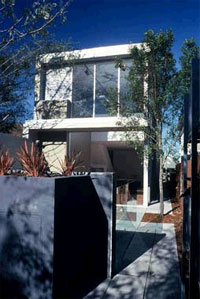 An article in the Sydney Morning Herald by Anne Susskind profiles this remodeled home designed by sustainability focused Kennedy Associates of Sydney.
Front of the semi-detached home was retained with contemporary two storey addition at the rear. The garden continues the space out the back with a courtyard and features an innovative water recycling system as a design feature.
Three rain water tanks and 'green wall' gray water treatment system enable the house to use 75% less water for the town water system. The house is heated and cooled using a solar powered system by Sun Lizard.
Firm: Kennedy Associates Architects
Article: smh.com - The art of space
Cocoon-like garden pavillion
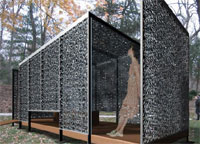 A Daily Dose of Architecture features some images of Butterflies by Della Valle + Bernheimer on display at the Philbrook Museum of Art LANDed exhibition.
Link: A Daily Dose of Architecture
More images: Della Valle + Bernheimer
Reference: LANDed (L+L)