May 2005
New York Times features Allied Works project in near Sun Valley, Idaho
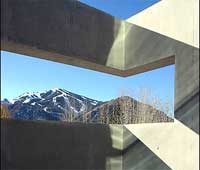 If you are familiar with Land+Living, you know that we can't resist modern mountain architecture, and this just leaves us begging for more.
An article by Christopher Hawthorne in the NY Times features a modern residence in Ketchum by Portland, Oregon based Allied Works. The firm's website features only one teeny-tiny image of this project, but thankfully the Times has a slideshow accompanying their article.
Allied Works managed to sneak an aggressively contemporary house into Sun Valley, where the architectural style might be called hunting-lodge chic on steroids.
Enjoy.
Firm: Allied Works Architecture
Article: NY Times - Sun Valley Surprise: Chalet So Spare
Originally posted 2/16/2005
UPDATE: Allied Works has updated their website and now offers some detailed text and amazing images of the house including sketches and models in design development, construction shots and the completed project. We've added a few images, including a reduced plan by request. Please visit Allied Works' website for much more.
Outdoor — May 31, 2005
Posted by Anthony
Not your dad's firepit
 Ever wonder what happens to old decommissioned propane tanks? We always did (well, not really, but we wish we could say we did). On that note, John T. Unger did and he did something we could only dream of doing: He cuts them up and makes one very cool fire pit out of them. With flames no less. Flames, so hot right now. We're diggin' it John!
"The Great Bowl of Fire is cut from quarter inch thick steel— you could hit it with a car and it wouldn't notice. Your car would though, so I don't really recommend such extreme product testing. A better idea might be to chuck it off the roof, but please be careful getting it up there, it's very heavy."
Link: Artbuzz [Thanks, John!]
Harborside park created from a former oil tank facility on North Sydney's Waverton Peninsula
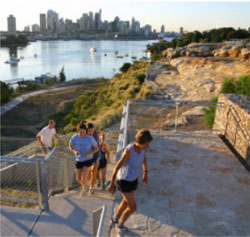 Led by landscape architect and urban designer Adrian McGregor, Sydney and Newcastle based mcgregor+partners are proponents of a new genre of environmentally focused landscape architecture which they frame within a modernist design approach.
This recent project, officially opened on March 12, 2005, is the first of three former industrial sites on the Waverton Peninsula to be transformed.
Firm: mcgregor+partners [Thanks, Tennille!]
Link: North Sydney Council BP Site Parkland
Images: Prior condition & remediation (pdf)
Images: Site construction (pdf)
Images: Opening (pdf)
USC Landscape Studio: projects by Harmil Raikhy, Kay Sales and Naomi Sanders
 The saga continues... sorry for the brief delay. I had been waiting in hopes of adding some more images which I will explain below.
And as the review continued on, we were plied with Jesus Juice... ahem... actually, we were treated to tasty homemade wine. Apparently one of the students makes batches of wine aged in her closet... quite impressive really.
This entry will complete the feature on the BrownLAb studio, and I must say that I thoroughly enjoyed the opportunity to see the work of this hardworking group of students. These small images and brief descriptions presented here are barely a glimpse into this vast project.
BrownLAb - Part I
BrownLAb - Part II
BrownLAb - Part III
Folded aluminum lounge chair
 We've seen the molded plywood version before, but we were not aware of this powder coated aluminum bad boy.
Designed by Toronto-based architects Brigitte Shim and Howard Sutcliffe, the chair is suitable for outdoor use. The ply version has a base price of $2,225 (Canadian), but a price is not listed for the metallic variety.
Designers: Shim-Sutcliffe Architects
Manufacturer: Nienkämper
Web exhibition for MoMA's landscape design showcase
 The Groundswell exhibit at MoMA may be closed, but it lives in digital form.
This website features images and information of all twenty-three projects from the show organized around an interactive world map. Six of the projects are explored in detail.
Link: Groundswell MoMA
Via: The Dirt
Reference: Groundswell (Land+Living)
Reference: More Groundswell (Land+Living)
Landscape designers from around the world compete at the Chelsea Flower Show in London
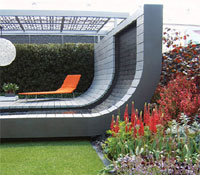 The famous annual garden show at Chelsea is now open, and the garden design winners have been announced. Here are a few of our favorites from the winners list.
Link: Chelsea 2005 awards
Link: Chelsea Flower Show 2005
Link: BBC Coverage of the Chelsea Flower Show
Reference: Chelsea 2005 (Land+Living)
USC Landscape Studio: projects by Jillian Morgan, Amy Morie and Ray Nagahata
 About half way through the review, we were treated to goodies from India Sweets and Spices... mmm mmm mmmmm. I wish I could share the same with you since we are now half way through our coverage of the studio, but sorry to say you're on your own.
Let's get back to the relevant topic. Part of the research for the studio included the study of brownfield and reclamation precedents including Westergasfabriek, the High Line, work by Peter Latz, etc. These kinds of projects are very exciting and make landscape architecture so very relevant in the world.
BrownLAb - Part I
BrownLAb - Part II
BrownLAb - Part IV
Misc — May 25, 2005
Posted by James
Your feeble CAD skills are no match for the power of the Dark Side
 According to entertainment gossip that is circulating (see 1, 2, 3, etc.), actor Hayden Christensen is considering giving up acting (and the Dark Side) to become... an architect." Psst... Hayden... I've got news for you... architecture IS the dark side.
Funny, so many people would say that they would like to be an actors. And for some reason, actors want to be architects (i.e. Brad Pitt). I think that neither profession is quite as exciting as the wannabes suspect.
But, Hayden, if you want to trade your Star Wars earnings for my MArch and CAD workstation, you've got a deal... as long as I get the lightsaber too.
"Cultural brainwashing"
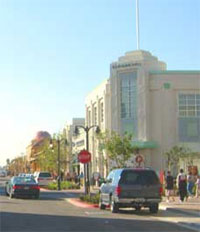 It has been a little while since we have visited this topic, but an article in Metropolis by Karrie Jacobs ties into some issues we have touched on here before... so nice of Karrie to help us weave some things together.
The article covers some territory we have crossed before with some nice observations and observations. She provides a critique of the "need to use the past as a sort of architectural tranquilizer" and takes a look at the lifestyle center phenomenon, specifically talking about Victoria Gardens (see Downtown Mauled Part I & Part II). Though I would disagree with her stance which places blame for architectural pastiche squarely on New Urbanism as its agenda is more spatial than aesthetic.
Article: Metropolis - The Manchurian Main Street
Via: Planetizen
Reference: It's a Crock(er) (Land+Living)
Reference: Reality Bites (Land+Living)
And more L+L references to be found in Commentary
USC Landscape Studio: projects by Erin Lau, Catie Lee and Catherine McLaughlin
 Before we carry on with part deux... a quick note: the student work is not shown here in the same order in which they were reviewed. Not that this is necessarily important, but I figured that I would just point this out along the way.
Overall the student work was very developed and considered, especially given the size and complexity of the site, and the fact that there was not a prescribed program. While certain elements are shared between many of the projects, each student had a unique take on the program, remediation process and site development.
BrownLAb - Part I
BrownLAb - Part III
BrownLAb - Part IV
News — May 23, 2005
Posted by James
"Thousands tour modern modular home at Sunset Magazine's annual open house"
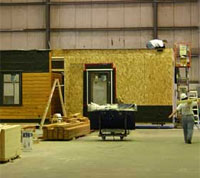 Michelle Kaufmann's modular "Sunset Breezhouse" was revealed this weekend to crowds at Sunset Magazine's annual Celebration Weekend in Menlo Park, California.
Sunset offers quite a few images of the house in the factory, in transit and on site, though you have to be a registered subscriber to view everything.
An article by John King on SF Gate provides some commentary.
Article: Sunset - The Sunset Breezehouse
Article: SF Gate - A model house for the modern age
Link: Sunset Breezehouse, Michelle Kaufmann Designs
Reference: Breezehouse (Land+Living)
USC Landscape Studio: Introduction and projects by Claire Cottrell and Veenu Jayavam
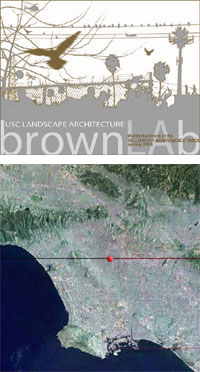 I participated on a jury for a USC landscape architecture studio as I mentioned a couple of weeks ago and had intended to do a write up last week. But (in addition to just being busy) I soon realized the challenge that lay before me as I began to sift through the notes and images that I have compiled.
The problem: how to do justice with limited time and space to all of the hard work of this group of students? Since I have already had my chance to "review" them, I will refrain from offering too many comments and will instead provide a gallery of their work.
The studio was entitled BrownLAb: Wunderkammer @ the Yellow Car Maintenance Yards. The project location is a brown field site in south Los Angeles, a former maintenance yard for the defunct Yellow Car rail transit network. The industrial functions of the facility over the years have left the site contaminated.
Currently, the site is underused but does serve several functions. The MTA uses some of the remaining maintenance buildings on the south edge and a school for "at-risk" students occupies the north west portion of the site. The most active function of the site is a swap meet on the north eastern edge which functions as a community gathering place for the surrounding neighborhood.
Seeing student work is refreshing. Unlike the majority of my work in the "real world," it is all about the process of design, analysis and presentation. The limitations on creativity are basically nonexistent. David Fletcher and Tom Leader created an outstanding studio project and environment; the resulting student work was well developed and intriguing, the product of collaborative investigation and individual design development.
BrownLAb - Part II
BrownLAb - Part III
BrownLAb - Part IV
Achitectural lino cut prints
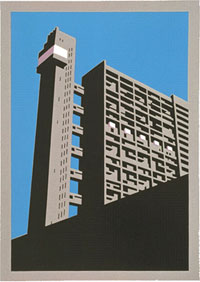 We really like the clean graphic quality and compostion of these lino prints by London-based printmaker and illustrator Paul Catherall. His designs are inspired by classic 20th century poster desgin, Soviet propaganda art and artists such as William Nicholson.
His subjects include many modern and historic architectural constructs from London and New York, capturing momumental impressions of everyday urban experience.
The lino cuts are printed on 100% cotton acid free paper with the finest quality oil based inks. Limited edition prints are available for purchase through Paul's website.
Link: Paul Catherall
Via: I Like
News — May 20, 2005
Posted by Anthony
A problem with Authority
Cathleen McGuigan penned an article for Newsweek/MSNBC on Pritzker Prize winner Thom Mayne.
Thom Mayne hasn't been sleeping well. The radical L.A. architect, whose edgy designs seem to mirror his notoriously intense personality, keeps waking up from anxiety dreams. "They're all connected to figures of authority," he says. We don't need Freud to figure this one out. Mayne, 61, a true child of the '60s, has spent most of his career as a rebel outside the architectural mainstream—teaching, entering design competitions, creating dense, hyperkinetic small projects and basically staying faithful to his own gestalt.
Article: MSNBC/Newsweek
Link: Morphosis
Reference: Morphosis Olympic Village (L+L)
News — May 19, 2005
Posted by James
U.S. Postal Service issues postage stamps featuring modern architecture
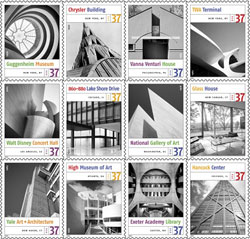 A set of 12 postage stamps featuring American Architectural masterworks was unveiled today at the AIA National Convention in Las Vegas. The stamps will be available to the public May 20th.
Featured are:
- Guggenheim Museum, Frank Lloyd Wright
- Chrysler Building, William Van Alen
- Vanna Venturi House, Robert Venturi
- TWA terminal, Eero Saarinen
- Walt Disney Concert Hall, Frank Gehry
- 860-880 Lake Shore Drive, Mies van der Rohe
- National Gallery of Art, IM Pei
- Glass House, Philip Johnson
- Yale Art and Architecture Building, Paul Rudolph
- High Museum of Art, Richard Meier
- Exeter Academy Library, Louis I. Kahn
- Hancock Center, Bruce Graham / SOM
Link: USPS
Link: USPS press release
Bath — May 19, 2005
Posted by James
Cast metal basins
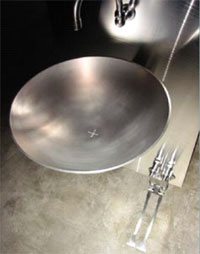 Infinite Fitting makes these wonderful sand-cast, hand-detailed metal basins designed by Bruce Tomb.
The design facilitates various installations, including an available wall bracket or on-countertop mounting. Available in white bronze, silicon bronze, brass or aluminum, each basin has a rough cast texture on the outside and a satin-polish on the inside.
To borrow the words of an infamous client, "quiet elegance." But in this case, we mean it - then again, so did he...
Link: Infinite Fitting
Link: Showrooms - US & Canada (pdf)
Designer: Bruce Tomb
Corbu's vertical garden city in Firminy, France
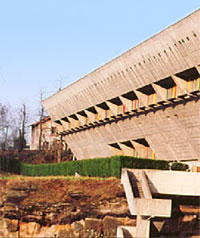 Saint-Pierre de Firminy, a church designed by Le Corbusier is nearing completion decades after it was commissioned in the Loire Valley. Firminy-Vert is the largest concentration of work by Le Corbusier outside Chandigarh - at least it will be next summer when the church is completed. The project is overseen by architect José Oubrerie, a Corbu apprentice who has been involved with Firminy-Vert since its inception.
Firminy-Vert was envisioned as a catalyst for urban renewal, centered around the former quarry. The plan called for three housing blocks (Corbu's Unité d'Habitation concept), a cultural center, stadium and a parish church. The project was completed after Corbu's death short two Unités and work on the church was halted in 1978.
Visit: Firminy (French)
Link: Culture.fr (French)
Article: IHT - Le Corbusier, by design (via: Planetizen)
A layered garden in London
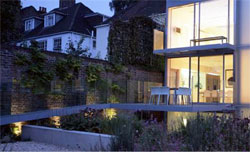 Jinny Blom is a London based landscape designer who's core interests include art, ecology, restoration and modernism. Her designs feature studied and structured plan overlaid with wild and naturalistic planting schemes.
This modern garden serves as an extension of the remodeled and expanded home by Eldridge Smerin Architects, in the Hampstead Village Conservation area of London. Inspired by the materiality of Carlo Scarpa, Ms. Blom defined the landscape as an extension of the modernist addition with concrete, glass, limestone and steel. The rich colors of the planting contrast and soften the rigid forms and materials.
Firm: Jinny Blom
Architects as gamers
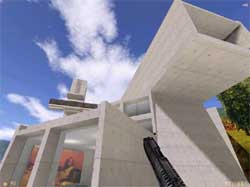 I used to work with a couple of guys who were pretty hardcore gamers. They'd spend all hours of the night playing online games such as Half-Life and Unreal Tournament. One of the cool things about these games is that end-users can modify the "worlds" in which these games are played. With that in mind, here's what happens when you have a few gamers that also happen to know how to create an architectural rendering or two. Ah, now just imagine being able to take a sniper position in Pierre Koenig's Case Study No. 22 House.
Link: PushPullBar
Is it too bent?
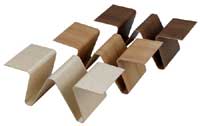 I remember several years back, after receiving my first DWR catalog in the mail, one of the first things that caught my eye was their Mag Table in walnut. I don't recall exactly what it was about it that caught my eye. Perhaps it was it's simple lines, that it was bentwood, or it might've just been the fact that it was (and still is?) one of the least expensive items in the catalog. It was design within my reach. Anyhow, I still have a thing for bentwood furniture and recently noticed this newspaper rack from Swedese. I like it, but I'm thinking it's either a bit too, um, bent, or it needs a piece of glass on top to support a lamp or other accessory. However, with a piece of glass, newspaper access would be restricted to the side.
Link: Swedese
Related: Swedese Bend Chair (L+L)
News — May 12, 2005
Posted by James
Understanding the process of design
We live in an age where people have grown accustomed to instant gratification. Fast food, fast lanes, fast news - you want it and you want it NOW!
I had a client come to me in April with a vague idea of how they wanted to remodel their home... and they wanted to break ground by the end of May! Uh... yeah. Most people have no concept of what it takes to design a building.
Design takes time; architect Arrol Gellner wrote an article published yesterday in the San Francisco Chronicle explaining the process of design. But he doesn't even begin to talk about dealing with government agencies to gain approvals and permits or the actual construction process.
Article: SF Gate - Rome (or your bathroom) wasn't designed in a day
Minimalist, sustainable, functional
 This slick smoke detector has been talked about quite a bit, but it is such a simple and graceful solution that it warrants yet another plug.
Created by brothers Jason and Geoffry Rosenblatt of San Francisco, the Modern Smoke Detector has a minimal profile and uses sustainable technologies... no radioactive material here as in other smoke detectors.
It is designed to lie recessed and flush-mounted into gypsum board finished wall or ceiling surfaces. Custom painting is available.
Link: Architectural Devices
UPDATE (12-11-06) - Now available. The first shipment has sold out, orders for the second shipment are currently being accepted.
Note: Land+Living does NOT sell these. You must contact the manufacturer, Architectural Devices, for sales information.
The designer's most valuable tool
Michael Bierut at Design Observer wrote a great piece on how designers talk about their creations. A perfect follow up to our post on design school reviews.
Link: On (Design) Bullshit
Optimum use of sun and shadow
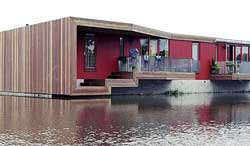 From Onix comes this communal housing project featuring 14 bungalows with a shared common area.
"Onix was requested by the Woonconcept Foundation to design approximately 14 patio bungalows for a small section of the Krakeel neighborhood in Hoogeveen. The houses are situated in a green zone that meanders through the suburb, consisting of an attractive green avenue, school facilities, ponds, a children’s farm, playing fields etc. An autonomous construction, the building forms a spatial jetty consists of private terraces, verandas, privacy screens, stages, a car port, end facades, roofs, a communal terrace, and an entrance gate to the inner area."
Firm: Onix
Green — May 10, 2005
Posted by James
Newsweek interview with leading ecological architect William McDonough
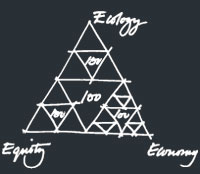 Architect William McDonough continues to garner attention for his "cradle-to-cradle" vision of an industrial revolution that uses nature as a model, completely rethinking the current concepts of recycling and production.
Imagine buildings that generate more energy than they consume and factories whose waste water is clean enough to drink.
Our job is to dream—and to make those dreams happen.
Article: Newsweek - Designing the Future
Link: William McDonough
Reference: Cradle to Cradle (Land+Living)
Reference: "Cradle To Cradle To Washington" (Land+Living)
Related: What Can I Do? (Land+Living)
A compact vertical addition to a small home
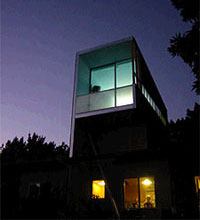 Designed by San Francisco based architect Bruce Tomb, this project is an interesting modern addition to a small duplex at Tierra Nueva, a co-housing community of 27 passive solar homes in Oceano, California.
Built on a modest budget, the addition was designed to sit over the existing house with a small footprint and minimal structural alteration. Access to the new room is provided via an exterior stair and bridge over the existing roof.
Link: Bruce Tomb
Outdoor — May 9, 2005
Posted by James
Modern oncrete planters and fountains
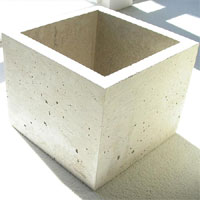 Simple, elemental, tactile, honest... we like the raw yet refined cast concrete planters and fountains by Studio Four Los Angeles.
We first became familiar Studio Four last year at CA Boom, and since then we haven't seen anything else like these refreshingly straightforward modern garden pieces. Sometimes the simple ideas are the best!
Link: Studio Four Los Angeles
Green — May 6, 2005
Posted by James
Individual Actions That Make a Difference
 WAIT! READ THIS! I know that you are scrolling right on past this post... but this is required reading for Land+Living... HOLD ON! Really... keep reading.
You may, like us, care about the environment and the well being of the planet, but often find it to be difficult to "live green," the response is always, that's great but what can I do? Don't despair... you can change the world by your actions, no matter how small.
Whoa, now that seems awfully optimistic. Well, if you like, please continue reading my explanation of my green optimism... but, you can skip my explanation and get right to the assignment by following the link below for a very helpful, non-preachy article with suggestions and tips for what you can actually do.
Read it. No really. Bookmark it or print it for later, or screw the work you should be doing and read it now, but please read it... and pass it on.
Article: Natural Capitalism, Inc. - But, What Can I Do? (pdf file)
Link: Natural Capitalism Solutions - Recommended Resources
Link: Rocky Mountain Institute
Book:
Natural Capitalism - Creating the Next Industrial Revolution
The Crit: Cruel and unusual punishment (?)
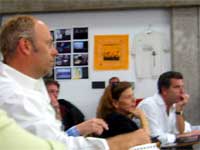 Yesterday I had jury duty... at the University of Southern California Department of Landscape Architecture. I had the opportunity to critique (along with Mark Rios, Mia Lehrer, Clark Stevens, and other jury members) the final presentations for a landscape architecture studio co-taught by David Fletcher and Tom Leader.
I will provided an overview of the student projects next week... the studio was very interesting and the work of a high caliber... but today I want to talk a bit about the design education hazing ritual known as the "crit."
Events — May 5, 2005
Posted by James
"Groundswell" and "The High Line" exhibitions reviewed
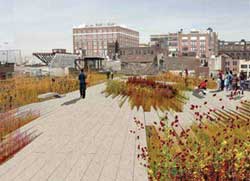 Groundswell, the exhibit currently showing at MoMA, is old news to us, but it's good news to see that it is still getting attention. Ada Louise Huxtable's review of Groundswell and the just opened High Line exhibition was published yesterday in the WSJ Opinion Journal.
Ms. Huxtable praises the innovative work of today's landscape architects and their focus on social issues and human needs... and she chastises architects for the current egomaniacal fixation on celebrity and object making.
Landscape architecture has come a long way from its theme-park and garden-club associations, and the design of public space is defining a new architectural frontier. The competitive infatuation with "signature" skyscrapers may continue to get the publicity, but some of the best young talents are staking their claims and reputations on the ground.
Article: Opinion Journal - Down-to-Earth Masterpieces of Public Landscape Design
Reference: Groundswell (Land+Living)
Reference: More Groundswell (Land+Living image gallery)
Outdoor — May 4, 2005
Posted by Anthony
Mailbox. Updated.
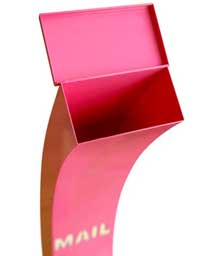 Originally developed as an entry for the 2005 *Frost furniture prototype exhibit in Edmonton, this hot pink mailbox from designer Adriean Koleric is sure to get your postman's attention. The mailbox is constructed from welded steel and features illuminated frosted plexi-glass letters on the front. The light is connected to a light sensitive transformer so it will not light during the day.
"From the start my main objective was to maintain a simple form that would not compete with the house / structure it sat infront of, plus be able to compliment any adjacent greenery. For something that will sit among shrubs and trees, it should look like it has the same right to be there. It almost feels like it grew out of the ground itself to a point that you almost anticipate it to get bigger each year or even sprout leaves. But the question usually asked is why pink ? Reason being this prototype was finished in that particular color was to bring it some attention right from the get go. With such an ultra simple form it needed a punch that would make someone stop and take notice."
Update 5/5/05: Looks like we're late to this party. Check out Josh Spear's write-up on this from a few days back.
Designer: Adriean Koleric
Link: I T E M [Thanks, Adriean!]
Events — May 4, 2005
Posted by James
Designs for pre-fabricated homes
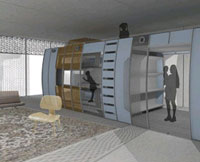 This exhibit at the Field Museum in Chicago is currently open and runs through January 16, 2006.
Developed by the City Design Center, College of Architecture and the Arts, UIC in collaboration with The Field Museum, the exhibition features original models and drawings by noted architects and industrial designers.
Contrary to popular belief, manufactured homes have long been an affordable and high quality housing option. The history of these pre-fabricated dwellings transcends time and cultural boundaries, reflecting a long and colorful history. Native American teepees, yurts in Central Asia, Sears and Roebuck “kit houses,” and the mobile home are but a few examples.
Link: Field Museum - Design Innovations in Manufactured Housing
Article: Chicago Tribune - Field prefab housing show is timely and provocative
More: Repeat - Beyond the Trailer Park -
Out of the Box
Richard Neutra designs for your home
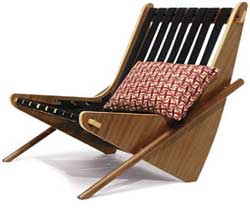 If this image doesn't get you going... leave... just go. We love the architecture and designs of Richard Neutra... perhaps it is our regional bias for California Modernism.
House Industries, in collaboration with Dion Neutra and Otto Design Group is offering a limited number of Neutra designed Boomerang Chairs, as well as Neutra patterned pillows.
Link: House Industries
"Affordable Landscapes: The growing numbers of blighted residential districts all over the world call for cost-effective ideas to upgrade public space."
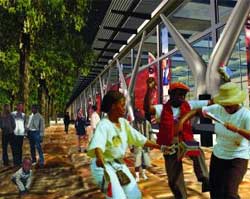 Australian landscape architect Elizabeth Mossop has an interesting article currently at Topos about the state of the profession and the opportunities that landscape architects have to shape the world beyond the realm of "privileged landscapes" where their work has traditionally been focused.
The key to future directions in landscape architecture is to broaden our ideas of landscape practice. Future practice must encompass all types of landscapes and all landscape problems. Landscape issues must become an intrinsic part of all developments; therefore, landscape practice must become "affordable."
Link: Topos Issue: 2005/50 - Affordable landscapes
Via: urbanism.org