

 A couple of weekends ago, I was in Marin County, California, and I realized that while I have seen it from the freeway, I have never actually visited Frank Lloyd Wright's Marin County Civic Center.
Serendipitously, Frank Lloyd Wright was born on this day in 1867, and (most) of the photos I took at the Civic Center are the only ones that my malfunctioning digital camera did not corrupt. So today seems like a good day to share those photos, as well as some information about this important work by Frank Lloyd Wright.
I developed a childhood fascination with Wright's architecture nearly 20 years ago (ok, yes, I was an archi-geek even then), and spent much of my early self-guided architectural education reading as much as I could about Wright. While I continued this interest into my college years, I became much more interested in European modernism and new architecture, leaving my interest in Wright more or less latent until last week. As I began to put together what I intended as a very brief photo gallery of the Marin County Civic Center, I found myself engrossed in the research of details and history of the project. While by no means exhaustive, we have a two-part look (through photos and abundant linkage) at the Marin County Civic Center as it was planned, as it is now, and as it may be in the future.
| Visit: | Marin County Civic Center |
| 3501 Civic Center Drive | |
| San Rafael California | |
| 415.499.6646 |
Photos: Marin County Civic Center Photographs
Book: An Architecture for Democracy: the Marin County Civic Center by Aaron Green
Part of what made Frank Lloyd Wright so interesting to me early on is that there is so much information available about his work. In reviewing material in print and online, I came to realize that this accessibility is somewhat problematic. Misinformation, stereotypes and plain old bad facts are all too common in accounts of Wright and his work. While this is not a thoroughly researched and checked piece of research, I have done my best to present educated facts and opinions here, as well as links to credible information.
View Land+Living Maps in a larger map
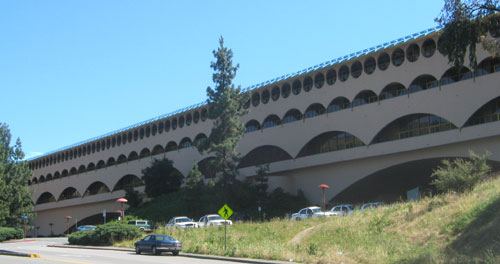
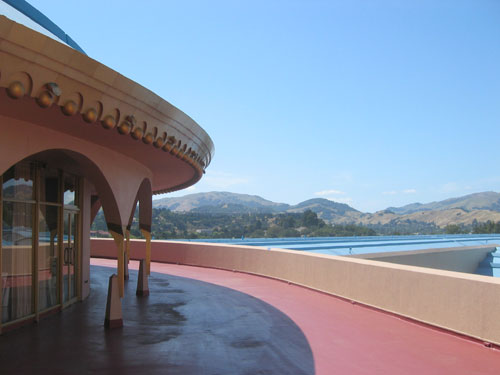
Like many of Wright's later works, the Marin County Civic Center is an exploration of circular geometries. It is not as elegant as the Guggenheim Museum, but not as tawdry as the Gammage Auditorium. It is both uniquely tied to its site, yet somehow otherworldly and Jetson-esque. The my experience of the building revealed a study in contrasts: futuristic yet somewhat dated, clean-lined and ornamented, modern and classic. These qualities have made it a desirable filming location for such movies as Andrew Niccol's Gattaca and George Lucas's THX 1138.
It is somewhat interesting to note that while the building is envisaged as a physical manifestation of democracy, these films depict themes of overarching control and suppression of individuals… However, Wright's design was very much focused on the citizens who would use Civic Center; the skylit central public atriums, the prominent placement of the library at the central dome, and the extensive park-like grounds.
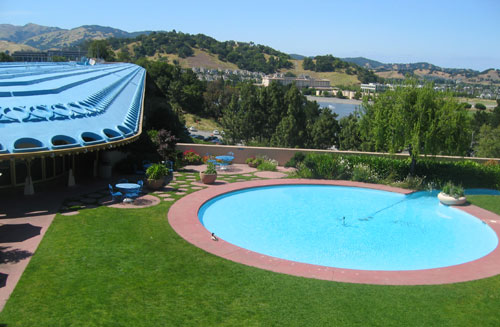
For the design of the main building, Frank Lloyd Wright conceived of a "complete synthesis of ground and building," harmonious with the site, yet progressive in form. He described the plan as being:
...in the spirit of the beauty of the county. Not necessarily pleasing to the chief citizens of the County who probably live in ugly buildings themselves. But something way ahead of Marin County at the present time and therefore something probably more commensurate with the young.The "chief citizens" are presumably the faction of individuals who opposed Wright's hiring and later briefly stopped the construction process only to be outvoted by an overwhelming majority who supported the project.
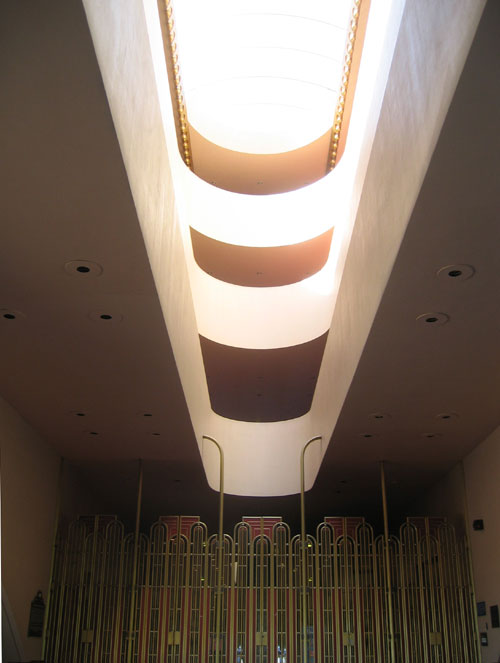
The Marin County Civic Center and Post Office are Frank Lloyd Wright's only built government buildings. It is incorrectly written many places that the Marin project was his only civic design commission, but in fact Wright designed unbuilt projects for the Pittsburgh Point Civic Center and the Arizona State Capital as well as civic designs for Baghdad commissioned by Iraq's King Faisal II. Wright also designed Monona Terrace, a cultural, governmental and recreational center for Madison, Wisconsin, which was later realized by Taliesin Architects, but significantly altered beyond the true authorship of Wright.
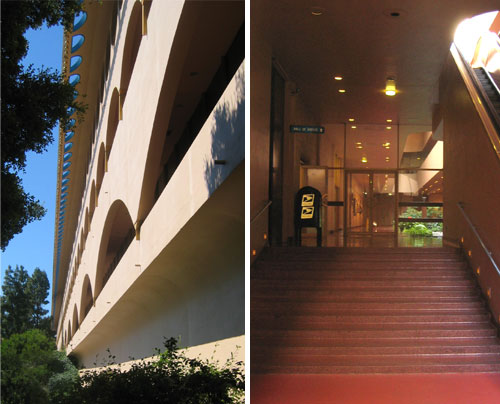
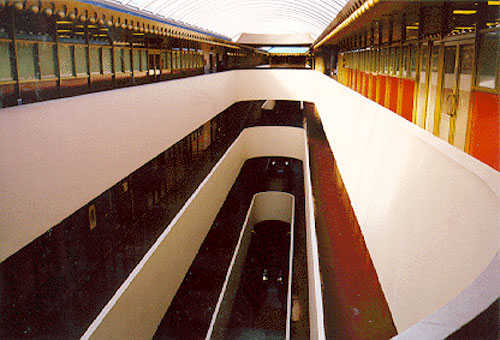
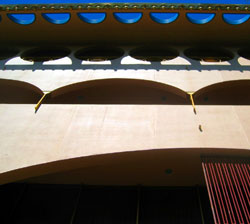
Reminiscent in a very basic way of a Roman aqueduct, Wright's concept was not, however, of load bearing arches but of a series of "suspended crescents... hanging from the floor above." Indeed with the exception of the lowest level of foundation arches, the arcs are an exterior skin hung on the building. The way the arches dissolve into thin metal strips emphasize this conceptual difference. According to Carl Book, Wright felt the original elevations were too evocative of an aqueduct and made the decision to change the top level arches to circular openings.
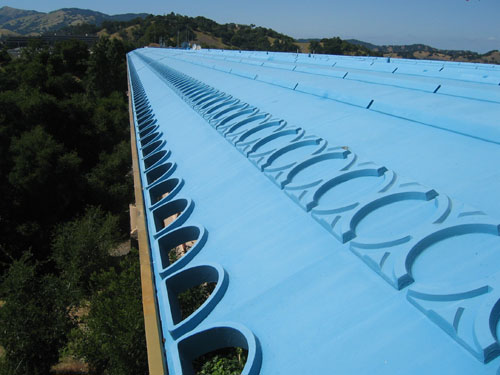
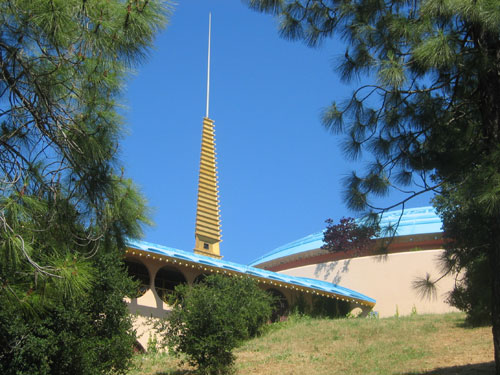
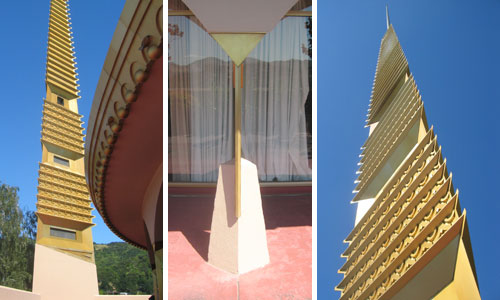
The roof structure is a pre-cast arched concrete shell with decorative circular design elements and half-circle openings along the eaves. The concrete is coated with a colored rubber coating. Wright's design called for the roof to be gold to compliment the dry grassy hillsides. But unlike the gold anodized aluminum detailing used for the fascia, railings and window mullions, the manufacturer of the roofing membrane could not guarantee the longevity of the gold color, so the decision was made after Wright's death to change the color to blue which Wright had intended for other details of the structure.
FLW trivia...
A modern masterpiece