

An architect of Case Study Houses, Edward Killingsworth used many of the same principles in his own home -- light, glass, an emphasis on indoor-outdoor living.
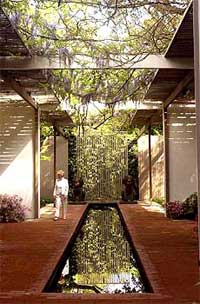 As one of the last surviving architects of the Case Study House program, Killingsworth, 86, is a quiet hero in the architectural community. His whole career he has consistently been stable, modest, thorough and relatively unknown in comparison to his Southern California contemporaries. Along with well-known figures such as Richard Neutra, Charles and Ray Eames, Pierre Koenig, Craig Ellwood and Raphael Soriano, he was one of a handful of optimistic, social-minded architects who tested unconventional concepts of plan, form and structure in residential architecture. Conceived by John Entenza, the editor of Arts and Architecture magazine, the Case Study Houses provided affordable yet progressive prototypes for living.
Via: Los Angeles Times
Excerpts from article by Cara Mullio and Jennifer M. Volland
"Emphasizing the technological innovations that defined Modern architecture, the architects implemented new industrial materials and open plans in their designs. Entenza discovered Killingsworth in 1950 when he drove past the young architect's first solo project, a 743-square-foot residence-office for his in-laws in Los Alamitos, a suburb of Long Beach. The house cost $5,500 and was one of the first post-and-beam structures in Southern California. It was direct and simple, with a smart plan that included office space fronting the public street and a private living area in the back. Impressed by the design, Entenza invited Killingsworth to participate in the program. "I owe my life to John Entenza," says Killingsworth."
"But with his family home, Killingsworth created a uniquely personal statement. The 3,200-square-foot residence has an open plan of beautifully proportioned, dynamic living spaces, with 12-foot-high ceilings and doors in most areas. Even with the high, expansive glass, the house feels unusually private, its street facade offering little indication of what lies within."
"With only two bedrooms, two bathrooms and a study, the floor plan was — and still is — considered an anomaly, particularly with the large amount of land on which to build. Killingsworth designed his house for a family of four and abstained from devouring the land, providing only the square footage they considered necessary for living space. "It's a very large small house," Laura says."
"All rooms radiate from the garden room, a space without formal barriers that acts as the central hub of the house. Its 30-foot-tall, skylighted ceilings, trellised cover, creeping vines and white-painted fireplace cast a warm and inviting aura. The room is defined by the interior brick flooring, which integrates with the brick paving in the surrounding gardens and sweeps through the kitchen."
"The gardens remain an essential, if not equal, part of the property. Although lush year round, color dominates in spring. George Tabor azaleas, potted more than 20 years ago, populate the grounds, and massive wisteria creates a huge canopy over a 60-foot-long, rectangular reflecting pool."

Laura and Edward Killingsworth relax in the master bedroom of their Long Beach home, where walls are few.

1963 AIA award winning Duffield Lincoln-Mercury dealership in Long Beach.
Times Past
I need comunicate with sir edward killingsworth